Maths4UBETA

Enlargement and changes in area

Enlarge from a centre, identify a scale factor and compare perimeters and areas.

Try the quick check →
Lesson 2 of 2

Section 1 of 4 · Core · about 8 min

Send a point along its ray

Mark the centre even when it lies inside or on the edge of the original shape.

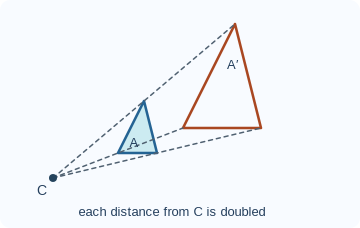
A small and a larger triangle along common rays pointing away from centre C

The centre stays fixed. The larger triangle is twice as far from it along each ray.

Worked example

Scale distances from a centre

Enlarge a shape by scale factor 5 about (5,3). One vertex is (7,1).

  1. Give the corresponding image coordinates.

    [2]
  2. Explain how to draw the other vertices.

    [2]
  1. (a) The vertex displacement from the centre is (2, -2).

  2. Multiply both changes by 5, then add them to the centre.

  3. (15,−7)(15,-7)

  4. (b) The same centre and scale factor apply to every vertex.

  5. Draw a ray from the centre through each vertex. Multiply the original distance along each ray by the scale factor.

Your turn

Enlarge a shape by scale factor 5 about (3,5). One vertex is (5,3).

Give the corresponding image coordinates.

Enter each pair in the order shown. Separate complete pairs with commas or semicolons.

Worked example

Scale distances from a centre

Enlarge a shape by scale factor 6 about (6,3). One vertex is (8,1).

  1. Give the corresponding image coordinates.

    [2]
  2. Explain how to draw the other vertices.

    [2]

Try it on paper first.

  1. (a) The vertex displacement from the centre is (2, -2).

  2. Multiply both changes by 6, then add them to the centre.

  3. (18,−9)(18,-9)

  4. (b) The same centre and scale factor apply to every vertex.

  5. Draw a ray from the centre through each vertex. Multiply the original distance along each ray by the scale factor.

Your turn

Enlarge a shape by scale factor 6 about (4,5). One vertex is (6,3).

Give the corresponding image coordinates.

Enter each pair in the order shown. Separate complete pairs with commas or semicolons.

Section 2 of 4 · Core · about 8 min

Recover the centre and factor

Join each vertex to its corresponding image vertex.

Worked example

Find the scale factor from one ray

The centre of an enlargement is (7,4). The vertex (9,6) moves to (13,10).

  1. Find the scale factor.

    [2]
  2. Describe how to find an unknown centre with two pairs of corresponding vertices.

    [2]
  1. (a) The horizontal displacement from the centre changes from 2 to 6. The vertical displacement has the same ratio.

  2. 33

  3. (b) Each original vertex, its image and the centre lie on the same straight line.

  4. Extend the two lines which each join an original vertex to its image. Find their intersection.

Your turn

The centre of an enlargement is (5,7). The vertex (7,9) moves to (11,13).

Find the scale factor.

Enter one number. Fractions and decimals are accepted.

Worked example

Find the scale factor from one ray

The centre of an enlargement is (8,4). The vertex (10,6) moves to (16,12).

  1. Find the scale factor.

    [2]
  2. Describe how to find an unknown centre with two pairs of corresponding vertices.

    [2]

Try it on paper first.

  1. (a) The horizontal displacement from the centre changes from 2 to 8. The vertical displacement has the same ratio.

  2. 44

  3. (b) Each original vertex, its image and the centre lie on the same straight line.

  4. Extend the two lines which each join an original vertex to its image. Find their intersection.

Your turn

The centre of an enlargement is (6,7). The vertex (8,9) moves to (14,15).

Find the scale factor.

Enter one number. Fractions and decimals are accepted.

Section 3 of 4 · Core · about 8 min

Scale two lengths to find an area

Picture a square of one unit side becoming a larger square.

Worked example

Compare scale factors of lengths and areas

The rectangle measures 2 cm by 2 cm. It is enlarged by positive scale factor 6.

  1. Find its new area in square centimetres.

    [2]
  2. Give the multiplier for the other measure.

    [1]
  1. (a) The new sides are 12 cm and 12 cm.

  2. Multiply the two new side lengths.

  3. 144144

  4. (b) Perimeter scales by k. Area scales by k squared.

  5. 66.

Your turn

The rectangle measures 2 cm by 2 cm. It is enlarged by positive scale factor 3.

Find its new area in square centimetres.

Enter one number. Fractions and decimals are accepted.

Worked example

Compare scale factors of lengths and areas

The rectangle measures 2 cm by 2 cm. It is enlarged by positive scale factor 2.

  1. Find its new area in square centimetres.

    [2]
  2. Give the multiplier for the other measure.

    [1]

Try it on paper first.

  1. (a) The new sides are 4 cm and 4 cm.

  2. Multiply the two new side lengths.

  3. 1616

  4. (b) Perimeter scales by k. Area scales by k squared.

  5. 22.

Your turn

The rectangle measures 2 cm by 2 cm. It is enlarged by positive scale factor 5.

Find its new area in square centimetres.

Enter one number. Fractions and decimals are accepted.

Section 4 of 4 · Core · about 8 min

Scale a one-dimensional measure

A perimeter is a total length, even when it travels around a whole rectangle.

Worked example

Compare scale factors of lengths and areas

The rectangle measures 2 cm by 2 cm. It is enlarged by positive scale factor 4.

  1. Find its new perimeter in centimetres.

    [2]
  2. Give the multiplier for the other measure.

    [1]
  1. (a) The new sides are 8 cm and 8 cm.

  2. Add the four new side lengths.

  3. 3232

  4. (b) Perimeter scales by k. Area scales by k squared.

  5. 1616.

Your turn

The rectangle measures 2 cm by 2 cm. It is enlarged by positive scale factor 6.

Find its new perimeter in centimetres.

Enter one number. Fractions and decimals are accepted.

Worked example

Compare scale factors of lengths and areas

The rectangle measures 2 cm by 2 cm. It is enlarged by positive scale factor 5.

  1. Find its new perimeter in centimetres.

    [2]
  2. Give the multiplier for the other measure.

    [1]

Try it on paper first.

  1. (a) The new sides are 10 cm and 10 cm.

  2. Add the four new side lengths.

  3. 4040

  4. (b) Perimeter scales by k. Area scales by k squared.

  5. 2525.

Your turn

The rectangle measures 2 cm by 2 cm. It is enlarged by positive scale factor 2.

Find its new perimeter in centimetres.

Enter one number. Fractions and decimals are accepted.

Worked examples

Practise the method

Core practice

Question 1 of 12

0 / 12 checked in this collection

Question list

Core practice

Fresh variants

Exam-style

Scale distances from a centre

1 mark

Enlarge a shape by scale factor 2 about (7,3). One vertex is (15,1).

Give the corresponding image coordinates.

Enter each pair in the order shown. Separate complete pairs with commas or semicolons.

Full answer-format guide

Exact numbers: 3/2, sqrt(5), 2-sqrt(3), pi/6, 3*pi/2. Sets: {1,4}. Intervals: (3,5]; a round bracket excludes the endpoint. Infinity: inf; union: U; no solutions: empty. Separate coordinate pairs or triples with semicolons. Expressions: 2x^2+3x-1; equations: x^2=3x+1 or the polynomial equal to zero. Factors: x-1 ; x+2. Parameter fraction: numerator ; denominator. List integer answers individually.

Review the method

Progress stays in this browser. Create an account to save it or sign in.

Extra practice from this lesson

Enlarge a shape by scale factor 5 about (12,7). One vertex is (14,5).

Give the corresponding image coordinates.

Enter each pair in the order shown. Separate complete pairs with commas or semicolons.

Enlarge a shape by scale factor 6 about (2,7). One vertex is (4,5).

Give the corresponding image coordinates.

Enter each pair in the order shown. Separate complete pairs with commas or semicolons.

The centre of an enlargement is (3,9). The vertex (5,11) moves to (9,15).

Find the scale factor.

Enter one number. Fractions and decimals are accepted.

The centre of an enlargement is (4,9). The vertex (6,11) moves to (12,17).

Find the scale factor.

Enter one number. Fractions and decimals are accepted.

The rectangle measures 2 cm by 2 cm. It is enlarged by positive scale factor 4.

Find its new area in square centimetres.

Enter one number. Fractions and decimals are accepted.

The rectangle measures 3 cm by 2 cm. It is enlarged by positive scale factor 3.

Find its new area in square centimetres.

Enter one number. Fractions and decimals are accepted.

The rectangle measures 3 cm by 2 cm. It is enlarged by positive scale factor 4.

Find its new perimeter in centimetres.

Enter one number. Fractions and decimals are accepted.

The rectangle measures 3 cm by 2 cm. It is enlarged by positive scale factor 5.

Find its new perimeter in centimetres.

Enter one number. Fractions and decimals are accepted.

Apply it · original exam-style problems

Show your working on paper and compare it with the worked solution and marking guidance.

Come back to what needs practice

Quick revision sheet (A4)

Your review plan starts after your first check.