Maths4UBETA

Graphs and compound measures

Read and compare rates such as speed and density from graph gradients.

Try the quick check →
Lesson 4 of 4

Section 1 of 3 · Core · about 8 min

Choose the correct units

A rate tells you how much of one quantity corresponds to one unit of another. In metres per second, a speed of 3 means that at a steady speed you travel 3 metres in each second.

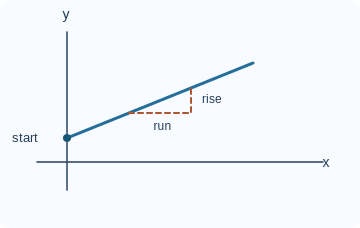
A rising straight line with its y-intercept and a right-angled rise and run marked

The gradient is rise divided by run. The intercept is the value at x = 0.

Worked example

Read a rate from a distance graph

A cycle route's distance–time graph is a straight line through the origin. After 10 minutes it reaches 60 metres.

  1. Find the speed in metres per minute.

    [2]
  2. Give the distance after one extra minute if this line continues.

    [1]
  1. (a) Calculate change in distance divided by elapsed time.

  2. 66

  3. (b) One extra minute adds 6 metres.

  4. 66 metres.

Your turn

A cycle route's distance–time graph is a straight line through the origin. After 10 minutes it reaches 120 metres.

Find the speed in metres per minute.

Enter one number. Fractions and decimals are accepted.

Worked example

Calculate speed after the timer has started

Distance readings
Time (min)Distance (m)
2180
5720

The distance–time graph is straight between these readings. Find the speed in metres per second.

Try it on paper first.

  1. The distance increases by 720−180=540 m720-180=540\,\text{m}. The time elapsed is 5−2=3 min5-2=3\,\text{min}.

  2. The question asks for seconds, so the elapsed time is 3×60=180 s3\times60=180\,\text{s}.

  3. The speed is 540180=3 m/s\frac{540}{180}=3\,\text{m/s}.

Your turn

A cycle route's distance–time graph is a straight line through the origin. After 10 minutes it reaches 130 metres.

Find the speed in metres per minute.

Enter one number. Fractions and decimals are accepted.

Your turn

A runner covers 900 m900\,\text{m} in 3 min3\,\text{min} at a steady speed. Find the speed in metres per second.

Enter one number. Fractions and decimals are accepted.

Section 2 of 3 · Core · about 8 min

Compare slopes with a common scale

Two cyclists can cover different distances and still have the same speed if they travel for different times. Compare rates in the same units or compare how far each goes in one equal time interval.

Worked example

Compare two slopes

Two straight distance–time lines start at zero. Route A covers 20 m in 4 seconds. Route B covers 22 m in 4 seconds.

  1. By how many metres per second is route B faster?

    [2]
  2. Which line is steeper?

    [1]
  1. (a) The speeds are 55 and 112\frac{11}{2} metres per second.

  2. Compare the two speeds by subtraction.

  3. 12\frac{1}{2}

  4. (b) A bigger distance per second gives a larger gradient.

  5. Route B.

Your turn

Two straight distance–time lines start at zero. Route A covers 44 m in 4 seconds. Route B covers 46 m in 4 seconds.

By how many metres per second is route B faster?

Enter an exact value or round to 3 significant figures.

Worked example

Compare routes measured over different times

One skater covers 60 m60\,\text{m} in 12 s12\,\text{s}. Another covers 36 m36\,\text{m} in 6 s6\,\text{s}. Both move steadily. Who is faster, and by how much?

Try it on paper first.

  1. The first speed is 6012=5 m/s\frac{60}{12}=5\,\text{m/s}. The second speed is 366=6 m/s\frac{36}{6}=6\,\text{m/s}.

  2. The second skater is 6−5=1 m/s6-5=1\,\text{m/s} faster, even though the second recorded distance is smaller.

  3. Over the first 6 seconds the first skater would cover 30 metres, still less than the second skater’s 36 metres.

Your turn

Two straight distance–time lines start at zero. Route A covers 48 m in 4 seconds. Route B covers 50 m in 4 seconds.

By how many metres per second is route B faster?

Enter an exact value or round to 3 significant figures.

Section 3 of 3 · Core · about 8 min

Compare masses for equal volumes

Density compares the mass of equal amounts of space. Imagine two solid cubes of identical size. The heavier cube has the greater density because it packs more mass into the same volume.

Worked example

Read a mass-per-volume graph

A mass–volume graph through the origin includes the point with volume 5 cubic centimetres and mass 2 grams.

  1. Give the density in grams per cubic centimetre.

    [2]
  2. Describe a higher-density substance on the same axes.

    [1]
  1. (a) The gradient of a mass versus volume graph gives mass per unit volume.

  2. 25\frac{2}{5}

  3. (b) For a fixed volume, the more dense substance has a larger mass.

  4. It has a steeper straight line through the origin.

Your turn

A mass–volume graph through the origin includes the point with volume 7 cubic centimetres and mass 7 grams.

Give the density in grams per cubic centimetre.

Enter one number. Fractions and decimals are accepted.

Worked example

Use density to choose the less bulky block

Two samples
MaterialVolume (cm³)Mass (g)
P824
Q630

A model-maker needs a 60 g60\,\text{g} block. Which material takes up less space, and what volume does it take?

Try it on paper first.

  1. Material P has density 24÷8=3 g/cm324\div8=3\,\text{g}/\text{cm}^3. Material Q has density 30÷6=5 g/cm330\div6=5\,\text{g}/\text{cm}^3.

  2. Q is denser, so a block of the same mass needs less space. The volumes are 60÷3=20 cm360\div3=20\,\text{cm}^3 for P and 60÷5=12 cm360\div5=12\,\text{cm}^3 for Q.

  3. Choose Q. Its block takes up 12 cm312\,\text{cm}^3.

Your turn

A mass–volume graph through the origin includes the point with volume 7 cubic centimetres and mass 7.7 grams.

Give the density in grams per cubic centimetre.

Enter an exact value or round to 3 significant figures.

Worked examples

Practise the method

Core practice

Question 1 of 12

0 / 12 checked in this collection

Question list

Core practice

Fresh variants

Exam-style

Read a rate from a distance graph

1 mark

A cycle route's distance–time graph is a straight line through the origin. After 40 minutes it reaches 520 metres.

Find the speed in metres per minute.

Enter one number. Fractions and decimals are accepted.

Full answer-format guide

Exact numbers: 3/2, sqrt(5), 2-sqrt(3), pi/6, 3*pi/2. Sets: {1,4}. Intervals: (3,5]; a round bracket excludes the endpoint. Infinity: inf; union: U; no solutions: empty. Separate coordinate pairs or triples with semicolons. Expressions: 2x^2+3x-1; equations: x^2=3x+1 or the polynomial equal to zero. Factors: x-1 ; x+2. Parameter fraction: numerator ; denominator. List integer answers individually.

Review the method

Progress stays in this browser. Create an account to save it or sign in.

Extra practice from this lesson

A cycle route's distance–time graph is a straight line through the origin. After 10 minutes it reaches 40 metres.

Find the speed in metres per minute.

Enter one number. Fractions and decimals are accepted.

A cycle route's distance–time graph is a straight line through the origin. After 10 minutes it reaches 50 metres.

Find the speed in metres per minute.

Enter one number. Fractions and decimals are accepted.

Two straight distance–time lines start at zero. Route A covers 12 m in 4 seconds. Route B covers 14 m in 4 seconds.

By how many metres per second is route B faster?

Enter an exact value or round to 3 significant figures.

Two straight distance–time lines start at zero. Route A covers 16 m in 4 seconds. Route B covers 18 m in 4 seconds.

By how many metres per second is route B faster?

Enter an exact value or round to 3 significant figures.

A mass–volume graph through the origin includes the point with volume 9 cubic centimetres and mass 14.4 grams.

Give the density in grams per cubic centimetre.

Enter an exact value or round to 3 significant figures.

A mass–volume graph through the origin includes the point with volume 9 cubic centimetres and mass 2.7 grams.

Give the density in grams per cubic centimetre.

Enter an exact value or round to 3 significant figures.

Apply it · original exam-style problems

Show your working on paper and compare it with the worked solution and marking guidance.

Come back to what needs practice

Quick revision sheet (A4)

Your review plan starts after your first check.