Maths4UBETA

Functions, inputs and linear models

Find outputs, reverse a function and write equations for simple rate-and-start situations.

Try the quick check →
Lesson 2 of 4

Section 1 of 3 · Core · about 8 min

Follow operations from input to output

Trace each operation in the stated order.

Worked example

Use a rule in the forward direction

A function squares its input and adds 2. Consider the input -5.

  1. Find the output.

    [2]
  2. Does the input 5 produce the same output? Explain.

    [1]
  1. (a) -5 squared is 25.

  2. Add 2.

  3. 2727

  4. (b) It is possible for two inputs to have one shared output. Each input still has only one output.

  5. Yes. Opposite inputs have equal squares.
Your turn

A function squares its input and adds 4. Consider the input -3.

Find the output.

Enter one number. Fractions and decimals are accepted.

Worked example

Use a rule in the forward direction

A function squares its input and adds 2. Consider the input 6.

  1. Find the output.

    [2]
  2. Does the input -6 produce the same output? Explain.

    [1]

Try it on paper first.

  1. (a) 6 squared is 36.

  2. Add 2.

  3. 3838

  4. (b) It is possible for two inputs to have one shared output. Each input still has only one output.

  5. Yes. Opposite inputs have equal squares.

Your turn

A function squares its input and adds 4. Consider the input 4.

Find the output.

Enter one number. Fractions and decimals are accepted.

Section 2 of 3 · Core · about 8 min

Reverse the operations

Write the output first and undo the last operation before the earlier ones.

Worked example

Work backwards to an input

A function takes a positive input, squares it and adds 3. The output is 52.

  1. Find the input.

    [2]
  2. Why is the negative square root not allowed here?

    [1]
  1. (a) Subtract 3 to undo the addition. This gives 49.

  2. Take the positive square root.

  3. 77

  4. (b) When undoing a square, always check which inputs are allowed.

  5. The inputs were restricted to positive numbers.

Your turn

A function takes a positive input, squares it and adds 6. The output is 31.

Find the input.

Enter one number. Fractions and decimals are accepted.

Worked example

Work backwards to an input

A function takes a positive input, squares it and adds 3. The output is 67.

  1. Find the input.

    [2]
  2. Why is the negative square root not allowed here?

    [1]

Try it on paper first.

  1. (a) Subtract 3 to undo the addition. This gives 64.

  2. Take the positive square root.

  3. 88

  4. (b) When undoing a square, always check which inputs are allowed.

  5. The inputs were restricted to positive numbers.

Your turn

A function takes a positive input, squares it and adds 6. The output is 42.

Find the input.

Enter one number. Fractions and decimals are accepted.

Section 3 of 3 · Core · about 8 min

Turn a fixed start and a rate into a line

Choose x for the changing amount and y for the result.

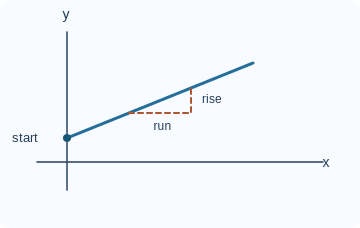
A rising straight line with its y-intercept and a right-angled rise and run marked

The gradient is rise divided by run. The intercept is the value at x = 0.

Worked example

Turn a rule into an equation

A tank has 5 litres at the start. Each filling cycle adds 9 litres. Let x be the number of cycles and y be the volume.

  1. Find y when x is 2.

    [2]
  2. Give the equation in x and y.

    [2]
  1. (a) The repeated addition is 9 × 2.

  2. Add the initial 5 litres.

  3. 2323

  4. (b) The coefficient of x gives the change per cycle.

  5. y=9x+5y=9x+5

Your turn

A tank has 7 litres at the start. Each filling cycle adds 7 litres. Let x be the number of cycles and y be the volume.

Find y when x is 2.

Enter one number. Fractions and decimals are accepted.

Worked example

Turn a rule into an equation

A tank has 5 litres at the start. Each filling cycle adds 10 litres. Let x be the number of cycles and y be the volume.

  1. Find y when x is 2.

    [2]
  2. Give the equation in x and y.

    [2]

Try it on paper first.

  1. (a) The repeated addition is 10 × 2.

  2. Add the initial 5 litres.

  3. 2525

  4. (b) The coefficient of x gives the change per cycle.

  5. y=10x+5y=10x+5

Your turn

A tank has 7 litres at the start. Each filling cycle adds 8 litres. Let x be the number of cycles and y be the volume.

Find y when x is 2.

Enter one number. Fractions and decimals are accepted.

Worked examples

Practise the method

Core practice

Question 1 of 12

0 / 12 checked in this collection

Question list

Core practice

Fresh variants

Exam-style

Use a rule in the forward direction

1 mark

A function squares its input and adds 5. Consider the input 7.

Find the output.

Enter one number. Fractions and decimals are accepted.

Full answer-format guide

Exact numbers: 3/2, sqrt(5), 2-sqrt(3), pi/6, 3*pi/2. Sets: {1,4}. Intervals: (3,5]; a round bracket excludes the endpoint. Infinity: inf; union: U; no solutions: empty. Separate coordinate pairs or triples with semicolons. Expressions: 2x^2+3x-1; equations: x^2=3x+1 or the polynomial equal to zero. Factors: x-1 ; x+2. Parameter fraction: numerator ; denominator. List integer answers individually.

Review the method

Progress stays in this browser. Create an account to save it or sign in.

Extra practice from this lesson

A function squares its input and adds 6. Consider the input -12.

Find the output.

Enter one number. Fractions and decimals are accepted.

A function squares its input and adds 6. Consider the input 2.

Find the output.

Enter one number. Fractions and decimals are accepted.

A function takes a positive input, squares it and adds 8. The output is 17.

Find the input.

Enter one number. Fractions and decimals are accepted.

A function takes a positive input, squares it and adds 8. The output is 24.

Find the input.

Enter one number. Fractions and decimals are accepted.

A tank has 9 litres at the start. Each filling cycle adds 5 litres. Let x be the number of cycles and y be the volume.

Find y when x is 2.

Enter one number. Fractions and decimals are accepted.

A tank has 9 litres at the start. Each filling cycle adds 6 litres. Let x be the number of cycles and y be the volume.

Find y when x is 2.

Enter one number. Fractions and decimals are accepted.

Apply it · original exam-style problems

Show your working on paper and compare it with the worked solution and marking guidance.

Come back to what needs practice

Quick revision sheet (A4)

Your review plan starts after your first check.