Maths4UBETA

Solid shapes and volume

Identify three-dimensional solids and find volume by counting layers or adding cuboids.

Try the quick check →
Lesson 4 of 6

Section 1 of 4 · Core · about 8 min

How do faces, edges and vertices tell solids apart?

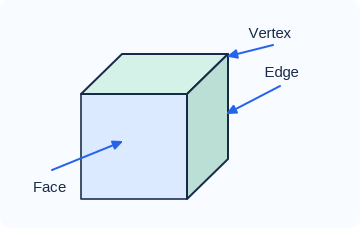
Describe both flat and curved surfaces. An edge is where faces or surfaces meet. A vertex is a corner.

A cube with a point labelled vertex, a side segment labelled edge and a square surface labelled face.

A cube with a point labelled vertex, a side segment labelled edge and a square surface labelled face.

Worked example

A display of prisms

A display has 2 identical hexagonal prisms. Each has a 6-sided polygon at each end.

  1. How many faces does one prism have?

    [2]
  2. How many vertices does one prism have?

    [2]
  3. Find the total number of faces, counting each prism separately.

    [2]
  1. (a) There are two end faces.

  2. There are 6 side faces, one for each edge of the end face.

  3. 88.

  4. (b) There are 6 vertices on each end.

  5. 1212.

  6. (c) Each of the 2 prisms has 8 faces.

  7. 1616.

Your turn

A display has 2 identical octagonal prisms. Each has an 8-sided polygon at each end.

How many faces does one prism have?

Enter the whole-number count.

Worked example

A display of prisms

A display has 2 identical heptagonal prisms. Each has a 7-sided polygon at each end.

  1. How many faces does one prism have?

    [2]
  2. How many vertices does one prism have?

    [2]
  3. Find the total number of faces, counting each prism separately.

    [2]

Try it on paper first.

  1. (a) There are two end faces.

  2. There are 7 side faces, one for each edge of the end face.

  3. 99.

  4. (b) There are 7 vertices on each end.

  5. 1414.

  6. (c) Each of the 2 prisms has 9 faces.

  7. 1818.

Your turn

A display has 2 identical triangular prisms. Each has a 3-sided polygon at each end.

How many faces does one prism have?

Enter the whole-number count.

Section 2 of 4 · Core · about 8 min

Which combination of features gives a specific solid?

First decide whether the faces are flat or curved. Then name the base shape and count vertices.

Worked example

Identify a solid by its features

A model takes up 21 cm of space from left to right. It has one circular base, one curved surface and one vertex.

  1. Name the solid.

    [1]
  2. Explain which feature rules out a sphere.

    [2]
  1. (a) Match all the given features to one solid.

  2. A cone

  3. (b) Look at the presence or lack of a flat face.

  4. A sphere has a continuous curved surface and no flat faces. This model has one circular base, one curved surface and one vertex.

Your turn

A model takes up 41 cm of space from left to right. It has one circular base, one curved surface and one vertex.

Name the solid.

Choose one answer

Worked example

Identify a solid by its features

A model takes up 22 cm of space from left to right. It has two parallel circular ends, a curved surface and no vertices.

  1. Name the solid.

    [1]
  2. Explain which feature rules out a sphere.

    [2]

Try it on paper first.

  1. (a) Match all the given features to one solid.

  2. A cylinder

  3. (b) Look at the presence or lack of a flat face.

  4. A sphere has a continuous curved surface and no flat faces. This model has two parallel circular ends, a curved surface and no vertices.

Your turn

A model takes up 5 cm of space from left to right. It has two parallel circular ends, a curved surface and no vertices.

Name the solid.

Choose one answer

Section 3 of 4 · Core · about 8 min

How many unit cubes fit inside?

A layer is a rectangle of unit cubes. Count how many cubes are in a layer and how many layers make the solid.

Worked example

Building a stack of cuboids

A cuboid measures 11 m by 2 m by 3 m.

  1. Find the volume of the whole solid.

    [2]
  2. How many 1 m cubes cover the base of the first cuboid in a single layer?

    [2]
  1. (a) The first base has area 22 m².

  2. Multiply by the height 3 m to get 66 m³.

  3. 6666 m³.

  4. (b) The layer has 11 by 2 cubes.

  5. 2222.

Your turn

A cuboid measures 10 mm by 3 mm by 2 mm.

Find the volume of the whole solid.

Enter one number. Fractions and decimals are accepted.

Worked example

Building a stack of cuboids

A cuboid measures 12 cm by 2 cm by 4 cm.

  1. Find the volume of the whole solid.

    [2]
  2. How many 1 cm cubes cover the base of the first cuboid in a single layer?

    [2]

Try it on paper first.

  1. (a) The first base has area 24 cm².

  2. Multiply by the height 4 cm to get 96 cm³.

  3. 9696 cm³.

  4. (b) The layer has 12 by 2 cubes.

  5. 2424.

Your turn

A cuboid measures 11 m by 3 m by 3 m.

Find the volume of the whole solid.

Enter one number. Fractions and decimals are accepted.

Section 4 of 4 · Core · about 8 min

How do we find volume when there is a step?

Imagine slicing the solid across a join, into cuboids with no overlapping parts.

Worked example

Building a stack of cuboids

A cuboid measures 3 cm by 3 cm by 2 cm. A second block measuring 2 cm by 3 cm by 1 cm stands next to it on the same base level and makes a step.

  1. Find the volume of the whole solid.

    [2]
  2. How many 1 cm cubes cover the base of the first cuboid in a single layer?

    [2]
  1. (a) The first base has area 9 cm².

  2. Multiply by the height 2 cm to get 18 cm³.

  3. Add the volume of the other block, 6 cm³.

  4. 2424 cm³.

  5. (b) The layer has 3 by 3 cubes.

  6. 99.

Your turn

A cuboid measures 23 m by 4 m by 8 m. A second block measuring 3 m by 4 m by 7 m stands next to it on the same base level and makes a step.

Find the volume of the whole solid.

Enter one number. Fractions and decimals are accepted.

Worked example

Building a stack of cuboids

A cuboid measures 4 mm by 3 mm by 3 mm. A second block measuring 2 mm by 3 mm by 2 mm stands next to it on the same base level and makes a step.

  1. Find the volume of the whole solid.

    [2]
  2. How many 1 mm cubes cover the base of the first cuboid in a single layer?

    [2]

Try it on paper first.

  1. (a) The first base has area 12 mm².

  2. Multiply by the height 3 mm to get 36 mm³.

  3. Add the volume of the other block, 12 mm³.

  4. 4848 mm³.

  5. (b) The layer has 4 by 3 cubes.

  6. 1212.

Your turn

A cuboid measures 3 cm by 4 cm by 2 cm. A second block measuring 3 cm by 4 cm by 1 cm stands next to it on the same base level and makes a step.

Find the volume of the whole solid.

Enter one number. Fractions and decimals are accepted.

Worked examples

Practise the method

Core practice

Question 1 of 12

0 / 12 checked in this collection

Question list

Core practice

Fresh variants

Exam-style

A display of prisms

1 mark

A display has 6 identical pentagonal prisms. Each has a 5-sided polygon at each end.

How many faces does one prism have?

Enter the whole-number count.

Full answer-format guide

Exact numbers: 3/2, sqrt(5), 2-sqrt(3), pi/6, 3*pi/2. Sets: {1,4}. Intervals: (3,5]; a round bracket excludes the endpoint. Infinity: inf; union: U; no solutions: empty. Separate coordinate pairs or triples with semicolons. Expressions: 2x^2+3x-1; equations: x^2=3x+1 or the polynomial equal to zero. Factors: x-1 ; x+2. Parameter fraction: numerator ; denominator. List integer answers individually.

Review the method

Progress stays in this browser. Create an account to save it or sign in.

Extra practice from this lesson

A display has 3 identical quadrilateral prisms. Each has a 4-sided polygon at each end.

How many faces does one prism have?

Enter the whole-number count.

A display has 3 identical pentagonal prisms. Each has a 5-sided polygon at each end.

How many faces does one prism have?

Enter the whole-number count.

A model takes up 24 cm of space from left to right. It has one circular base, one curved surface and one vertex.

Name the solid.

Choose one answer

A model takes up 25 cm of space from left to right. It has two parallel circular ends, a curved surface and no vertices.

Name the solid.

Choose one answer

A cuboid measures 9 cm by 4 cm by 8 cm.

Find the volume of the whole solid.

Enter one number. Fractions and decimals are accepted.

A cuboid measures 10 mm by 4 mm by 2 mm.

Find the volume of the whole solid.

Enter one number. Fractions and decimals are accepted.

A cuboid measures 22 mm by 4 mm by 7 mm. A second block measuring 3 mm by 4 mm by 6 mm stands next to it on the same base level and makes a step.

Find the volume of the whole solid.

Enter one number. Fractions and decimals are accepted.

A cuboid measures 4 mm by 4 mm by 3 mm. A second block measuring 3 mm by 4 mm by 2 mm stands next to it on the same base level and makes a step.

Find the volume of the whole solid.

Enter one number. Fractions and decimals are accepted.

Apply it · original exam-style problems

Show your working on paper and compare it with the worked solution and marking guidance.

Come back to what needs practice

Quick revision sheet (A4)

Your review plan starts after your first check.