Maths4UBETA

Angles around points and on lines

Find unknown angles and explain each step using angle facts.

Try the quick check →
Lesson 6 of 6

Section 1 of 4 · Core · about 8 min

What is the total around a point?

Imagine a full turn around the corner of a page. Wherever you start, the complete turn is 360°.

Worked example

A missing angle

Three of four sectors around a point are 63°, 65° and 80°.

  1. Find the fourth angle.

    [2]
  2. Explain where the total of 360° comes from.

    [2]
  1. (a) The three angles add to 208°.

  2. Take this from 360°.

  3. 152152 degrees.

  4. (b) The sectors fill the turn without gaps or overlap.

  5. A complete turn is 360°.

Your turn

Three of four sectors around a point are 83°, 65° and 85°.

Find the fourth angle.

Enter the angle in degrees.

Worked example

A missing angle

Three of four sectors around a point are 64°, 65° and 81°.

  1. Find the fourth angle.

    [2]
  2. Explain where the total of 360° comes from.

    [2]

Try it on paper first.

  1. (a) The three angles add to 210°.

  2. Take this from 360°.

  3. 150150 degrees.

  4. (b) The sectors fill the turn without gaps or overlap.

  5. A complete turn is 360°.

Your turn

Three of four sectors around a point are 84°, 65° and 86°.

Find the fourth angle.

Enter the angle in degrees.

Section 2 of 4 · Core · about 8 min

Why do the four angles make 360°?

A diagonal splits a convex quadrilateral into two triangles.

Worked example

A missing angle

Three of the four interior angles of a quadrilateral are 76°, 65° and 78°.

  1. Find the fourth angle.

    [2]
  2. Explain where the total of 360° comes from.

    [2]
  1. (a) The three angles add to 219°.

  2. Take this from 360°.

  3. 141141 degrees.

  4. (b) The two triangle angle sums add together at the original corners.

  5. A diagonal splits a quadrilateral into two triangles. Each has angle sum 180°.

Your turn

Three of the four interior angles of a quadrilateral are 96°, 66° and 83°.

Find the fourth angle.

Enter the angle in degrees.

Worked example

A missing angle

Three of the four interior angles of a quadrilateral are 77°, 65° and 79°.

  1. Find the fourth angle.

    [2]
  2. Explain where the total of 360° comes from.

    [2]

Try it on paper first.

  1. (a) The three angles add to 221°.

  2. Take this from 360°.

  3. 139139 degrees.

  4. (b) The two triangle angle sums add together at the original corners.

  5. A diagonal splits a quadrilateral into two triangles. Each has angle sum 180°.

Your turn

Three of the four interior angles of a quadrilateral are 97°, 66° and 84°.

Find the fourth angle.

Enter the angle in degrees.

Section 3 of 4 · Core · about 8 min

How can we tell which angles are equal?

When one line crosses two parallel lines, compare positions at both crossings.

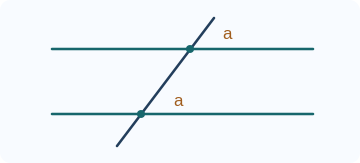
Parallel horizontal lines cut by one slanted transversal

The marked angles share the same position at their crossings, so they are corresponding angles.

Worked example

Identify corresponding and supplementary angles

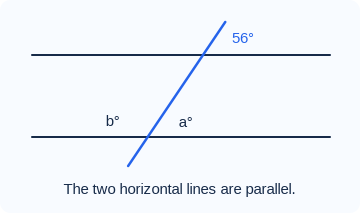
Two parallel horizontal lines are crossed by a third straight line. At the top crossing, the angle above the horizontal line on the right of the transversal is 56°.

  1. Find the angle above the lower horizontal line on the right of the transversal.

    [2]
  2. Find the other angle above the lower horizontal line, to the left of the transversal.

    [2]
  3. At the bottom crossing, explain why the angle below the line on the left of the transversal has the same size as the first angle.

    [2]

Upper-right angle 56 degrees. At the lower crossing, a is above the line to the right and b is above it to the left.

  1. (a) The two angles are in matching positions at their crossings.

  2. They are corresponding angles, so they are equal.

  3. 5656 degrees.

  4. (b) The two angles together make a straight line.

  5. Subtract 56° from 180°.

  6. 124124 degrees.

  7. (c) Both angles are equal to 180° minus the same neighbouring angle.

  8. They are vertically opposite, so both are 56°.

Your turn

In the worked diagram, compare the given upper angle with aa at the lower crossing. Which relationship justifies their equality?

Angle relationship

Your turn

Two parallel horizontal lines are crossed by a third straight line. At the top crossing, the angle above the horizontal line on the right of the transversal is 76°.

Find the angle above the lower horizontal line on the right of the transversal.

Upper-right angle 76 degrees with the corresponding lower-right angle left blank.

Enter the angle in degrees.

Worked example

Identify corresponding and supplementary angles

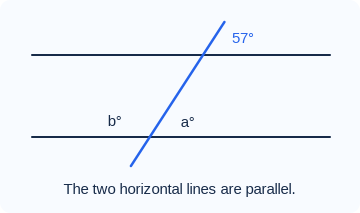
Two parallel horizontal lines are crossed by a third straight line. At the top crossing, the angle above the horizontal line on the right of the transversal is 57°.

  1. Find the angle above the lower horizontal line on the right of the transversal.

    [2]
  2. Find the other angle above the lower horizontal line, to the left of the transversal.

    [2]
  3. At the bottom crossing, explain why the angle below the line on the left of the transversal has the same size as the first angle.

    [2]

Upper-right angle 57 degrees. At the lower crossing, a is above the line to the right and b is above it to the left.

Try it on paper first.

  1. (a) The two angles are in matching positions at their crossings.

  2. They are corresponding angles, so they are equal.

  3. 5757 degrees.

  4. (b) The two angles together make a straight line.

  5. Subtract 57° from 180°.

  6. 123123 degrees.

  7. (c) Both angles are equal to 180° minus the same neighbouring angle.

  8. They are vertically opposite, so both are 57°.

Your turn

Two parallel horizontal lines are crossed by a third straight line. At the top crossing, the angle above the horizontal line on the right of the transversal is 77°.

Find the angle above the lower horizontal line on the right of the transversal.

Upper-right angle 77 degrees with the corresponding lower-right angle left blank.

Enter the angle in degrees.

Section 4 of 4 · Core · about 8 min

How can we recognise a right-angle pair?

Perpendicular lines meet at exactly 90°. If another line divides that angle, the two parts still make 90°.

Worked example

Splitting a right angle

Two lines meet at a right angle. A third line through the meeting point splits this right angle into 55° and x°.

  1. Find x.

    [2]
  2. Find the opposite angle of a° in this diagram if the lines are extended. Name the fact you use.

    [2]
  1. (a) Perpendicular lines meet at 90°.

  2. Subtract 55 from 90.

  3. 3535 degrees.

  4. (b) Extending a straight line does not change the size of its existing angle.

  5. It is 55°. Angles opposite each other at an intersection are equal.

Your turn

Two lines meet at a right angle. A third line through the meeting point splits this right angle into 13° and x°.

Find x.

Enter one number. Fractions and decimals are accepted.

Worked example

Splitting a right angle

Two lines meet at a right angle. A third line through the meeting point splits this right angle into 56° and x°.

  1. Find x.

    [2]
  2. Find the opposite angle of a° in this diagram if the lines are extended. Name the fact you use.

    [2]

Try it on paper first.

  1. (a) Perpendicular lines meet at 90°.

  2. Subtract 56 from 90.

  3. 3434 degrees.

  4. (b) Extending a straight line does not change the size of its existing angle.

  5. It is 56°. Angles opposite each other at an intersection are equal.

Your turn

Two lines meet at a right angle. A third line through the meeting point splits this right angle into 14° and x°.

Find x.

Enter one number. Fractions and decimals are accepted.

Worked examples

Practise the method

Core practice

Question 1 of 12

0 / 12 checked in this collection

Question list

Core practice

Fresh variants

Exam-style

A missing angle

1 mark

Three of four sectors around a point are 92°, 81° and 82°.

Find the fourth angle.

Enter the angle in degrees.

Full answer-format guide

Exact numbers: 3/2, sqrt(5), 2-sqrt(3), pi/6, 3*pi/2. Sets: {1,4}. Intervals: (3,5]; a round bracket excludes the endpoint. Infinity: inf; union: U; no solutions: empty. Separate coordinate pairs or triples with semicolons. Expressions: 2x^2+3x-1; equations: x^2=3x+1 or the polynomial equal to zero. Factors: x-1 ; x+2. Parameter fraction: numerator ; denominator. List integer answers individually.

Review the method

Progress stays in this browser. Create an account to save it or sign in.

Extra practice from this lesson

Three of four sectors around a point are 64°, 66° and 90°.

Find the fourth angle.

Enter the angle in degrees.

Three of four sectors around a point are 65°, 66° and 91°.

Find the fourth angle.

Enter the angle in degrees.

Three of the four interior angles of a quadrilateral are 77°, 66° and 88°.

Find the fourth angle.

Enter the angle in degrees.

Three of the four interior angles of a quadrilateral are 78°, 66° and 89°.

Find the fourth angle.

Enter the angle in degrees.

Two parallel horizontal lines are crossed by a third straight line. At the top crossing, the angle above the horizontal line on the right of the transversal is 39°.

Find the angle above the lower horizontal line on the right of the transversal.

Upper-right angle 39 degrees with the corresponding lower-right angle left blank.

Enter the angle in degrees.

Two parallel horizontal lines are crossed by a third straight line. At the top crossing, the angle above the horizontal line on the right of the transversal is 40°.

Find the angle above the lower horizontal line on the right of the transversal.

Upper-right angle 40 degrees with the corresponding lower-right angle left blank.

Enter the angle in degrees.

Two lines meet at a right angle. A third line through the meeting point splits this right angle into 33° and x°.

Find x.

Enter one number. Fractions and decimals are accepted.

Two lines meet at a right angle. A third line through the meeting point splits this right angle into 34° and x°.

Find x.

Enter one number. Fractions and decimals are accepted.

Apply it · original exam-style problems

Show your working on paper and compare it with the worked solution and marking guidance.

Come back to what needs practice

Quick revision sheet (A4)

Your review plan starts after your first check.