Maths4UBETA

Area units, triangles and compound shapes

Convert square units, explain the triangle formula and find the area of a composite shape.

Try the quick check →
Lesson 3 of 6

Section 1 of 3 · Core · about 8 min

Why do square units use a different conversion?

A square centimetre is 10 mm long and 10 mm wide. There are 100 square millimetres inside it.

Worked example

Converting a measured area

A parcel map records a region with area 1500 mm². There are 2 regions of that size.

  1. Convert the area of one region to cm².

    [2]
  2. Find the total area of both regions, in cm².

    [2]
  1. (a) One cm² equals 100 mm².

  2. Divide 1500 by 100.

  3. 1515 cm².

  4. (b) Each region takes 15 cm².

  5. 3030 cm².

Your turn

A parcel map records a region with area 350000 m². There are 2 regions of that size.

Convert the area of one region to ha.

Enter one number. Fractions and decimals are accepted.

Worked example

Converting a measured area

A parcel map records a region with area 160000 cm². There are 2 regions of that size.

  1. Convert the area of one region to m².

    [2]
  2. Find the total area of both regions, in m².

    [2]

Try it on paper first.

  1. (a) One m² equals 10000 cm².

  2. Divide 160000 by 10000.

  3. 1616 m².

  4. (b) Each region takes 16 m².

  5. 3232 m².

Your turn

A parcel map records a region with area 3600 mm². There are 2 regions of that size.

Convert the area of one region to cm².

Enter one number. Fractions and decimals are accepted.

Section 2 of 3 · Core · about 8 min

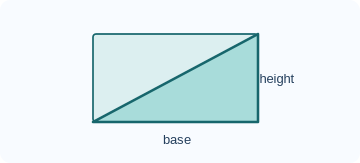
Why is the triangle area half the base times height?

Put the triangle into a rectangle or pair it with a matching copy to form a parallelogram.

A triangle is half a rectangle of the same base and perpendicular height

The diagonal splits this rectangle in two triangles of equal area.

Worked example

A shape on a workshop plan

A triangle has base 21 cm and perpendicular height 2 cm.

  1. Find the area of the triangle.

    [2]
  2. Explain why the triangle area uses a factor of one half.

    [2]
  1. (a) Half of 21×221\times 2 is 2121. That is the triangle area.

  2. 2121 cm².

  3. (b) Turn one copy over a shared edge or use the matching enclosing rectangle.

  4. Two copies of the triangle can make a parallelogram with the same base and height. The parallelogram has twice the triangle area.

Your turn

A triangle has base 41 cm and perpendicular height 3 cm.

Find the area of the triangle.

Enter an exact value or round to 3 significant figures.

Worked example

A shape on a workshop plan

A triangle has base 22 cm and perpendicular height 2 cm.

  1. Find the area of the triangle.

    [2]
  2. Explain why the triangle area uses a factor of one half.

    [2]

Try it on paper first.

  1. (a) Half of 22×222\times 2 is 2222. That is the triangle area.

  2. 2222 cm².

  3. (b) Turn one copy over a shared edge or use the matching enclosing rectangle.

  4. Two copies of the triangle can make a parallelogram with the same base and height. The parallelogram has twice the triangle area.

Your turn

A triangle has base 42 cm and perpendicular height 3 cm.

Find the area of the triangle.

Enter one number. Fractions and decimals are accepted.

Section 3 of 3 · Core · about 8 min

How do we split a compound shape?

Draw a line across the shape to make smaller pieces you already know.

Worked example

A shape on a workshop plan

A triangle has base 34 cm and perpendicular height 2 cm. Its base lies along the top edge of a rectangle that is 34 cm wide and 7 cm high. The shapes do not overlap.

  1. Find the area of the whole shape.

    [2]
  2. Explain why the triangle area uses a factor of one half.

    [2]
  1. (a) Half of 34×234\times 2 is 3434. That is the triangle area.

  2. The rectangle adds 238238 square centimetres.

  3. 272272 cm².

  4. (b) Turn one copy over a shared edge or use the matching enclosing rectangle.

  5. Two copies of the triangle can make a parallelogram with the same base and height. The parallelogram has twice the triangle area.

Your turn

A triangle has base 15 cm and perpendicular height 3 cm. Its base lies along the top edge of a rectangle that is 15 cm wide and 3 cm high. The shapes do not overlap.

Find the area of the whole shape.

Enter an exact value or round to 3 significant figures.

Worked example

A shape on a workshop plan

A triangle has base 35 cm and perpendicular height 2 cm. Its base lies along the top edge of a rectangle that is 35 cm wide and 8 cm high. The shapes do not overlap.

  1. Find the area of the whole shape.

    [2]
  2. Explain why the triangle area uses a factor of one half.

    [2]

Try it on paper first.

  1. (a) Half of 35×235\times 2 is 3535. That is the triangle area.

  2. The rectangle adds 280280 square centimetres.

  3. 315315 cm².

  4. (b) Turn one copy over a shared edge or use the matching enclosing rectangle.

  5. Two copies of the triangle can make a parallelogram with the same base and height. The parallelogram has twice the triangle area.

Your turn

A triangle has base 16 cm and perpendicular height 3 cm. Its base lies along the top edge of a rectangle that is 16 cm wide and 4 cm high. The shapes do not overlap.

Find the area of the whole shape.

Enter one number. Fractions and decimals are accepted.

Worked examples

Practise the method

Core practice

Question 1 of 12

0 / 12 checked in this collection

Question list

Core practice

Fresh variants

Exam-style

Converting a measured area

1 mark

A parcel map records a region with area 320000 m². There are 4 regions of that size.

Convert the area of one region to ha.

Enter one number. Fractions and decimals are accepted.

Full answer-format guide

Exact numbers: 3/2, sqrt(5), 2-sqrt(3), pi/6, 3*pi/2. Sets: {1,4}. Intervals: (3,5]; a round bracket excludes the endpoint. Infinity: inf; union: U; no solutions: empty. Separate coordinate pairs or triples with semicolons. Expressions: 2x^2+3x-1; equations: x^2=3x+1 or the polynomial equal to zero. Factors: x-1 ; x+2. Parameter fraction: numerator ; denominator. List integer answers individually.

Review the method

Progress stays in this browser. Create an account to save it or sign in.

Extra practice from this lesson

A parcel map records a region with area 150000 cm². There are 3 regions of that size.

Convert the area of one region to m².

Enter one number. Fractions and decimals are accepted.

A parcel map records a region with area 160000 m². There are 3 regions of that size.

Convert the area of one region to ha.

Enter one number. Fractions and decimals are accepted.

A triangle has base 22 cm and perpendicular height 3 cm.

Find the area of the triangle.

Enter one number. Fractions and decimals are accepted.

A triangle has base 23 cm and perpendicular height 3 cm.

Find the area of the triangle.

Enter an exact value or round to 3 significant figures.

A triangle has base 35 cm and perpendicular height 4 cm. Its base lies along the top edge of a rectangle that is 35 cm wide and 7 cm high. The shapes do not overlap.

Find the area of the whole shape.

Enter one number. Fractions and decimals are accepted.

A triangle has base 36 cm and perpendicular height 4 cm. Its base lies along the top edge of a rectangle that is 36 cm wide and 8 cm high. The shapes do not overlap.

Find the area of the whole shape.

Enter one number. Fractions and decimals are accepted.

Apply it · original exam-style problems

Show your working on paper and compare it with the worked solution and marking guidance.

Come back to what needs practice

Quick revision sheet (A4)

Your review plan starts after your first check.