Maths4UBETA

Powers, roots and calculation order

Read square and cube notation and work out expressions in the correct order.

Try the quick check →
Lesson 3 of 4

Section 1 of 3 · Core · about 8 min

Which part of a calculation comes first?

An expression is a set of instructions. Group with brackets when you want an operation to happen first.

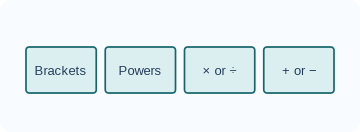
Brackets, Powers, × or ÷, + or −

Use a fixed order. Tied operations go from left to right.

Worked example

Compare two calculations

The same three numbers, 5, 2 and 5, appear in two calculations.

  1. Work out 5+2×525+2\times 5^2.

    [2]
  2. Work out (5+2)×52(5+2)\times 5^2.

    [2]
  1. (a) Calculate 5 squared first. It is 25.

  2. Multiply 2 by 25, then add 5.

  3. 5555.

  4. (b) Work out the bracket: 7.

  5. Multiply that by 25.

  6. 175175.

Your turn

The same three numbers, 2, 2 and 5, appear in two calculations.

Work out 2+2×522+2\times 5^2.

Enter one number. Fractions and decimals are accepted.

Worked example

Compare two calculations

The same three numbers, 6, 2 and 2, appear in two calculations.

  1. Work out 6+2×226+2\times 2^2.

    [2]
  2. Work out (6+2)×22(6+2)\times 2^2.

    [2]

Try it on paper first.

  1. (a) Calculate 2 squared first. It is 4.

  2. Multiply 2 by 4, then add 6.

  3. 1414.

  4. (b) Work out the bracket: 8.

  5. Multiply that by 4.

  6. 3232.

Your turn

The same three numbers, 3, 2 and 2, appear in two calculations.

Work out 3+2×223+2\times 2^2.

Enter one number. Fractions and decimals are accepted.

Section 2 of 3 · Core · about 8 min

How does a square root undo a square?

A square array has the same number of rows and columns. Its area is its side length squared.

Worked example

Square tiles

A square sits on a board next to a row of 2 loose tiles. The square has area 324 square units.

  1. What is the side length of the square?

    [2]
  2. How many tiles are used, including the loose tiles, if each covers one square unit?

    [2]
  1. (a) Find the positive number that gives 324 when multiplied by itself.

  2. 18 squared is 324.

  3. 1818.

  4. (b) The square takes 324 tiles.

  5. Add the 2 loose tiles.

  6. 326326.

Your turn

A square sits on a board next to a row of 3 loose tiles. The square has area 4 square units.

What is the side length of the square?

Enter one number. Fractions and decimals are accepted.

Worked example

Square tiles

A square sits on a board next to a row of 2 loose tiles. The square has area 361 square units.

  1. What is the side length of the square?

    [2]
  2. How many tiles are used, including the loose tiles, if each covers one square unit?

    [2]

Try it on paper first.

  1. (a) Find the positive number that gives 361 when multiplied by itself.

  2. 19 squared is 361.

  3. 1919.

  4. (b) The square takes 361 tiles.

  5. Add the 2 loose tiles.

  6. 363363.

Your turn

A square sits on a board next to a row of 3 loose tiles. The square has area 9 square units.

What is the side length of the square?

Enter one number. Fractions and decimals are accepted.

Section 3 of 3 · Core · about 8 min

What does a cube root tell us?

Think of a solid block with the same number of unit cubes along its length, width and height.

Worked example

A cube made of small blocks

A solid cube contains 125 small unit cubes. A second cube has an edge 1 units longer.

  1. How long is each edge of the first cube?

    [2]
  2. How many blocks make the second cube?

    [2]
  1. (a) A cube with edge 5 has 5 lots of 5 by 5.

  2. 535^3 is 125125.

  3. 55 units.

  4. (b) The edge is 6 units.

  5. Multiply 6 by itself three times.

  6. 216216.

Your turn

A solid cube contains 1728 small unit cubes. A second cube has an edge 2 units longer.

How long is each edge of the first cube?

Enter one number. Fractions and decimals are accepted.

Worked example

A cube made of small blocks

A solid cube contains 216 small unit cubes. A second cube has an edge 1 units longer.

  1. How long is each edge of the first cube?

    [2]
  2. How many blocks make the second cube?

    [2]

Try it on paper first.

  1. (a) A cube with edge 6 has 6 lots of 6 by 6.

  2. 636^3 is 216216.

  3. 66 units.

  4. (b) The edge is 7 units.

  5. Multiply 7 by itself three times.

  6. 343343.

Your turn

A solid cube contains 2197 small unit cubes. A second cube has an edge 2 units longer.

How long is each edge of the first cube?

Enter one number. Fractions and decimals are accepted.

Worked examples

Practise the method

Core practice

Question 1 of 12

0 / 12 checked in this collection

Question list

Core practice

Fresh variants

Exam-style

Compare two calculations

1 mark

The same three numbers, 19, 7 and 2, appear in two calculations.

Work out 19+7×2219+7\times 2^2.

Enter one number. Fractions and decimals are accepted.

Full answer-format guide

Exact numbers: 3/2, sqrt(5), 2-sqrt(3), pi/6, 3*pi/2. Sets: {1,4}. Intervals: (3,5]; a round bracket excludes the endpoint. Infinity: inf; union: U; no solutions: empty. Separate coordinate pairs or triples with semicolons. Expressions: 2x^2+3x-1; equations: x^2=3x+1 or the polynomial equal to zero. Factors: x-1 ; x+2. Parameter fraction: numerator ; denominator. List integer answers individually.

Review the method

Progress stays in this browser. Create an account to save it or sign in.

Extra practice from this lesson

The same three numbers, 22, 3 and 5, appear in two calculations.

Work out 22+3×5222+3\times 5^2.

Enter one number. Fractions and decimals are accepted.

The same three numbers, 23, 3 and 2, appear in two calculations.

Work out 23+3×2223+3\times 2^2.

Enter one number. Fractions and decimals are accepted.

A square sits on a board next to a row of 3 loose tiles. The square has area 16 square units.

What is the side length of the square?

Enter one number. Fractions and decimals are accepted.

A square sits on a board next to a row of 3 loose tiles. The square has area 25 square units.

What is the side length of the square?

Enter one number. Fractions and decimals are accepted.

A solid cube contains 216 small unit cubes. A second cube has an edge 3 units longer.

How long is each edge of the first cube?

Enter one number. Fractions and decimals are accepted.

A solid cube contains 343 small unit cubes. A second cube has an edge 3 units longer.

How long is each edge of the first cube?

Enter one number. Fractions and decimals are accepted.

Apply it · original exam-style problems

Show your working on paper and compare it with the worked solution and marking guidance.

Come back to what needs practice

Quick revision sheet (A4)

Your review plan starts after your first check.