Maths4UBETA

Place value and rounding

Use powers of ten to change a number and round measurements to a stated precision.

Try the quick check →
Lesson 1 of 4

Section 1 of 3 · Core · about 8 min

What changes when we multiply by 10?

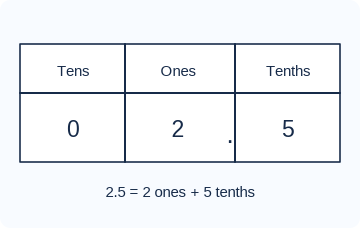
Put each digit in a place-value column. A digit moves one place for each factor of ten.

Place value of 2.5. Zero tens, two ones and five tenths.

Place value of 2.5. Zero tens, two ones and five tenths.

Worked example

Powers of ten

Look at this calculation 1.6×1011.6\times10^1.

  1. Work out 1.6×1011.6\times10^1.

    [2]
  2. Explain how you can tell whether your answer will be larger than the starting number.

    [2]
  1. (a) 10110^1 equals 1010.

  2. Each digit moves 1 place to the left in a place-value chart.

  3. 1616.

  4. (b) Compare the factor with 1.

  5. Multiplying a positive number by 10 gives a larger value.

Your turn

Work out 3.6×1013.6\times10^1.

Enter one number. Fractions and decimals are accepted.

Worked example

Powers of ten

Look at this calculation 1.7×1011.7\times10^1.

  1. Work out 1.7×1011.7\times10^1.

    [2]
  2. Explain how you can tell whether your answer will be larger than the starting number.

    [2]

Try it on paper first.

  1. (a) 10110^1 equals 1010.

  2. Each digit moves 1 place to the left in a place-value chart.

  3. 1717.

  4. (b) Compare the factor with 1.

  5. Multiplying a positive number by 10 gives a larger value.

Your turn

Work out 3.7×1013.7\times10^1.

Enter one number. Fractions and decimals are accepted.

Section 2 of 3 · Core · about 8 min

How do we divide by a power of 10?

A digit worth 7 ones becomes worth 7 tenths after one division by ten.

Worked example

Powers of ten

Look at this calculation 290.29÷101290.29\div10^1.

  1. Work out 290.29÷101290.29\div10^1.

    [2]
  2. Explain how you can tell whether your answer will be larger than the starting number.

    [2]
  1. (a) 10110^1 equals 1010.

  2. Each digit moves 1 place to the right in a place-value chart.

  3. 29.02929.029.

  4. (b) Compare the factor with 1.

  5. Dividing a positive number by 10 gives a smaller value.

Your turn

Work out 4900.49÷1024900.49\div10^2.

Enter an exact value or round to 3 significant figures.

Worked example

Powers of ten

Look at this calculation 300.3÷101300.3\div10^1.

  1. Work out 300.3÷101300.3\div10^1.

    [2]
  2. Explain how you can tell whether your answer will be larger than the starting number.

    [2]

Try it on paper first.

  1. (a) 10110^1 equals 1010.

  2. Each digit moves 1 place to the right in a place-value chart.

  3. 30.0330.03.

  4. (b) Compare the factor with 1.

  5. Dividing a positive number by 10 gives a smaller value.

Your turn

Work out 5000.5÷1025000.5\div10^2.

Enter an exact value or round to 3 significant figures.

Section 3 of 3 · Core · about 8 min

Which digit tells us how to round?

The requested precision tells you which digit to keep. The next digit decides whether it changes.

Worked example

Choosing a rounded measurement

A model train travels 31.193 m in a test run.

  1. Round the distance to 2 decimal places.

    [2]
  2. Round the original distance to the nearest metre.

    [2]
  1. (a) Keep 2 digits after the decimal point and look at the next digit, 3.

  2. It is below 5, so keep the last digit.

  3. 31.1931.19 m.

  4. (b) The tenths digit is 1.

  5. 3131 m.

Your turn

A model train travels 51.294 m in a test run.

Round the distance to 2 decimal places.

Enter one number. Fractions and decimals are accepted.

Worked example

Choosing a rounded measurement

A model train travels 32.103 m in a test run.

  1. Round the distance to 1 decimal place.

    [2]
  2. Round the original distance to the nearest metre.

    [2]

Try it on paper first.

  1. (a) Keep 1 digit after the decimal point and look at the next digit, 0.

  2. It is below 5, so keep the last digit.

  3. 32.132.1 m.

  4. (b) The tenths digit is 1.

  5. 3232 m.

Your turn

A model train travels 52.204 m in a test run.

Round the distance to 1 decimal place.

Enter one number. Fractions and decimals are accepted.

Worked examples

Practise the method

Core practice

Question 1 of 12

0 / 12 checked in this collection

Question list

Core practice

Fresh variants

Exam-style

Powers of ten

1 mark

Look at this calculation 5.1×1025.1\times10^2.

Work out 5.1×1025.1\times10^2.

Enter one number. Fractions and decimals are accepted.

Full answer-format guide

Exact numbers: 3/2, sqrt(5), 2-sqrt(3), pi/6, 3*pi/2. Sets: {1,4}. Intervals: (3,5]; a round bracket excludes the endpoint. Infinity: inf; union: U; no solutions: empty. Separate coordinate pairs or triples with semicolons. Expressions: 2x^2+3x-1; equations: x^2=3x+1 or the polynomial equal to zero. Factors: x-1 ; x+2. Parameter fraction: numerator ; denominator. List integer answers individually.

Review the method

Progress stays in this browser. Create an account to save it or sign in.

Extra practice from this lesson

Work out 5.6×1025.6\times10^2.

Enter one number. Fractions and decimals are accepted.

Work out 5.7×1025.7\times10^2.

Enter one number. Fractions and decimals are accepted.

Work out 6900.69÷1026900.69\div10^2.

Enter an exact value or round to 3 significant figures.

Work out 7000.7÷1027000.7\div10^2.

Enter an exact value or round to 3 significant figures.

A model train travels 12.396 m in a test run.

Round the distance to 2 decimal places.

Enter one number. Fractions and decimals are accepted.

A model train travels 13.306 m in a test run.

Round the distance to 1 decimal place.

Enter one number. Fractions and decimals are accepted.

Apply it · original exam-style problems

Show your working on paper and compare it with the worked solution and marking guidance.

Come back to what needs practice

Quick revision sheet (A4)

Your review plan starts after your first check.