Maths4UBETA

Factors, multiples and divisibility

Find common factors and multiples and test divisibility of larger whole numbers.

Try the quick check →
Lesson 4 of 4

Section 1 of 3 · Core · about 8 min

What is the biggest group count that works?

Two totals can be split into the same number of equal groups only when that group count divides both totals exactly.

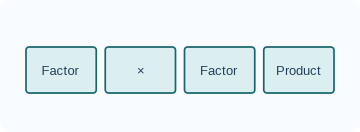
Factor, ×, Factor, Product

A factor is part of a product. The product is a multiple of both factors.

Worked example

Identical activity packs

A club has 10 pencils and 15 stickers. It uses all the items to make identical packs.

  1. Find the greatest possible number of packs.

    [2]
  2. How many stickers go into each of these packs?

    [2]
  1. (a) The number of packs must divide both 10 and 15 exactly.

  2. The greatest shared divisor is 5.

  3. 55.

  4. (b) Share 15 stickers among 5 packs.

  5. 33.

Your turn

A club has 35 pencils and 21 stickers. It uses all the items to make identical packs.

Find the greatest possible number of packs.

Enter the whole-number count.

Worked example

Identical activity packs

A club has 12 pencils and 18 stickers. It uses all the items to make identical packs.

  1. Find the greatest possible number of packs.

    [2]
  2. How many stickers go into each of these packs?

    [2]

Try it on paper first.

  1. (a) The number of packs must divide both 12 and 18 exactly.

  2. The greatest shared divisor is 6.

  3. 66.

  4. (b) Share 18 stickers among 6 packs.

  5. 33.

Your turn

A club has 12 pencils and 6 stickers. It uses all the items to make identical packs.

Find the greatest possible number of packs.

Enter the whole-number count.

Section 2 of 3 · Core · about 8 min

When will two repeating events meet again?

List the times after the shared start for both events. Look for the first matching time.

Worked example

Two flashing lights

An amber light flashes every 24 seconds and a blue light every 18 seconds. Both flash at second 1.

  1. How many seconds after second 1 will both first flash at the same time?

    [2]
  2. At which clock second does this happen?

    [2]
  1. (a) Look for a positive number in both the 24 and 18 times tables.

  2. The first match is 72.

  3. 7272 seconds.

  4. (b) Add the interval 72 to the start time 1.

  5. 7373 seconds.

Your turn

An amber light flashes every 16 seconds and a blue light every 8 seconds. Both flash at second 2.

How many seconds after second 2 will both first flash at the same time?

Enter the whole-number count.

Worked example

Two flashing lights

An amber light flashes every 28 seconds and a blue light every 21 seconds. Both flash at second 1.

  1. How many seconds after second 1 will both first flash at the same time?

    [2]
  2. At which clock second does this happen?

    [2]

Try it on paper first.

  1. (a) Look for a positive number in both the 28 and 21 times tables.

  2. The first match is 84.

  3. 8484 seconds.

  4. (b) Add the interval 84 to the start time 1.

  5. 8585 seconds.

Your turn

An amber light flashes every 24 seconds and a blue light every 12 seconds. Both flash at second 2.

How many seconds after second 2 will both first flash at the same time?

Enter the whole-number count.

Section 3 of 3 · Core · about 8 min

Can we spot factors without long division?

A quick test rules a factor in or out. A successful test helps you find a partner factor.

Worked example

Testing factors of a larger number

A store has 980 small clips. Different organisers are sold in trays of 7, 10, 11 and 12.

  1. How many trays of 7 can be filled exactly using all the clips?

    [2]
  2. Use a divisibility test to decide whether trays of 10 can use all the clips.

    [2]
  3. Give another factor of the number greater than 1.

    [2]
  1. (a) Divide 980 by 7.

  2. Check by multiplying 140 by 7.

  3. 140140.

  4. (b) The ones digit of 980 is 0.

  5. A whole number is divisible by 10 exactly when the ones digit is 0.

  6. Yes, because the ones digit is 0.

  7. (c) The multiplication 140×7140\times 7 gives 980.

  8. For example, 140 is also a factor.

Your turn

A store has 1120 small clips. Different organisers are sold in trays of 7, 10, 11 and 12.

How many trays of 7 can be filled exactly using all the clips?

Enter the whole-number count.

Worked example

Testing factors of a larger number

A store has 1269 small clips. Different organisers are sold in trays of 9, 10, 11 and 12.

  1. How many trays of 9 can be filled exactly using all the clips?

    [2]
  2. Use a divisibility test to decide whether trays of 10 can use all the clips.

    [2]
  3. Give another factor of the number greater than 1.

    [2]

Try it on paper first.

  1. (a) Divide 1269 by 9.

  2. Check by multiplying 141 by 9.

  3. 141141.

  4. (b) The ones digit of 1269 is 9.

  5. A whole number is divisible by 10 exactly when the ones digit is 0.

  6. No. The ones digit is not 0.

  7. (c) The multiplication 141×9141\times 9 gives 1269.

  8. For example, 141 is also a factor.

Your turn

A store has 1449 small clips. Different organisers are sold in trays of 9, 10, 11 and 12.

How many trays of 9 can be filled exactly using all the clips?

Enter the whole-number count.

Worked examples

Practise the method

Core practice

Question 1 of 12

0 / 12 checked in this collection

Question list

Core practice

Fresh variants

Exam-style

Identical activity packs

1 mark

A club has 32 pencils and 40 stickers. It uses all the items to make identical packs.

Find the greatest possible number of packs.

Enter the whole-number count.

Full answer-format guide

Exact numbers: 3/2, sqrt(5), 2-sqrt(3), pi/6, 3*pi/2. Sets: {1,4}. Intervals: (3,5]; a round bracket excludes the endpoint. Infinity: inf; union: U; no solutions: empty. Separate coordinate pairs or triples with semicolons. Expressions: 2x^2+3x-1; equations: x^2=3x+1 or the polynomial equal to zero. Factors: x-1 ; x+2. Parameter fraction: numerator ; denominator. List integer answers individually.

Review the method

Progress stays in this browser. Create an account to save it or sign in.

Extra practice from this lesson

A club has 27 pencils and 12 stickers. It uses all the items to make identical packs.

Find the greatest possible number of packs.

Enter the whole-number count.

A club has 36 pencils and 16 stickers. It uses all the items to make identical packs.

Find the greatest possible number of packs.

Enter the whole-number count.

An amber light flashes every 44 seconds and a blue light every 16 seconds. Both flash at second 2.

How many seconds after second 2 will both first flash at the same time?

Enter the whole-number count.

An amber light flashes every 55 seconds and a blue light every 20 seconds. Both flash at second 2.

How many seconds after second 2 will both first flash at the same time?

Enter the whole-number count.

A store has 1260 small clips. Different organisers are sold in trays of 7, 10, 11 and 12.

How many trays of 7 can be filled exactly using all the clips?

Enter the whole-number count.

A store has 1629 small clips. Different organisers are sold in trays of 9, 10, 11 and 12.

How many trays of 9 can be filled exactly using all the clips?

Enter the whole-number count.

Apply it · original exam-style problems

Show your working on paper and compare it with the worked solution and marking guidance.

Come back to what needs practice

Quick revision sheet (A4)

Your review plan starts after your first check.