Maths4UBETA

Total distance and changes of direction

Find times of reversal and use integral intervals to calculate total distance, signed displacement and speed.

Try the quick check →
Lesson 3 of 4

Section 1 of 3 · Lesson · about 5 min

Where should I split the time interval?

Set velocity to zero and retain the times in the stated interval. Test its sign on both sides before deciding that the particle turns.

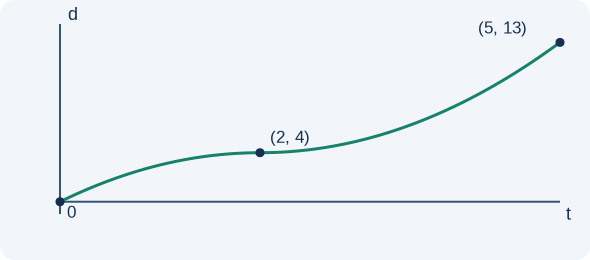
Accumulated distance keeps increasing. It has a horizontal tangent at 2 seconds, when the particle changes direction.

Accumulated distance keeps increasing. It has a horizontal tangent at 2 seconds, when the particle changes direction.

Practise the method

Factor the velocity to find its zeros. Mark them on a time line with the interval endpoints. Use a single test time in each part to establish the sign of velocity there.

Worked example

Separate total distance and signed displacement

A rail shuttle has velocity v=12t−84v=12 t - 84 in metres per second for 0≤t≤120\le t\le 12.

Find all the times at which the particle is at rest.

  1. Set the signed velocity 12t−8412 t - 84 equal to zero. Give all roots in the stated time interval.

  2. Answer: t=7t=7.

Your turn

A rail shuttle has velocity v=6t−42v=6 t - 42 in metres per second for 0≤t≤140\le t\le 14.

Find all the times at which the particle is at rest.

Enter one number. Fractions and decimals are accepted.

Worked example

Separate total distance and signed displacement

A rail shuttle has velocity v=6t−36v=6 t - 36 in metres per second for 0≤t≤100\le t\le 10.

Find the displacement during 3≤t≤103\le t\le 10.

Try it on paper first.

  1. Evaluate the definite integral of velocity from 3 s3\,\mathrm{s} to 10 s10\,\mathrm{s}. Keep the signs of the contributions.

  2. Answer: 21 m21\,\mathrm{m}.

Your turn

A rail shuttle has velocity v=11t−66v=11 t - 66 in metres per second for 0≤t≤130\le t\le 13.

Find the displacement during 1≤t≤131\le t\le 13.

Velocity (m/s) plotted against Time (s) from 1 to 13. The graph crosses the horizontal axis within the interval.

Enter one number. Fractions and decimals are accepted.

Section 2 of 3 · Lesson · about 5 min

What does the signed integral measure?

Velocity has a sign. The integral gives the final position minus the initial position along the chosen direction.

Practise the method

Copy the lower and upper limits from the question. Integrate velocity across the entire interval, or sum the signed changes for its separate pieces. Use a graph to check the sign.

Worked example

Separate total distance and signed displacement

A sensor travels backwards and forwards along a straight beam. Its velocity in metres per second is v=(t−10)(6t−36)v=\left(t - 10\right) \left(6 t - 36\right) for 0≤t≤130\le t\le 13.

Find all the times at which the particle is at rest.

  1. Set the signed velocity (t−10)(6t−36)\left(t - 10\right) \left(6 t - 36\right) equal to zero. Give all roots in the stated time interval.

  2. Answer: t=6 or t=10t=6\text{ or }t=10.

Your turn

A sensor travels backwards and forwards along a straight beam. Its velocity in metres per second is v=(t−12)(6t−36)v=\left(t - 12\right) \left(6 t - 36\right) for 0≤t≤170\le t\le 17.

Find all the times at which the particle is at rest.

Give the complete set: {1, 4} for separate values, (1, 5] for an interval, U for union or empty for no real solutions. Use sqrt(...) for exact roots.

Worked example

Separate total distance and signed displacement

A sensor travels backwards and forwards along a straight beam. Its velocity in metres per second is v=(t−9)(6t−12)v=\left(t - 9\right) \left(6 t - 12\right) for 0≤t≤140\le t\le 14.

Find the displacement during 0≤t≤140\le t\le 14.

Try it on paper first.

  1. Evaluate the definite integral of velocity from 0 s0\,\mathrm{s} to 14 s14\,\mathrm{s}. Keep the signs of the contributions.

  2. Answer: 532 m532\,\mathrm{m}.

Your turn

A sensor travels backwards and forwards along a straight beam. Its velocity in metres per second is v=(t−9)(5t−15)v=\left(t - 9\right) \left(5 t - 15\right) for 0≤t≤100\le t\le 10.

Find the displacement during 1≤t≤101\le t\le 10.

Velocity (m/s) plotted against Time (s) from 1 to 10. The graph crosses the horizontal axis within the interval.

Enter one number. Fractions and decimals are accepted.

Section 3 of 3 · Lesson · about 5 min

How do I calculate total distance?

Distance is the sum of the lengths travelled in each direction. Split at every turning time and add the absolute value of each integral.

Practise the method

Use your turning times to create an integral for each time interval. Evaluate each one with its sign, then take its magnitude and add all of them. Equivalently, subtract the smaller position from the larger on every monotone part of the journey.

Worked example

Separate total distance and signed displacement

A model lift has velocity v=−10(t−5)(t+7)v=- 10 \left(t - 5\right) \left(t + 7\right) in metres per second for 0≤t≤110\le t\le 11. Downwards is the positive direction.

Find all the times at which the particle is at rest.

  1. Set the signed velocity (50−10t)(t+7)\left(50 - 10 t\right) \left(t + 7\right) equal to zero. Give all roots in the stated time interval.

  2. Answer: t=5t=5.

Your turn

A particle has modelled velocity v=−8(t−7)(t+1)v=- 8 \left(t - 7\right) \left(t + 1\right) in metres per second for 0≤t≤150\le t\le 15. Downwards is the positive direction.

Find all the times at which the particle is at rest.

Enter one number. Fractions and decimals are accepted.

Worked example

Find total distance after a reversal

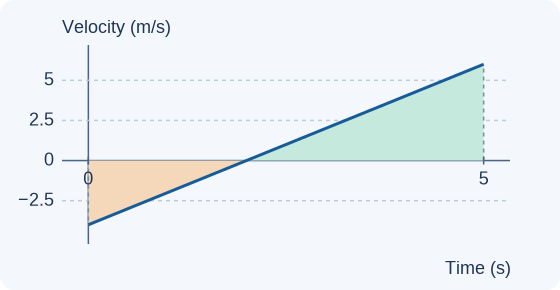
A robot moves along a straight rail. Its velocity in metres per second is v=2t−4,0≤t≤5v=2t-4,\quad 0\le t\le5. Find the signed displacement and the total distance travelled.

Velocity (m/s) plotted against Time (s) from 0 to 5. The graph crosses the horizontal axis within the interval.

Try it on paper first.

  1. Solve 2t−4=02t-4=0 to get t=2t=2. The robot moves in the negative direction before 2 s, then in the positive direction.

  2. Integrate 2t−42t-4 to obtain t2−4tt^2-4t. From 0 to 2 s the signed displacement is [t2−4t]02=−4[t^2-4t]_0^2=-4 m. From 2 to 5 s it is [t2−4t]25=9[t^2-4t]_2^5=9 m.

  3. The signed displacement is −4+9=5-4+9=5 m. The total distance is ∣−4∣+∣9∣=13|-4|+|9|=13 m.

Your turn

A cart moves with velocity v=6−2t,0≤t≤4v=6-2t,\quad 0\le t\le4 metres per second. Find its signed displacement and its total distance.

Velocity (m/s) plotted against Time (s) from 0 to 4. The graph crosses the horizontal axis within the interval.

Enter one number. Fractions and decimals are accepted.

Enter one number. Fractions and decimals are accepted.

Your turn

A particle has modelled velocity v=−2(t−2)(t+7)v=- 2 \left(t - 2\right) \left(t + 7\right) in metres per second for 0≤t≤100\le t\le 10. Downwards is the positive direction.

Find the displacement during 0≤t≤100\le t\le 10.

Velocity (m/s) plotted against Time (s) from 0 to 10. The graph crosses the horizontal axis within the interval.

Enter an exact value or round to 3 significant figures.

Worked examples

Practise the method

Core practice

Question 1 of 5

0 / 5 checked in this collection

Question list

Core practice

Fresh variants

Exam-style

Separate total distance and signed displacement

1 mark

A rail shuttle has velocity v=7t−49v=7 t - 49 in metres per second for 0≤t≤140\le t\le 14.

Find all the times at which the particle is at rest.

Enter one number. Fractions and decimals are accepted.

Full answer-format guide

Exact numbers: 3/2, sqrt(5), 2-sqrt(3), pi/6, 3*pi/2. Sets: {1,4}. Intervals: (3,5]; a round bracket excludes the endpoint. Infinity: inf; union: U; no solutions: empty. Separate coordinate pairs or triples with semicolons. Expressions: 2x^2+3x-1; equations: x^2=3x+1 or the polynomial equal to zero. Factors: x-1 ; x+2. Parameter fraction: numerator ; denominator. List integer answers individually.

Review the method

Progress stays in this browser. Create an account to save it or sign in.

Extra practice from this lesson

Separate total distance and signed displacement

A rail shuttle has velocity v=8t−24v=8 t - 24 in metres per second for 0≤t≤100\le t\le 10.

Find all the times at which the particle is at rest.

Enter one number. Fractions and decimals are accepted.

Separate total distance and signed displacement

A rail shuttle has velocity v=11t−22v=11 t - 22 in metres per second for 0≤t≤80\le t\le 8.

Find the displacement during 1≤t≤81\le t\le 8.

Velocity (m/s) plotted against Time (s) from 1 to 8. The graph crosses the horizontal axis within the interval.

Enter an exact value or round to 3 significant figures.

Separate total distance and signed displacement

A sensor travels backwards and forwards along a straight beam. Its velocity in metres per second is v=(t−6)(t−3)v=\left(t - 6\right) \left(t - 3\right) for 0≤t≤80\le t\le 8.

Find all the times at which the particle is at rest.

Give the complete set: {1, 4} for separate values, (1, 5] for an interval, U for union or empty for no real solutions. Use sqrt(...) for exact roots.

Separate total distance and signed displacement

A sensor travels backwards and forwards along a straight beam. Its velocity in metres per second is v=(t−11)(11t−77)v=\left(t - 11\right) \left(11 t - 77\right) for 0≤t≤120\le t\le 12.

Find the displacement during 5≤t≤125\le t\le 12.

Velocity (m/s) plotted against Time (s) from 5 to 12. The graph crosses the horizontal axis within the interval.

Enter an exact value or round to 3 significant figures.

Separate total distance and signed displacement

A particle has modelled velocity v=−7(t−3)(t+4)v=- 7 \left(t - 3\right) \left(t + 4\right) in metres per second for 0≤t≤110\le t\le 11. Downwards is the positive direction.

Find all the times at which the particle is at rest.

Enter one number. Fractions and decimals are accepted.

Separate total distance and signed displacement

A particle has modelled velocity v=−12(t−1)(t+2)v=- 12 \left(t - 1\right) \left(t + 2\right) in metres per second for 0≤t≤120\le t\le 12. Downwards is the positive direction.

Find the displacement during 0≤t≤120\le t\le 12.

Velocity (m/s) plotted against Time (s) from 0 to 12. The graph crosses the horizontal axis within the interval.

Enter one number. Fractions and decimals are accepted.

Apply it · original exam-style problems

Show your working on paper and compare it with the worked solution and marking guidance.

Come back to what needs practice

Quick revision sheet (A4)

Your review plan starts after your first check.