Cambridge IGCSE Additional Mathematics (0606) · Kinematics · Quick revision
Total distance and changes of direction
Where should I split the time interval?
Solve within the model's time range. Check where the sign of v actually changes. Each change separates two directions of motion.
What does the signed integral measure?
The integral measures the net change in position. Parts of the journey in opposite directions can cancel.
How do I calculate total distance?
Total distance is the area under the speed graph. Compute by splitting at changes of direction, then adding the magnitudes of the separate displacements.
Quick worked example
A robot moves along a straight rail. Its velocity in metres per second is . Find the signed displacement and the total distance travelled.
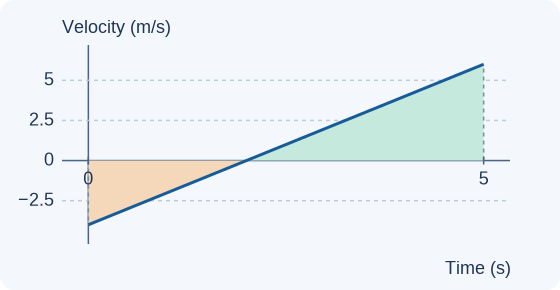
Solve to get . The robot moves in the negative direction before 2 s, then in the positive direction.
Integrate to obtain . From 0 to 2 s the signed displacement is m. From 2 to 5 s it is m.
The signed displacement is m. The total distance is m.