Maths4UBETA

Displacement, velocity and acceleration

Use derivatives to calculate velocity and acceleration, find when a particle stops and explain its motion along a straight line.

Try the quick check →
Lesson 1 of 4

Section 1 of 3 · Lesson · about 5 min

How fast is the position changing?

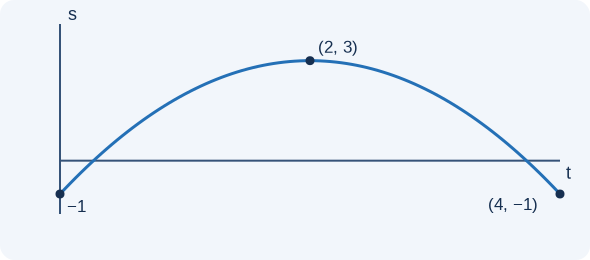
The displacement rises, has a horizontal tangent at 2 seconds, then falls. The origin of displacement is 3 m below its maximum.

The displacement rises, has a horizontal tangent at 2 seconds, then falls. The origin of displacement is 3 m below its maximum.

Practise the method

Start by drawing the origin and the positive direction. Differentiate the formula for displacement term by term. A stationary value of the position has velocity zero. The sign of the displacement alone gives a position.

Position and rates
QuantityRead it from a graph
DisplacementHeight on the displacement graph
VelocityGradient on the displacement graph
AccelerationGradient on the velocity graph

Worked example

Find motion from a position function

A toy train on a straight track has displacement s=t22−5t+4s=\frac{t^{2}}{2} - 5 t + 4 for 0≤t≤140\le t\le 14, where t is measured in seconds.

Find the velocity v in terms of t.

  1. Differentiate each term of the position formula. A constant term has derivative zero.

  2. v=t−5v=t - 5

  3. Answer: t−5t - 5.

Your turn

A toy train on a straight track has displacement s=6t2−84t+4s=6 t^{2} - 84 t + 4 for 0≤t≤190\le t\le 19, where t is measured in seconds.

Find the velocity v in terms of t.

Enter an expression in t; use ^ for powers and / for fractions.

Worked example

Find motion from a position function

A toy train on a straight track has displacement s=3t2−24t−6s=3 t^{2} - 24 t - 6 for 0≤t≤110\le t\le 11, where t is measured in seconds.

Find all the times at which the particle is at rest.

Try it on paper first.

  1. Set the signed velocity 6t−246 t - 24 equal to zero. Give all roots in the stated time interval.

  2. Answer: t=4t=4.

Your turn

A toy train on a straight track has displacement s=t22−5t+5s=\frac{t^{2}}{2} - 5 t + 5 for 0≤t≤110\le t\le 11, where t is measured in seconds.

Find all the times at which the particle is at rest.

Enter one number. Fractions and decimals are accepted.

Section 2 of 3 · Lesson · about 5 min

How do I find the times at rest?

Practise the method

Write the velocity equation, factor it where possible and solve each factor. To confirm a reversal, check the sign of velocity before and after the instant.

Worked example

Find motion from a position function

A battery-powered inspection device moves along a straight track. Its position in metres, measured from a fixed reference, is s=7t33−63t22+98t−6s=\frac{7 t^{3}}{3} - \frac{63 t^{2}}{2} + 98 t - 6 for 0≤t≤110\le t\le 11, where t is measured in seconds.

Find the velocity v in terms of t.

  1. Differentiate each term of the position formula. A constant term has derivative zero.

  2. v=7t2−63t+98v=7 t^{2} - 63 t + 98

  3. Answer: 7t2−63t+987 t^{2} - 63 t + 98.

Your turn

A battery-powered inspection device moves along a straight track. Its position in metres, measured from a fixed reference, is s=5t33−75t22+270t−5s=\frac{5 t^{3}}{3} - \frac{75 t^{2}}{2} + 270 t - 5 for 0≤t≤130\le t\le 13, where t is measured in seconds.

Find the velocity v in terms of t.

Enter an expression in t; use ^ for powers and / for fractions.

Worked example

Find motion from a position function

A battery-powered inspection device moves along a straight track. Its position in metres, measured from a fixed reference, is s=10t33−45t2+140t+5s=\frac{10 t^{3}}{3} - 45 t^{2} + 140 t + 5 for 0≤t≤90\le t\le 9, where t is measured in seconds.

Find all the times at which the particle is at rest.

Try it on paper first.

  1. Set the signed velocity (t−7)(10t−20)\left(t - 7\right) \left(10 t - 20\right) equal to zero. Give all roots in the stated time interval.

  2. Answer: t=2 or t=7t=2\text{ or }t=7.

Your turn

A battery-powered inspection device moves along a straight track. Its position in metres, measured from a fixed reference, is s=5t33−25t2+80t+7s=\frac{5 t^{3}}{3} - 25 t^{2} + 80 t + 7 for 0≤t≤90\le t\le 9, where t is measured in seconds.

Find all the times at which the particle is at rest.

Give the complete set: {1, 4} for separate values, (1, 5] for an interval, U for union or empty for no real solutions. Use sqrt(...) for exact roots.

Section 3 of 3 · Lesson · about 5 min

What does acceleration measure?

Practise the method

Find the velocity expression first. Differentiate it to obtain acceleration and evaluate it at the requested time. Retain a negative result as a signed physical quantity. Compare the signs of velocity and acceleration if asked whether speed increases.

Worked example

Read direction from a displacement model

A trolley moves on a straight horizontal rail. Its displacement from the marker is s=−4t2+24t+10s=- 4 t^{2} + 24 t + 10, in metres, for 0≤t≤120\le t\le 12, where t is measured in seconds. Take right as positive.

Find the velocity v in terms of t.

  1. Differentiate the displacement expression once with respect to time.

  2. v=24−8tv=24 - 8 t

  3. Answer: 24−8t24 - 8 t.

Your turn

A trolley moves on a straight horizontal rail. Its displacement from the marker is s=−5t22+15t−5s=- \frac{5 t^{2}}{2} + 15 t - 5, in metres, for 0≤t≤80\le t\le 8, where t is measured in seconds. Take right as positive.

Find the velocity v in terms of t.

Enter an expression in t; use ^ for powers and / for fractions.

Worked example

Read direction from a displacement model

A trolley moves on a straight horizontal rail. Its displacement from the marker is s=−11t22+44t+1s=- \frac{11 t^{2}}{2} + 44 t + 1, in metres, for 0≤t≤120\le t\le 12, where t is measured in seconds. Take right as positive.

Find the acceleration at t=6t=6 and include its sign.

Try it on paper first.

  1. Differentiate velocity to obtain a=−11a=-11. The acceleration is constant for this model.

  2. Answer: −11 m s−2-11\,\mathrm{m\,s^{-2}}.

Your turn

A trolley moves on a straight horizontal rail. Its displacement from the marker is s=−9t22+45t−11s=- \frac{9 t^{2}}{2} + 45 t - 11, in metres, for 0≤t≤160\le t\le 16, where t is measured in seconds. Take right as positive.

Find the acceleration at t=6t=6 and include its sign.

Enter one number. Fractions and decimals are accepted.

Worked examples

Practise the method

Core practice

Question 1 of 5

0 / 5 checked in this collection

Question list

Core practice

Fresh variants

Exam-style

Find motion from a position function

1 mark

A toy train on a straight track has displacement s=7t22−14t+3s=\frac{7 t^{2}}{2} - 14 t + 3 for 0≤t≤130\le t\le 13, where t is measured in seconds.

Find the velocity v in terms of t.

Enter an expression in t; use ^ for powers and / for fractions.

Full answer-format guide

Exact numbers: 3/2, sqrt(5), 2-sqrt(3), pi/6, 3*pi/2. Sets: {1,4}. Intervals: (3,5]; a round bracket excludes the endpoint. Infinity: inf; union: U; no solutions: empty. Separate coordinate pairs or triples with semicolons. Expressions: 2x^2+3x-1; equations: x^2=3x+1 or the polynomial equal to zero. Factors: x-1 ; x+2. Parameter fraction: numerator ; denominator. List integer answers individually.

Review the method

Progress stays in this browser. Create an account to save it or sign in.

Extra practice from this lesson

Find motion from a position function

A toy train on a straight track has displacement s=4t2−48t+1s=4 t^{2} - 48 t + 1 for 0≤t≤170\le t\le 17, where t is measured in seconds.

Find the velocity v in terms of t.

Enter an expression in t; use ^ for powers and / for fractions.

Find motion from a position function

A toy train on a straight track has displacement s=2t2−8t+2s=2 t^{2} - 8 t + 2 for 0≤t≤90\le t\le 9, where t is measured in seconds.

Find all the times at which the particle is at rest.

Enter one number. Fractions and decimals are accepted.

Find motion from a position function

A battery-powered inspection device moves along a straight track. Its position in metres, measured from a fixed reference, is s=4t3−60t2+252t−1s=4 t^{3} - 60 t^{2} + 252 t - 1 for 0≤t≤120\le t\le 12, where t is measured in seconds.

Find the velocity v in terms of t.

Enter an expression in t; use ^ for powers and / for fractions.

Find motion from a position function

A battery-powered inspection device moves along a straight track. Its position in metres, measured from a fixed reference, is s=t33−21t22+98t−9s=\frac{t^{3}}{3} - \frac{21 t^{2}}{2} + 98 t - 9 for 0≤t≤150\le t\le 15, where t is measured in seconds.

Find all the times at which the particle is at rest.

Give the complete set: {1, 4} for separate values, (1, 5] for an interval, U for union or empty for no real solutions. Use sqrt(...) for exact roots.

Read direction from a displacement model

A trolley moves on a straight horizontal rail. Its displacement from the marker is s=−t2+12t−12s=- t^{2} + 12 t - 12, in metres, for 0≤t≤140\le t\le 14, where t is measured in seconds. Take right as positive.

Find the velocity v in terms of t.

Enter an expression in t; use ^ for powers and / for fractions.

Read direction from a displacement model

A trolley moves on a straight horizontal rail. Its displacement from the marker is s=−t2+6t+8s=- t^{2} + 6 t + 8, in metres, for 0≤t≤90\le t\le 9, where t is measured in seconds. Take right as positive.

Find the acceleration at t=5t=5 and include its sign.

Enter one number. Fractions and decimals are accepted.

Apply it · original exam-style problems

Show your working on paper and compare it with the worked solution and marking guidance.

Come back to what needs practice

Quick revision sheet (A4)

Your review plan starts after your first check.