Cambridge IGCSE Additional Mathematics (0606) · Kinematics · Quick revision
Displacement, velocity and acceleration
How fast is the position changing?
A displacement measures position from an origin along the chosen positive direction. Its derivative is the signed velocity .
How do I find the times at rest?
Use to find a time with no instantaneous motion. Check the permitted time interval and give every valid time.
What does acceleration measure?
Differentiate again to obtain . It measures the change in signed velocity each second.
Quick worked example
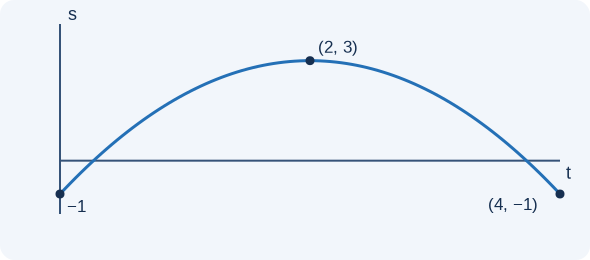
A toy train on a straight track has displacement for , where t is measured in seconds.
Find the velocity v in terms of t.
Differentiate each term of the position formula. A constant term has derivative zero.