Maths4UBETA

Derivatives of logarithmic functions

Find the admissible domain, differentiate the argument and evaluate exact gradients.

Try the quick check →
Lesson 2 of 4

Section 1 of 3 · Lesson · about 5 min

Why does the logarithmic argument matter?

For a real natural logarithm, its input must be positive. Establish this before finding a derivative or evaluating a gradient.
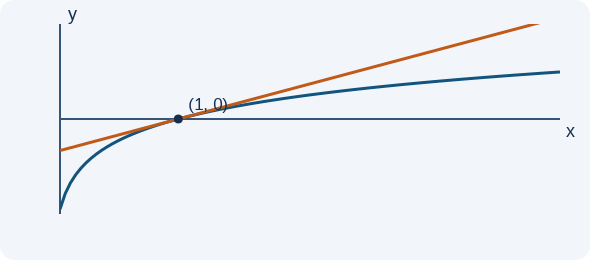
The curve y = ln x and its tangent at x = 1. The shown curve stays to the right of the vertical asymptote.

The curve y = ln x and its tangent at x = 1. The shown curve stays to the right of the vertical asymptote.

Practise the method

  1. Solve the strict inequality for the logarithm's input.
  2. Differentiate the argument separately.
  3. Put that derivative above the original argument.

Worked example

Read a value and a gradient on the logarithm

Find the tangent to y=ln⁡xy=\ln x at x=1x=1.

  1. The domain is x>0x>0. At the chosen input, ln⁡1=0\ln 1=0, giving (1,0)(1,0).

  2. The derivative is 1x\frac1x, giving a slope of 11.

  3. The tangent equation is y=x−1y=x-1.

Your turn

State the domain of f(x)=ln⁡(3x−6)f(x)=\ln(3x-6).

Give the complete set: {1, 4} for separate values, (1, 5] for an interval, U for union or empty for no real solutions. Use sqrt(...) for exact roots.

Worked example

Differentiate a logarithm on its real domain

A function is given by y=2ln⁡(3x−8)+7y=2 \ln{\left(3 x - 8 \right)} + 7.

Find dydx\frac{\mathrm dy}{\mathrm dx}.

  1. dydx=63x−8\frac{\mathrm dy}{\mathrm dx}=\frac{6}{3 x - 8}
  2. dydx=23x−8\frac{\mathrm dy}{\mathrm dx}=\frac{2}{3 x - 8}
  3. dydx=−9+63x−8\frac{\mathrm dy}{\mathrm dx}=-9 + \frac{6}{3 x - 8}
  4. dydx=11+63x−8\frac{\mathrm dy}{\mathrm dx}=11 + \frac{6}{3 x - 8}

Try it on paper first.

  1. Let u=3x−8u=3x-8. The domain requires u>0u>0, so x>83x>\frac83. For y=2ln⁡u+7y=2\ln u+7, dydu=2u\frac{\mathrm dy}{\mathrm du}=\frac2u.

  2. Multiply by dudx=3\frac{\mathrm du}{\mathrm dx}=3. Thus y′=63x−8y^\prime=\frac6{3x-8}, option A.

Your turn

A function is given by y=12ln⁡(2x+2)−3y=12 \ln{\left(2 x + 2 \right)} - 3.

Find dydx\frac{\mathrm dy}{\mathrm dx}.

Choose the complete result

Section 2 of 3 · Lesson · about 5 min

What if the inner slope is negative?

A negative coefficient makes the argument decrease with x. It reverses the domain inequality and can make the derivative negative.

Practise the method

  1. Solve the positive-argument inequality without dropping the sign.
  2. Preserve the negative derivative of the argument.
  3. Check the requested input is inside the domain.

Worked example

Distinguish a domain argument from a slope argument

For y=2ln⁡(7−3x)y=2\ln(7-3x), find its domain and gradient at x=2x=2.

  1. Require 7−3x>07-3x>0, so x<73x<\frac73 and x=2x=2 is allowed.

  2. y′=2(−3)7−3x=−67−3xy'=\frac{2(-3)}{7-3x}=-\frac{6}{7-3x}.

  3. At x=2x=2, the denominator is 11, so the gradient is −6-6.

Your turn

For y=3ln⁡(8−2x)y=3\ln(8-2x), find y′y' at x=3x=3.

Enter one number. Fractions and decimals are accepted.

Worked example

Keep the negative inner derivative of a logarithm

A function is given by y=10ln⁡(1−2x)−7y=10 \ln{\left(1 - 2 x \right)} - 7.

Find dydx\frac{\mathrm dy}{\mathrm dx}.

  1. dydx=−201−2x\frac{\mathrm dy}{\mathrm dx}=- \frac{20}{1 - 2 x}
  2. dydx=101−2x\frac{\mathrm dy}{\mathrm dx}=\frac{10}{1 - 2 x}
  3. dydx=−9−201−2x\frac{\mathrm dy}{\mathrm dx}=-9 - \frac{20}{1 - 2 x}
  4. dydx=11−201−2x\frac{\mathrm dy}{\mathrm dx}=11 - \frac{20}{1 - 2 x}

Try it on paper first.

  1. Let u=1−2xu=1-2x, so the domain requires x<12x<\frac12. The outer derivative is 10u\frac{10}{u}.

  2. Multiply by the inner derivative −2-2. This gives y′=−201−2xy^\prime=-\frac{20}{1-2x}, option A.

Your turn

A function is given by y=11ln⁡(−6x−2)+10y=11 \ln{\left(- 6 x - 2 \right)} + 10.

Find dydx\frac{\mathrm dy}{\mathrm dx}.

Choose the complete result

Section 3 of 3 · Lesson · about 5 min

How do you differentiate a logarithm plus a linear term?

Differentiate a logarithm and a separate algebraic term individually. The restriction from the logarithm still applies to the sum.

Practise the method

  1. Keep the logarithm's multiplier and its inner derivative.
  2. Evaluate the derivative of the algebraic term separately.
  3. Add the contributions in the original domain.

Worked example

Use the addition rule before solving a gradient equation

Find where y=2ln⁡x+xy=2\ln x+x has gradient 33.

  1. On x>0x>0, the derivative is 2x+1\frac2x+1.

  2. Solve 2x+1=3\frac2x+1=3 to obtain 2=2x2=2x, so x=1x=1.

  3. Substitution gives slope 2+1=32+1=3 at an allowed input.

Your turn

Find the x-coordinate where y=ln⁡(2x+1)+xy=\ln(2x+1)+x has gradient 2.

Enter an exact value or round to 3 significant figures.

Worked example

Differentiate a logarithm on its correct domain

A function is given by y=−8x+11ln⁡(9x−7)y=- 8 x + 11 \ln{\left(9 x - 7 \right)}.

Find dydx\frac{\mathrm dy}{\mathrm dx}.

  1. dydx=−8+999x−7\frac{\mathrm dy}{\mathrm dx}=-8 + \frac{99}{9 x - 7}
  2. dydx=−8+119x−7\frac{\mathrm dy}{\mathrm dx}=-8 + \frac{11}{9 x - 7}
  3. dydx=−17+999x−7\frac{\mathrm dy}{\mathrm dx}=-17 + \frac{99}{9 x - 7}
  4. dydx=3+999x−7\frac{\mathrm dy}{\mathrm dx}=3 + \frac{99}{9 x - 7}

Try it on paper first.

  1. The derivative of the logarithm uses its input in the denominator, so 11ln⁡(9x−7)11 \ln{\left(9 x - 7 \right)} contributes 999x−7\frac{99}{9 x - 7}. Add the derivative of the linear term.

  2. dydx=−8+999x−7\frac{\mathrm dy}{\mathrm dx}=-8 + \frac{99}{9 x - 7}

  3. Answer: dydx=−8+999x−7\frac{\mathrm dy}{\mathrm dx}=-8 + \frac{99}{9 x - 7}.

Your turn

A function is given by y=−7x+11ln⁡(8x−5)y=- 7 x + 11 \ln{\left(8 x - 5 \right)}.

Find dydx\frac{\mathrm dy}{\mathrm dx}.

Choose the complete result

Worked examples

Practise the method

Core practice

Question 1 of 5

0 / 5 checked in this collection

Question list

Core practice

Fresh variants

Exam-style

Differentiate a logarithm on its correct domain

1 mark

A function is given by y=4−2ln⁡(3x−5)y=4 - 2 \ln{\left(3 x - 5 \right)}.

State the domain of the function.

Use inequalities in x or interval notation. Join intervals with ‘or’ or ∪. Enter an isolated value on its own.

Full answer-format guide

Exact numbers: 3/2, sqrt(5), 2-sqrt(3), pi/6, 3*pi/2. Sets: {1,4}. Intervals: (3,5]; a round bracket excludes the endpoint. Infinity: inf; union: U; no solutions: empty. Separate coordinate pairs or triples with semicolons. Expressions: 2x^2+3x-1; equations: x^2=3x+1 or the polynomial equal to zero. Factors: x-1 ; x+2. Parameter fraction: numerator ; denominator. List integer answers individually.

Review the method

Progress stays in this browser. Create an account to save it or sign in.

Extra practice from this lesson

Differentiate a logarithm on its correct domain

A function is given by y=7ln⁡(8x−6)−7y=7 \ln{\left(8 x - 6 \right)} - 7.

State the domain of y.

Use inequalities in x or interval notation. Join intervals with ‘or’ or ∪. Enter an isolated value on its own.

Differentiate a logarithm on its correct domain

A function is given by y=8ln⁡(6x−6)+8y=8 \ln{\left(6 x - 6 \right)} + 8.

Find dydx\frac{\mathrm dy}{\mathrm dx}.

Choose the complete result

Differentiate a logarithm on its correct domain

A function is given by y=9ln⁡(3−7x)−1y=9 \ln{\left(3 - 7 x \right)} - 1.

State the domain of y.

Use inequalities in x or interval notation. Join intervals with ‘or’ or ∪. Enter an isolated value on its own.

Differentiate a logarithm on its correct domain

A function is given by y=3ln⁡(2−6x)+1y=3 \ln{\left(2 - 6 x \right)} + 1.

Find dydx\frac{\mathrm dy}{\mathrm dx}.

Choose the complete result

Differentiate a logarithm on its correct domain

A function is given by y=−10x+11ln⁡(6x−1)y=- 10 x + 11 \ln{\left(6 x - 1 \right)}.

State the domain of y.

Use inequalities in x or interval notation. Join intervals with ‘or’ or ∪. Enter an isolated value on its own.

Use the gradient to recover a logarithmic multiplier

For y=aln⁡(2x+1)−xy=a\ln(2x+1)-x, the gradient at x=0x=0 is 5. Find a.

Enter one number. Fractions and decimals are accepted.

Previous checkpoints

Differentiate a logarithm on its correct domain

A function is given by y=2ln⁡(9x−4)−5y=2 \ln{\left(9 x - 4 \right)} - 5.

State the domain of y.

Use inequalities in x or interval notation. Join intervals with ‘or’ or ∪. Enter an isolated value on its own.

Differentiate a logarithm on its correct domain

A function is given by y=9ln⁡(−3x−4)+6y=9 \ln{\left(- 3 x - 4 \right)} + 6.

State the domain of y.

Use inequalities in x or interval notation. Join intervals with ‘or’ or ∪. Enter an isolated value on its own.

Differentiate a logarithm on its correct domain

A function is given by y=5x+8ln⁡(2x+3)y=5 x + 8 \ln{\left(2 x + 3 \right)}.

State the domain of y.

Use inequalities in x or interval notation. Join intervals with ‘or’ or ∪. Enter an isolated value on its own.

Differentiate a logarithm on its correct domain

A function is given by y=−7x+5ln⁡(8x−4)y=- 7 x + 5 \ln{\left(8 x - 4 \right)}.

Find dydx\frac{\mathrm dy}{\mathrm dx}.

Choose the complete result

Apply it · original exam-style problems

Show your working on paper and compare it with the worked solution and marking guidance.

Come back to what needs practice

Quick revision sheet (A4)

Your review plan starts after your first check.