Maths4UBETA

Derivatives of exponential functions

Differentiate e raised to a linear expression and combine the chain and product rules.

Try the quick check →
Lesson 1 of 4

Section 1 of 3 · Lesson · about 5 min

What stays when an exponential differentiates?

An exponential with base e has derivative equal to itself when the exponent is x. A more complicated exponent changes the rate by its own derivative.
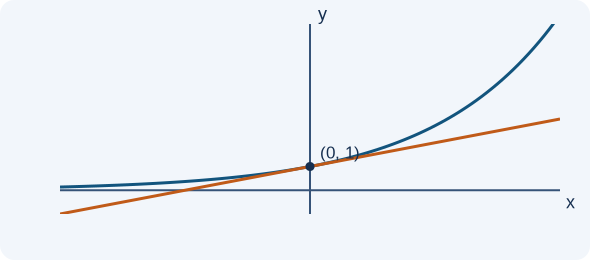
The curve y = eˣ and its tangent at x = 0. The tangent slope there is one.

The curve y = eˣ and its tangent at x = 0. The tangent slope there is one.

Practise the method

  1. Identify the entire exponent.
  2. Find its derivative without changing the original exponential.
  3. Multiply the original exponential by the new factor.

Worked example

Read the tangent gradient of the basic exponential

Find the equation of the tangent to y=exy=e^x at x=0x=0.

  1. The point is (0,e0)=(0,1)(0,e^0)=(0,1).

  2. The derivative is exe^x, so the tangent gradient at zero is 11.

  3. Use y−1=1(x−0)y-1=1(x-0), giving y=x+1y=x+1.

Your turn

For y=4e2x−1+3y=4e^{2x-1}+3, find the exact gradient at x=12x=\frac12.

Enter one number. Fractions and decimals are accepted.

Worked example

Evaluate an exponential at zero exponent

Consider the curve y=2e9x+6−6y=2 e^{9 x + 6} - 6.

Find the exact gradient when x=−23x=- \frac{2}{3}.

Try it on paper first.

  1. For y=2e9x+6−6y=2e^{9x+6}-6, the inner derivative is 99, so y′=18e9x+6y^\prime=18e^{9x+6}.

  2. At x=−23x=-\frac23, the exponent is 00. Hence the gradient is 18e0=1818e^0=18.

Your turn

Consider the curve y=12e8x−8−1y=12 e^{8 x - 8} - 1.

Find the exact gradient when x=1x=1.

Enter one number. Fractions and decimals are accepted.

Section 2 of 3 · Lesson · about 5 min

What if the exponent decreases with x?

When the exponent is linear with a negative coefficient, the exponential component falls as x increases.

Practise the method

  1. Keep the original exponent unchanged on the exponential.
  2. Differentiate the exponent, including its sign.
  3. Add the derivatives of any remaining terms.

Worked example

Differentiate a decay model with a baseline

A function is y=5+4e−2xy=5+4e^{-2x}. Find its slope when x=0x=0.

  1. The constant 5 has derivative zero. For the exponential, the inner slope is −2-2.

  2. Therefore y′=−8e−2xy'=-8e^{-2x}.

  3. At zero, y′=−8e0=−8y'=-8e^0=-8, even though the function value is 99.

Your turn

For y=3e1−2x+xy=3e^{1-2x}+x, find the exact gradient at x=12x=\frac12.

Enter one number. Fractions and decimals are accepted.

Worked example

Keep the negative inner derivative

Consider the curve y=9x+3e−2x−7y=9 x + 3 e^{- 2 x - 7}.

Find the exact gradient when x=−72x=- \frac{7}{2}.

Try it on paper first.

  1. For y=9x+3e−2x−7y=9x+3e^{-2x-7}, the linear term contributes 99. The inner derivative of the exponential is −2-2.

  2. So y′=9−6e−2x−7y^\prime=9-6e^{-2x-7}. At x=−72x=-\frac72, this is 9−6e0=39-6e^0=3.

Your turn

Consider the curve y=−10x+2e3−7xy=- 10 x + 2 e^{3 - 7 x}.

Find the exact gradient when x=37x=\frac{3}{7}.

Enter one number. Fractions and decimals are accepted.

Section 3 of 3 · Lesson · about 5 min

What changes when a linear factor multiplies the exponential?

If an exponential is multiplied by a variable factor, both factors can change. Apply the product rule around the exponential chain rule.

Practise the method

  1. Identify the product factors and differentiate each one.
  2. Add both product contributions.
  3. Factor out the common exponential when it helps simplify a gradient equation.

Worked example

Use the product rule before evaluating

For y=(x+2)e3xy=(x+2)e^{3x}, find the tangent gradient at x=0x=0.

  1. The factors have derivatives 11 and 3e3x3e^{3x}.

  2. y′=e3x+(x+2)3e3x=(3x+7)e3xy'=e^{3x}+(x+2)3e^{3x}=(3x+7)e^{3x}.

  3. At x=0x=0, the slope is 7⋅1=77\cdot1=7.

Your turn

For y=(2x−2)e3x−3y=(2x-2)e^{3x-3}, find the gradient at x=1x=1.

Enter one number. Fractions and decimals are accepted.

Worked example

Evaluate an exponential product derivative

Consider the curve y=(3x+4)e7x+7y=\left(3 x + 4\right) e^{7 x + 7}.

Find the exact gradient when x=−1x=-1.

Try it on paper first.

  1. For y=(3x+4)e7x+7y=(3x+4)e^{7x+7}, the product rule gives 3e7x+7+(3x+4)7e7x+73e^{7x+7}+(3x+4)7e^{7x+7}.

  2. This is (21x+31)e7x+7(21x+31)e^{7x+7}. At x=−1x=-1, the gradient is 10e0=1010e^0=10.

Your turn

Consider the curve y=(4x+5)e9x+4y=\left(4 x + 5\right) e^{9 x + 4}.

Find the exact gradient when x=−49x=- \frac{4}{9}.

Enter one number. Fractions and decimals are accepted.

Worked examples

Practise the method

Core practice

Question 1 of 5

0 / 5 checked in this collection

Question list

Core practice

Fresh variants

Exam-style

Differentiate an exponential model

1 mark

Consider the function y=−4ex−2−4y=- 4 e^{x - 2} - 4.

Find dydx\frac{\mathrm dy}{\mathrm dx}.

Choose the complete result

Choose one option. Explain your reasoning on paper.

Review the method

Progress stays in this browser. Create an account to save it or sign in.

Extra practice from this lesson

Differentiate an exponential model

Consider the curve y=4e6x−9+9y=4 e^{6 x - 9} + 9.

Find dydx\frac{\mathrm dy}{\mathrm dx}.

Choose the complete result

Differentiate an exponential model

Consider the curve y=6e9x−7−5y=6 e^{9 x - 7} - 5.

Find the exact gradient when x=79x=\frac{7}{9}.

Enter one number. Fractions and decimals are accepted.

Differentiate an exponential model

Consider the curve y=−10x+e−2x−8y=- 10 x + e^{- 2 x - 8}.

Find dydx\frac{\mathrm dy}{\mathrm dx}.

Choose the complete result

Differentiate an exponential model

Consider the curve y=7x+3e−3x−8y=7 x + 3 e^{- 3 x - 8}.

Find the exact gradient when x=−83x=- \frac{8}{3}.

Enter one number. Fractions and decimals are accepted.

Differentiate an exponential model

Consider the curve y=(8x−6)e4x+2y=\left(8 x - 6\right) e^{4 x + 2}.

Find dydx\frac{\mathrm dy}{\mathrm dx}.

Choose the complete result

Recover the decay constant from a slope

For y=6e−kx+4y=6e^{-kx}+4, the gradient at x=0x=0 is −15. Find k.

Enter an exact value or round to 3 significant figures.

Previous checkpoints

Differentiate an exponential model

Consider the curve y=9e6x+5+4y=9 e^{6 x + 5} + 4.

Find dydx\frac{\mathrm dy}{\mathrm dx}.

Choose the complete result

Differentiate an exponential model

Consider the curve y=4x+8e1−4xy=4 x + 8 e^{1 - 4 x}.

Find dydx\frac{\mathrm dy}{\mathrm dx}.

Choose the complete result

Differentiate an exponential model

Consider the curve y=10xe2x−1y=10 x e^{2 x - 1}.

Find dydx\frac{\mathrm dy}{\mathrm dx}.

Choose the complete result

Differentiate an exponential model

Consider the curve y=(4x+2)e7x−8y=\left(4 x + 2\right) e^{7 x - 8}.

Find the exact gradient when x=87x=\frac{8}{7}.

Enter one number. Fractions and decimals are accepted.

Apply it · original exam-style problems

Show your working on paper and compare it with the worked solution and marking guidance.

Come back to what needs practice

Quick revision sheet (A4)

Your review plan starts after your first check.