Cambridge IGCSE Additional Mathematics (0606) · Calculus: Differentiation 2 · Quick revision
Derivatives of exponential functions
What stays when an exponential differentiates?
For , with a and b constant, use .
What if the exponent decreases with x?
. For k positive, the derivative is negative.
What changes when a linear factor multiplies the exponential?
For , use .
Quick worked example
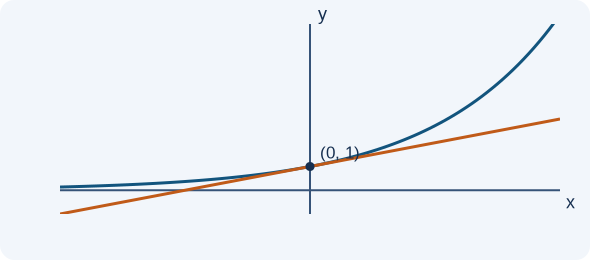
Find the equation of the tangent to at .
The point is .
The derivative is , so the tangent gradient at zero is .
Use , giving .