← Back to the lesson

Cambridge IGCSE Additional Mathematics (0606) · Calculus: Differentiation 2 · Quick revision

Derivatives of logarithmic functions

Why does the logarithmic argument matter?

On u(x)>0u(x)>0, the derivative of ln⁡(u(x))\ln(u(x)) is u′(x)u(x)\frac{u'(x)}{u(x)}.

What if the inner slope is negative?

For u=a−bxu=a-bx with b>0b>0, use x<abx<\frac ab and ddxln⁡(a−bx)=−ba−bx\frac{\mathrm d}{\mathrm dx}\ln(a-bx)=-\frac{b}{a-bx}.

How do you differentiate a logarithm plus a linear term?

On ax+b>0ax+b>0,ddx(cln⁡(ax+b)+dx)=caax+b+d\frac{\mathrm d}{\mathrm dx}\bigl(c\ln(ax+b)+dx\bigr)=\frac{ca}{ax+b}+d.

Quick worked example

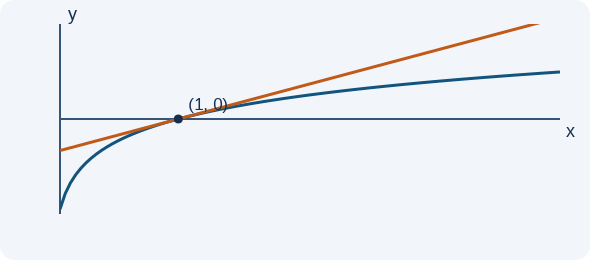
Find the tangent to y=ln⁡xy=\ln x at x=1x=1.

The domain is x>0x>0. At the chosen input, ln⁡1=0\ln 1=0, giving (1,0)(1,0).

The derivative is 1x\frac1x, giving a slope of 11.

The tangent equation is y=x−1y=x-1.

The curve y = ln x and its tangent at x = 1. The shown curve stays to the right of the vertical asymptote.