Maths4UBETA

Stationary points and classification

Find every stationary point and justify each maximum or minimum with a derivative test.

Try the quick check →
Lesson 9 of 10

Section 1 of 3 · Lesson · about 5 min

Why set the gradient equal to zero?

The tangent at a stationary point is horizontal. Use the gradient function to locate the point, then use the original curve to find its height.
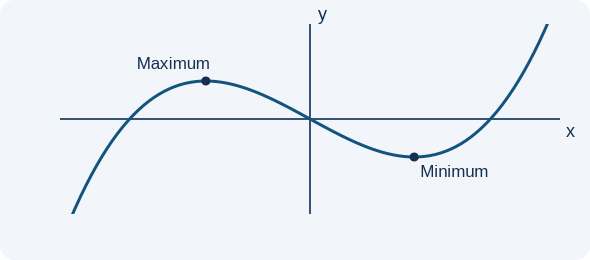
A cubic has a local maximum at x = −1 and a local minimum at x = 1.

A cubic has a local maximum at x = −1 and a local minimum at x = 1.

Practise the method

  1. Differentiate and set the derivative to zero.
  2. Find every solution within the domain.
  3. Substitute each one into the original curve to get a coordinate pair.

Worked example

Find both stationary points

Find the stationary points of y=x3−3xy=x^3-3x.

  1. y′=3x2−3=3(x−1)(x+1)y'=3x^2-3=3(x-1)(x+1).

  2. The derivative is zero at x=−1x=-1 and x=1x=1.

  3. The heights are (−1)3−3(−1)=2(-1)^3-3(-1)=2 and 13−3(1)=−21^3-3(1)=-2. The points are (−1,2)(-1,2) and (1,−2)(1,-2).

Your turn

Find both stationary points of y=x3−12xy=x^3-12x.

Enter a point as (1, 2) or x = 1, y = 2. Separate complete pairs with commas or semicolons.

Worked example

Locate and justify the nature of stationary points

Consider the curve y=14x3−21x2−504x−12y=14 x^{3} - 21 x^{2} - 504 x - 12.

Find d2ydx2\frac{\mathrm d^2y}{\mathrm dx^2} at x=−3x=-3.

Try it on paper first.

  1. Differentiate the gradient function (x−4)(42x+126)\left(x - 4\right) \left(42 x + 126\right) and substitute −3-3.

  2. Answer: −294-294.

Your turn

Consider the curve y=12x3−180x2+576x−4y=12 x^{3} - 180 x^{2} + 576 x - 4.

Find d2ydx2\frac{\mathrm d^2y}{\mathrm dx^2} at x=2x=2.

Enter one number. Fractions and decimals are accepted.

Section 2 of 3 · Lesson · about 5 min

Which sign change gives a maximum?

Test the direction of the graph on either side of the stationary input. This method also works when the second derivative test gives zero.

Practise the method

  1. Find the stationary inputs to split the number line.
  2. Find the sign of the derivative in each interval.
  3. Name each extremum from the adjacent signs.

Worked example

Classify with the first derivative

Classify the stationary point at x=1x=1 of y=x3−3xy=x^3-3x.

  1. y′=3(x−1)(x+1)y'=3(x-1)(x+1). Just to the left of 11, the first factor is negative and the second is positive.

  2. Just to the right both factors are positive.

  3. The graph falls then rises, giving a local minimum at (1,−2)(1,-2).

Your turn

At a stationary point the gradient changes from positive to negative. What type of point is it?

Type of point

Worked example

Locate and justify the nature of stationary points

Consider the curve y=−10x3+45x2+120x−3y=- 10 x^{3} + 45 x^{2} + 120 x - 3.

Find d2ydx2\frac{\mathrm d^2y}{\mathrm dx^2} at x=−1x=-1.

Try it on paper first.

  1. Differentiate the gradient function (−30x−30)(x−4)\left(- 30 x - 30\right) \left(x - 4\right) and substitute −1-1.

  2. Answer: 150150.

Your turn

Consider the curve y=−2x3+6x2+48x+3y=- 2 x^{3} + 6 x^{2} + 48 x + 3.

Find d2ydx2\frac{\mathrm d^2y}{\mathrm dx^2} at x=−2x=-2.

Enter one number. Fractions and decimals are accepted.

Section 3 of 3 · Lesson · about 5 min

When is the second derivative test conclusive?

Use the second derivative after locating a stationary input. Its sign tells you whether the gradient is increasing or decreasing through zero.

Practise the method

  1. Find the first and second derivative functions.
  2. At each stationary input, evaluate the second derivative.
  3. If its sign is zero, use the first derivative sign test.

Worked example

Use the sign test when the second derivative is zero

Classify the stationary point of f(x)=x4+3f(x)=x^4+3.

  1. f′(x)=4x3f'(x)=4x^3, so the stationary input is 00. The height is 33.

  2. f′′(x)=12x2f''(x)=12x^2 vanishes at zero. The second derivative test is inconclusive.

  3. 4x34x^3 changes from negative to positive through zero, proving a local minimum at (0,3)(0,3).

Your turn

The curve y=x3−3x2y=x^3-3x^2 has stationary inputs x=0x=0 and x=2x=2. Give the x-coordinate of its local maximum.

Enter one number. Fractions and decimals are accepted.

Worked example

Locate and justify the nature of stationary points

Consider the curve y=4(x+2)2−1y=4 \left(x + 2\right)^{2} - 1.

Find d2ydx2\frac{\mathrm d^2y}{\mathrm dx^2} at x=−2x=-2.

Try it on paper first.

  1. Differentiate the gradient function 8x+168 x + 16 and substitute −2-2.

  2. Answer: 88.

Your turn

Consider the curve y=2(x+1)2−10y=2 \left(x + 1\right)^{2} - 10.

Find d2ydx2\frac{\mathrm d^2y}{\mathrm dx^2} at x=−1x=-1.

Enter one number. Fractions and decimals are accepted.

Worked examples

Practise the method

Core practice

Question 1 of 5

0 / 5 checked in this collection

Question list

Core practice

Fresh variants

Exam-style

Locate and justify the nature of stationary points

1 mark

The curve is given by y=4x3−18x2+4y=4 x^{3} - 18 x^{2} + 4.

Find the coordinates of every stationary point.

Enter a point as (1, 2) or x = 1, y = 2. Separate complete pairs with commas or semicolons.

Full answer-format guide

Exact numbers: 3/2, sqrt(5), 2-sqrt(3), pi/6, 3*pi/2. Sets: {1,4}. Intervals: (3,5]; a round bracket excludes the endpoint. Infinity: inf; union: U; no solutions: empty. Separate coordinate pairs or triples with semicolons. Expressions: 2x^2+3x-1; equations: x^2=3x+1 or the polynomial equal to zero. Factors: x-1 ; x+2. Parameter fraction: numerator ; denominator. List integer answers individually.

Review the method

Progress stays in this browser. Create an account to save it or sign in.

Extra practice from this lesson

Locate and justify the nature of stationary points

Consider the curve y=2x3−27x2+48x−7y=2 x^{3} - 27 x^{2} + 48 x - 7.

Find the coordinates of every stationary point.

Enter a point as (1, 2) or x = 1, y = 2. Separate complete pairs with commas or semicolons.

Locate and justify the nature of stationary points

Consider the curve y=6x3+54x2+144x−5y=6 x^{3} + 54 x^{2} + 144 x - 5.

Find d2ydx2\frac{\mathrm d^2y}{\mathrm dx^2} at x=−4x=-4.

Enter one number. Fractions and decimals are accepted.

Locate and justify the nature of stationary points

Consider the curve y=−2x3−15x2+3y=- 2 x^{3} - 15 x^{2} + 3.

Find the coordinates of every stationary point.

Enter a point as (1, 2) or x = 1, y = 2. Separate complete pairs with commas or semicolons.

Locate and justify the nature of stationary points

Consider the curve y=−2x3−18x2−48x−8y=- 2 x^{3} - 18 x^{2} - 48 x - 8.

Find d2ydx2\frac{\mathrm d^2y}{\mathrm dx^2} at x=−4x=-4.

Enter one number. Fractions and decimals are accepted.

Locate and justify the nature of stationary points

Consider the curve y=4(x−2)2+9y=4 \left(x - 2\right)^{2} + 9.

Find the coordinates of every stationary point.

Enter a point as (1, 2) or x = 1, y = 2. Separate complete pairs with commas or semicolons.

Connect a derivative sign to a point

For y=x3−27xy=x^3-27x, give the coordinates of the local minimum.

Enter a point as (1, 2) or x = 1, y = 2. Separate complete pairs with commas or semicolons.

Previous checkpoints

Locate and justify the nature of stationary points

Consider the curve y=2x3+9x2−60x+4y=2 x^{3} + 9 x^{2} - 60 x + 4.

Find the coordinates of every stationary point.

Enter a point as (1, 2) or x = 1, y = 2. Separate complete pairs with commas or semicolons.

Locate and justify the nature of stationary points

Consider the curve y=−12x3−18x2+432x−3y=- 12 x^{3} - 18 x^{2} + 432 x - 3.

Find the coordinates of every stationary point.

Enter a point as (1, 2) or x = 1, y = 2. Separate complete pairs with commas or semicolons.

Locate and justify the nature of stationary points

Consider the curve y=5(x+1)2−11y=5 \left(x + 1\right)^{2} - 11.

Find the coordinates of every stationary point.

Enter a point as (1, 2) or x = 1, y = 2. Separate complete pairs with commas or semicolons.

Locate and justify the nature of stationary points

Consider the curve y=7(x+4)2−1y=7 \left(x + 4\right)^{2} - 1.

Find d2ydx2\frac{\mathrm d^2y}{\mathrm dx^2} at x=−4x=-4.

Enter one number. Fractions and decimals are accepted.

Apply it · original exam-style problems

Show your working on paper and compare it with the worked solution and marking guidance.

Come back to what needs practice

Quick revision sheet (A4)

Your review plan starts after your first check.