Maths4UBETA

Gradient function and the power rule

Read gradient as an instantaneous rate and apply the power rule to sums, roots and reciprocals.

Try the quick check →
Lesson 1 of 10

Section 1 of 3 · Lesson · about 5 min

What does a derivative tell you?

The gradient of a secant measures how much y changes per unit of x over an interval. Shrink the interval around a fixed point to approach the tangent gradient.

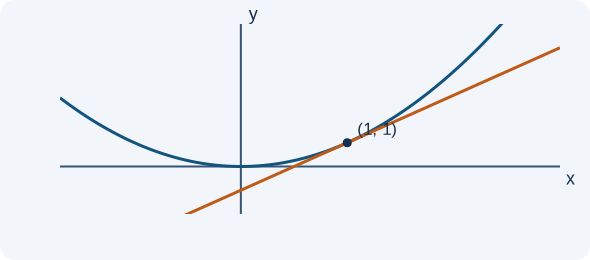
A tangent to y = x² at (1, 1) has the same gradient as the curve at the point.

A tangent to y = x² at (1, 1) has the same gradient as the curve at the point.

Practise the method

  1. For a single power, multiply its coefficient by the old exponent.
  2. Reduce that exponent by one. Repeat term by term, and replace every constant with zero.
  3. Substitute an x-value only after writing the gradient function.

Worked example

Use the curve and the tangent for different jobs

The curve is y=x2y=x^2. Find its height and gradient at x=1x=1.

  1. Substitute into the curve to obtain y=12=1y=1^2=1. The point has coordinates (1,1)(1,1).

  2. Differentiate the power x2x^2 to obtain dydx=2x\frac{\mathrm dy}{\mathrm dx}=2x.

  3. Set x=1x=1 in the derivative to get gradient 22. The curve passes through (1,1)(1,1) with tangent slope 22.

Your turn

For f(x)=2x3−5x+1f(x)=2x^3-5x+1, find the gradient at x=2x=2.

Enter one number. Fractions and decimals are accepted.

Worked example

Find and interpret a gradient function

A curve is defined by y=3x3+2x2−3x+1y=3 x^{3} + 2 x^{2} - 3 x + 1.

Find the gradient at the specified input. Use x=2x=2.

Try it on paper first.

  1. Substitute 22 into dydx\frac{\mathrm dy}{\mathrm dx} after differentiating.

  2. dydx∣x=2=41\frac{\mathrm dy}{\mathrm dx}\big|_{x=2}=41

  3. Answer: 4141.

Your turn

A curve is defined by y=x3−3x−9y=x^{3} - 3 x - 9.

Find the gradient at the specified input. Use x=−2x=-2.

Enter one number. Fractions and decimals are accepted.

Section 2 of 3 · Lesson · about 5 min

How do roots and reciprocals differentiate?

A root or a denominator can hide a power of x. Rewrite the expression on its domain so the usual rule is visible.

Practise the method

  1. Convert each root and reciprocal to a power.
  2. Multiply the original coefficient by the signed exponent and subtract one from that exponent.
  3. Re-express negative powers as fractions if convenient.

Worked example

Differentiate a reciprocal and a square root together

Find f′(x)f'(x) for f(x)=4x+3x2f(x)=4\sqrt{x}+\frac{3}{x^2} on x>0x>0.

  1. Rewrite the expression as 4x1/2+3x−24x^{1/2}+3x^{-2}.

  2. The first term contributes 4⋅12x1/2−1=2x−1/24\cdot\frac12x^{1/2-1}=2x^{-1/2}; the second contributes 3(−2)x−2−1=−6x−33(-2)x^{-2-1}=-6x^{-3}.

  3. So f′(x)=2x−6x3f'(x)=\frac{2}{\sqrt{x}}-\frac{6}{x^3} on the given domain.

Your turn

For f(x)=6x−8x2f(x)=6\sqrt{x}-\frac{8}{x^2}, find f′(4)f'(4).

Enter one number. Fractions and decimals are accepted.

Worked example

Find and interpret a gradient function

A curve is defined by y=7x+5x+9+5xy=7 \sqrt{x} + 5 x + 9 + \frac{5}{x}. The domain is x>0x>0.

Find the gradient at the specified input. Use x=1x=1.

Try it on paper first.

  1. Substitute 11 into dydx\frac{\mathrm dy}{\mathrm dx} after differentiating.

  2. dydx∣x=1=72\frac{\mathrm dy}{\mathrm dx}\big|_{x=1}=\frac{7}{2}

  3. Answer: 72\frac{7}{2}.

Your turn

A curve is defined by y=5x+4x+6+2xy=5 \sqrt{x} + 4 x + 6 + \frac{2}{x}. The domain is x>0x>0.

Find the gradient at the specified input. Use x=1x=1.

Enter an exact value or round to 3 significant figures.

Section 3 of 3 · Lesson · about 5 min

How does the sign describe the curve?

A signed derivative describes the direction of the graph as you move from left to right. The position of the point above or below the axis is independent.

Practise the method

  1. Find the derivative before looking for intervals.
  2. Find any zeros of the derivative, then choose a test input in each interval.
  3. Use the derivative signs to state increasing and decreasing intervals.

Worked example

Use signs on both sides of a zero

Where is f(x)=x2−4x+1f(x)=x^2-4x+1 decreasing?

  1. Differentiate to get f′(x)=2x−4=2(x−2)f'(x)=2x-4=2(x-2).

  2. For x<2x<2, the factor x−2x-2 is negative. For x>2x>2, it is positive.

  3. Therefore the function decreases on x<2x<2 and increases on x>2x>2. At x=2x=2, the tangent is horizontal.

Your turn

Find the values of x for which f(x)=3x−x2f(x)=3x-x^2 has positive gradient.

Give the complete set: {1, 4} for separate values, (1, 5] for an interval, U for union or empty for no real solutions. Use sqrt(...) for exact roots.

Worked example

Find and interpret a gradient function

A curve is defined by y=6x3+2x+21y=6 x^{3} + 2 x + 21.

Find the gradient at the specified input. Use x=1x=1.

Try it on paper first.

  1. Substitute 11 into dydx\frac{\mathrm dy}{\mathrm dx} after differentiating.

  2. dydx∣x=1=20\frac{\mathrm dy}{\mathrm dx}\big|_{x=1}=20

  3. Answer: 2020.

Your turn

A curve is defined by y=8x2+2x−6y=8 x^{2} + 2 x - 6.

Find the gradient at the specified input. Use x=5x=5.

Enter one number. Fractions and decimals are accepted.

Worked examples

Practise the method

Core practice

Question 1 of 5

0 / 5 checked in this collection

Question list

Core practice

Fresh variants

Exam-style

Find and interpret a gradient function

1 mark

A curve is defined by y=2x3−4x2+4x−2y=2 x^{3} - 4 x^{2} + 4 x - 2.

Find dydx\frac{\mathrm dy}{\mathrm dx}.

Enter an expression in x; use ^ for powers and / for fractions.

Full answer-format guide

Exact numbers: 3/2, sqrt(5), 2-sqrt(3), pi/6, 3*pi/2. Sets: {1,4}. Intervals: (3,5]; a round bracket excludes the endpoint. Infinity: inf; union: U; no solutions: empty. Separate coordinate pairs or triples with semicolons. Expressions: 2x^2+3x-1; equations: x^2=3x+1 or the polynomial equal to zero. Factors: x-1 ; x+2. Parameter fraction: numerator ; denominator. List integer answers individually.

Review the method

Progress stays in this browser. Create an account to save it or sign in.

Extra practice from this lesson

Find and interpret a gradient function

A curve is defined by y=3x3−7x2−7x−7y=3 x^{3} - 7 x^{2} - 7 x - 7.

Find dydx\frac{\mathrm dy}{\mathrm dx}.

Enter an expression in x; use ^ for powers and / for fractions.

Find and interpret a gradient function

A curve is defined by y=4x3+3x2−9x−7y=4 x^{3} + 3 x^{2} - 9 x - 7.

Find the gradient at the specified input. Use x=2x=2.

Enter one number. Fractions and decimals are accepted.

Find and interpret a gradient function

A curve is defined by y=8x+2x+7−8xy=8 \sqrt{x} + 2 x + 7 - \frac{8}{x}. The domain is x>0x>0.

Find dydx\frac{\mathrm dy}{\mathrm dx}.

Choose the complete result

Find and interpret a gradient function

A curve is defined by y=x−2x+8−2xy=\sqrt{x} - 2 x + 8 - \frac{2}{x}. The domain is x>0x>0.

Find the gradient at the specified input. Use x=16x=16.

Enter an exact value or round to 3 significant figures.

Find and interpret a gradient function

A curve is defined by y=x3+6x−18y=x^{3} + 6 x - 18.

Find dydx\frac{\mathrm dy}{\mathrm dx}.

Enter an expression in x; use ^ for powers and / for fractions.

Recover a coefficient from a gradient

Let f(x)=ax2−3xf(x)=ax^2-3x. The gradient at x=2x=2 is 9. Find a.

Enter one number. Fractions and decimals are accepted.

Previous checkpoints

Find and interpret a gradient function

A curve is defined by y=7x3−6x2−10x−7y=7 x^{3} - 6 x^{2} - 10 x - 7.

Find dydx\frac{\mathrm dy}{\mathrm dx}.

Enter an expression in x; use ^ for powers and / for fractions.

Find and interpret a gradient function

A curve is defined by y=8x−7x+3−4xy=8 \sqrt{x} - 7 x + 3 - \frac{4}{x}. The domain is x>0x>0.

Find dydx\frac{\mathrm dy}{\mathrm dx}.

Choose the complete result

Find and interpret a gradient function

A curve is defined by y=2x4+2x−12y=2 x^{4} + 2 x - 12.

Find dydx\frac{\mathrm dy}{\mathrm dx}.

Enter an expression in x; use ^ for powers and / for fractions.

Find and interpret a gradient function

A curve is defined by y=6x2+3x+10y=6 x^{2} + 3 x + 10.

Find the gradient at the specified input. Use x=3x=3.

Enter one number. Fractions and decimals are accepted.

Apply it · original exam-style problems

Show your working on paper and compare it with the worked solution and marking guidance.

Come back to what needs practice

Quick revision sheet (A4)

Your review plan starts after your first check.