Cambridge IGCSE Additional Mathematics (0606) · Calculus: Differentiation 1 · Quick revision
Gradient function and the power rule
What does a derivative tell you?
The derivative is a new function giving the gradient at each input where the tangent has a finite slope. For a power, where the derivative exists.
How do roots and reciprocals differentiate?
For positive x, use and . Keep the original domain when differentiating.
How does the sign describe the curve?
If on an interval, f increases there. If , f decreases. A zero derivative at one point gives a horizontal tangent.
Quick worked example
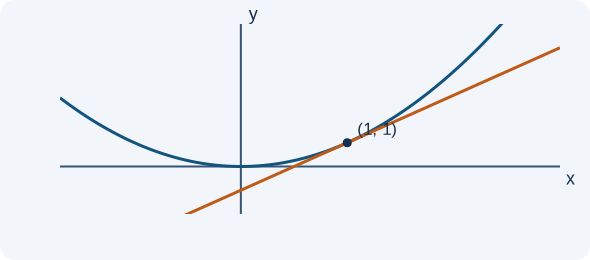
The curve is . Find its height and gradient at .
Substitute into the curve to obtain . The point has coordinates .
Differentiate the power to obtain .
Set in the derivative to get gradient . The curve passes through with tangent slope .