Cambridge IGCSE Additional Mathematics (0606) · Calculus: Differentiation 1 · Quick revision
Stationary points and classification
Why set the gradient equal to zero?
At a stationary point . Check all roots and substitute each valid x into .
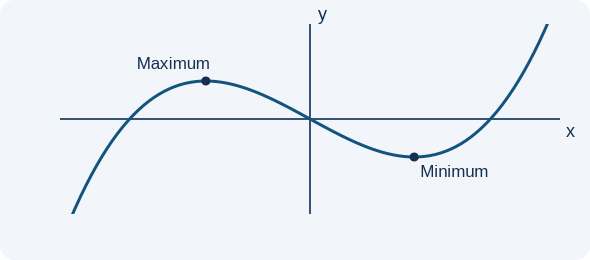
Which sign change gives a maximum?
changing from positive to negative gives a local maximum. A change from negative to positive gives a local minimum.
When is the second derivative test conclusive?
At , gives a local minimum and gives a local maximum. If , test the sign of on both sides.
Quick worked example
Find the stationary points of .
.
The derivative is zero at and .
The heights are and . The points are and .