Maths4UBETA

Line and circle intersections

Solve for both coordinates and interpret the number of intersections.

Try the quick check →
Lesson 2 of 4

Section 1 of 3 · Lesson · about 8 min

How does a horizontal line simplify the circle equation?

Every point on a horizontal line has the same y-value. Substituting it leaves an equation in x.

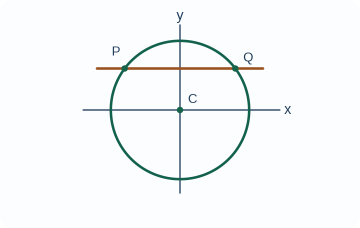
A circle cut by a horizontal line at P and Q

Substitute the same y-value to find both x-values.

Worked example

The two ends of a horizontal chord

A circle is given by (x−4)2+(y−3)2=25(x-4)^2+(y-3)^2=25. A line has equation y=6y=6.

  1. Find both points where the line crosses the circle.

    [2]
  2. Find the chord length.

    [2]
  3. Find the distance from the centre to the line.

    [2]
  1. (a) Substitute the given y-value. This gives (x−4)2=16(x-4)^2=16.

  2. The signed difference x−4x-4 can be 44 or −4-4.

  3. (0,6), (8,6)(0,6),\ (8,6)

  4. (b) The chord is horizontal, so subtract the smaller x-coordinate from the larger one.

  5. 88

  6. (c) The perpendicular to a horizontal line is vertical. Use the change between 33 and 66.

  7. 33

Your turn

A circle is given by (x−5)2+(y−3)2=25(x-5)^2+(y-3)^2=25. A line has equation y=6y=6.

Find both points where the line crosses the circle.

Enter a point as (1, 2) or x = 1, y = 2. Separate complete pairs with commas or semicolons.

Worked example

The two ends of a horizontal chord

A circle is given by (x−10)2+(y−3)2=25(x-10)^2+(y-3)^2=25. A line has equation y=6y=6.

  1. Find both points where the line crosses the circle.

    [2]
  2. Find the chord length.

    [2]
  3. Find the distance from the centre to the line.

    [2]

Try it on paper first.

  1. (a) Substitute the given y-value. This gives (x−10)2=16(x-10)^2=16.

  2. The signed difference x−10x-10 can be 44 or −4-4.

  3. (6,6), (14,6)(6,6),\ (14,6)

  4. (b) The chord is horizontal, so subtract the smaller x-coordinate from the larger one.

  5. 88

  6. (c) The perpendicular to a horizontal line is vertical. Use the change between 33 and 66.

  7. 33

Your turn

A circle is given by (x−7)2+(y−3)2=25(x-7)^2+(y-3)^2=25. A line has equation y=6y=6.

Find both points where the line crosses the circle.

Enter a point as (1, 2) or x = 1, y = 2. Separate complete pairs with commas or semicolons.

Section 2 of 3 · Lesson · about 8 min

How do I substitute a sloping line?

Replace y with its expression from the line. Then solve the resulting quadratic before finding y separately for each root.

Worked example

A diagonal through the centre

The line y=x+7y=x+7 meets the circle (x+1)2+(y−6)2=2(x+1)^2+(y-6)^2=2 in two points.

  1. Find both points of intersection.

    [2]
  2. Find the midpoint of the chord.

    [2]
  3. Explain why the chord is a diameter.

    [1]
  1. (a) From the line equation, y−6=x+1y-6=x+1.

  2. Substitute to get 2(x+1)2=22(x+1)^2=2. Solve with both signs and recover y from the line.

  3. (−2,5), (0,7)(-2,5),\ (0,7)

  4. (b) The two intersections have equal and opposite displacements from the centre.

  5. (−1,6)(-1,6)

  6. (c) The circle's centre lies on the line segment between its two boundary points.

  7. It passes through the centre of the circle.

Your turn

The line y=x+6y=x+6 meets the circle x2+(y−6)2=2x^2+(y-6)^2=2 in two points.

Find both points of intersection.

Enter a point as (1, 2) or x = 1, y = 2. Separate complete pairs with commas or semicolons.

Worked example

A diagonal through the centre

The line y=x+1y=x+1 meets the circle (x−5)2+(y−6)2=2(x-5)^2+(y-6)^2=2 in two points.

  1. Find both points of intersection.

    [2]
  2. Find the midpoint of the chord.

    [2]
  3. Explain why the chord is a diameter.

    [1]

Try it on paper first.

  1. (a) From the line equation, y−6=x−5y-6=x-5.

  2. Substitute to get 2(x−5)2=22(x-5)^2=2. Solve with both signs and recover y from the line.

  3. (4,5), (6,7)(4,5),\ (6,7)

  4. (b) The two intersections have equal and opposite displacements from the centre.

  5. (5,6)(5,6)

  6. (c) The circle's centre lies on the line segment between its two boundary points.

  7. It passes through the centre of the circle.

Your turn

The line y=x+4y=x+4 meets the circle (x−2)2+(y−6)2=2(x-2)^2+(y-6)^2=2 in two points.

Find both points of intersection.

Enter a point as (1, 2) or x = 1, y = 2. Separate complete pairs with commas or semicolons.

Section 3 of 3 · Further practice · about 8 min

How can I tell whether a line is a tangent?

Study the number of roots after substitution. A line and circle may share two points, one point or no point.

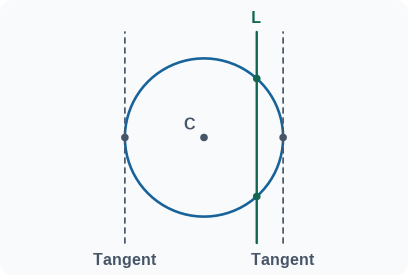
A solid vertical line L intersects a circle twice. The two dashed vertical tangents touch the circle once each.
Compare the horizontal distance from the centre to each vertical line with the radius.

Worked example

Does a vertical line meet the circle?

Let LL be the line x=−4x=-4 and let CC be the circle (x+6)2+(y−9)2=9(x+6)^2+(y-9)^2=9.

  1. How many distinct points do the line and circle share?

    [2]
  2. Give the equations of both vertical lines tangent to CC.

    [2]
  1. (a) Substitute into the circle to get (y−9)2=5(y-9)^2=5.

  2. A positive right-hand side gives two roots, zero gives one and a negative value gives none.

  3. 2 points.

  4. (b) Each tangent is horizontally 33 units from the centre.

  5. x=−9x=-9 and x=−3x=-3.

Your turn

Let LL be the line x=−3x=-3 and let CC be the circle (x+5)2+(y−9)2=9(x+5)^2+(y-9)^2=9.

How many distinct points do the line and circle share?

Choose one answer

Worked example

Does a vertical line meet the circle?

Let LL be the line x=2x=2 and let CC be the circle x2+(y−9)2=9x^2+(y-9)^2=9.

  1. How many distinct points do the line and circle share?

    [2]
  2. Give the equations of both vertical lines tangent to CC.

    [2]

Try it on paper first.

  1. (a) Substitute into the circle to get (y−9)2=5(y-9)^2=5.

  2. A positive right-hand side gives two roots, zero gives one and a negative value gives none.

  3. 2 points.

  4. (b) Each tangent is horizontally 33 units from the centre.

  5. x=−3x=-3 and x=3x=3.

Your turn

Let LL be the line x=−1x=-1 and let CC be the circle (x+3)2+(y−9)2=9(x+3)^2+(y-9)^2=9.

How many distinct points do the line and circle share?

Choose one answer

Worked examples

Practise the method

Core practice

Question 1 of 5

0 / 5 checked in this collection

Question list

Core practice

Fresh variants

Exam-style

The two ends of a horizontal chord

1 mark

A circle is given by (x+3)2+(y+6)2=225(x+3)^2+(y+6)^2=225. A line has equation y=3y=3.

Find both points where the line crosses the circle.

Enter a point as (1, 2) or x = 1, y = 2. Separate complete pairs with commas or semicolons.

Full answer-format guide

Exact numbers: 3/2, sqrt(5), 2-sqrt(3), pi/6, 3*pi/2. Sets: {1,4}. Intervals: (3,5]; a round bracket excludes the endpoint. Infinity: inf; union: U; no solutions: empty. Separate coordinate pairs or triples with semicolons. Expressions: 2x^2+3x-1; equations: x^2=3x+1 or the polynomial equal to zero. Factors: x-1 ; x+2. Parameter fraction: numerator ; denominator. List integer answers individually.

Review the method

Progress stays in this browser. Create an account to save it or sign in.

Extra practice from this lesson

A circle is given by (x+6)2+(y−4)2=25(x+6)^2+(y-4)^2=25. A line has equation y=7y=7.

Find both points where the line crosses the circle.

Enter a point as (1, 2) or x = 1, y = 2. Separate complete pairs with commas or semicolons.

A circle is given by (x+5)2+(y−4)2=25(x+5)^2+(y-4)^2=25. A line has equation y=7y=7.

Find both points where the line crosses the circle.

Enter a point as (1, 2) or x = 1, y = 2. Separate complete pairs with commas or semicolons.

The line y=x−2y=x-2 meets the circle (x−8)2+(y−6)2=2(x-8)^2+(y-6)^2=2 in two points.

Find both points of intersection.

Enter a point as (1, 2) or x = 1, y = 2. Separate complete pairs with commas or semicolons.

The line y=x−3y=x-3 meets the circle (x−9)2+(y−6)2=2(x-9)^2+(y-6)^2=2 in two points.

Find both points of intersection.

Enter a point as (1, 2) or x = 1, y = 2. Separate complete pairs with commas or semicolons.

Let LL be the line x=6x=6 and let CC be the circle (x−3)2+(y−9)2=9(x-3)^2+(y-9)^2=9.

How many distinct points do the line and circle share?

Choose one answer

Let LL be the line x=7x=7 and let CC be the circle (x−4)2+(y−9)2=9(x-4)^2+(y-9)^2=9.

How many distinct points do the line and circle share?

Choose one answer

Apply it · original exam-style problems

Show your working on paper and compare it with the worked solution and marking guidance.

Come back to what needs practice

Quick revision sheet (A4)

Your review plan starts after your first check.