Maths4UBETA

Equations of circle tangents

Use the radius direction and point of contact to write a tangent equation.

Try the quick check →
Lesson 3 of 4

Section 1 of 3 · Lesson · about 8 min

Which gradient belongs to the tangent?

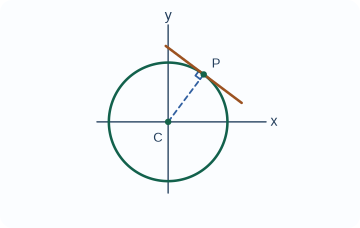
Mark the centre and point of contact. The radius between them is perpendicular to the tangent.

A tangent perpendicular to the radius at P

At P the tangent has a right angle with the radius.

Worked example

The tangent perpendicular to a sloping radius

A circle has equation (x+2)2+(y−4)2=25(x+2)^2+(y-4)^2=25. The point P(1,8)P(1,8) lies on the circle.

  1. Find the equation of the tangent at PP.

    [3]
  2. Find the y-intercept of the tangent.

    [2]
  1. (a) The radius from (−2,4)(-2,4) to (1,8)(1,8) has gradient 43\frac{4}{3}.

  2. The tangent has gradient −34-\frac{3}{4}. Substitute the point of contact into y=mx+cy=mx+c to get c=354c=\frac{35}{4}.

  3. y=−34x+354y=-\frac{3}{4}x+\frac{35}{4}

  4. (b) Use x=0x=0 in y=−34x+354y=-\frac{3}{4}x+\frac{35}{4} to obtain y=354y=\frac{35}{4}.

  5. (0,354)(0,\frac{35}{4})

Your turn

A circle has equation (x+1)2+(y−4)2=25(x+1)^2+(y-4)^2=25. The point P(2,8)P(2,8) lies on the circle.

Find the equation of the tangent at PP.

Enter both sides of the equation or give an expression equal to zero. Use ^ for powers and / for fractions.

Worked example

The tangent perpendicular to a sloping radius

A circle has equation (x−4)2+(y−4)2=25(x-4)^2+(y-4)^2=25. The point P(7,8)P(7,8) lies on the circle.

  1. Find the equation of the tangent at PP.

    [3]
  2. Find the y-intercept of the tangent.

    [2]

Try it on paper first.

  1. (a) The radius from (4,4)(4,4) to (7,8)(7,8) has gradient 43\frac{4}{3}.

  2. The tangent has gradient −34-\frac{3}{4}. Substitute the point of contact into y=mx+cy=mx+c to get c=534c=\frac{53}{4}.

  3. y=−34x+534y=-\frac{3}{4}x+\frac{53}{4}

  4. (b) Use x=0x=0 in y=−34x+534y=-\frac{3}{4}x+\frac{53}{4} to obtain y=534y=\frac{53}{4}.

  5. (0,534)(0,\frac{53}{4})

Your turn

A circle has equation (x−1)2+(y−4)2=25(x-1)^2+(y-4)^2=25. The point P(4,8)P(4,8) lies on the circle.

Find the equation of the tangent at PP.

Enter both sides of the equation or give an expression equal to zero. Use ^ for powers and / for fractions.

Section 2 of 3 · Lesson · about 8 min

What if a radius is horizontal or vertical?

Use direction rather than a reciprocal when a gradient is zero or undefined.

Worked example

Tangent at the end of a vertical radius

A circle has equation (x+7)2+(y−7)2=4(x+7)^2+(y-7)^2=4 and is tangent to a line at P(−7,5)P(-7,5).

  1. Find the equation of the tangent.

    [2]
  2. Find the point of contact of the parallel tangent.

    [2]
  3. Give the distance between the parallel tangents.

    [2]
  1. (a) The centre is (−7,7)(-7,7). The radius to PP is vertical, so the tangent is horizontal.

  2. y=5y=5

  3. (b) The second point lies the same distance 22 from the centre on the opposite side.

  4. (−7,9)(-7,9)

  5. (c) The vertical separation is the diameter of the circle.

  6. 44

Your turn

A circle has equation (x+6)2+(y−7)2=4(x+6)^2+(y-7)^2=4 and is tangent to a line at P(−6,5)P(-6,5).

Find the equation of the tangent.

Enter both sides of the equation or give an expression equal to zero. Use ^ for powers and / for fractions.

Worked example

Tangent at the end of a vertical radius

A circle has equation (x+1)2+(y−7)2=4(x+1)^2+(y-7)^2=4 and is tangent to a line at P(−1,9)P(-1,9).

  1. Find the equation of the tangent.

    [2]
  2. Find the point of contact of the parallel tangent.

    [2]
  3. Give the distance between the parallel tangents.

    [2]

Try it on paper first.

  1. (a) The centre is (−1,7)(-1,7). The radius to PP is vertical, so the tangent is horizontal.

  2. y=9y=9

  3. (b) The second point lies the same distance 22 from the centre on the opposite side.

  4. (−1,5)(-1,5)

  5. (c) The vertical separation is the diameter of the circle.

  6. 44

Your turn

A circle has equation (x+4)2+(y−7)2=4(x+4)^2+(y-7)^2=4 and is tangent to a line at P(−4,5)P(-4,5).

Find the equation of the tangent.

Enter both sides of the equation or give an expression equal to zero. Use ^ for powers and / for fractions.

Section 3 of 3 · Further practice · about 8 min

Where is a second parallel tangent?

All radii to parallel tangents have the same line direction. Their contact points lie at opposite ends of a diameter.

Worked example

Two parallel tangents to a circle

A circle has equation (x−7)2+(y−9)2=25(x-7)^2+(y-9)^2=25. The point P(10,13)P(10,13) lies on the circle.

  1. Find the equation of the tangent at PP.

    [3]
  2. Find the contact point of the other tangent parallel to it.

    [2]
  3. Find the equation of the other tangent.

    [2]
  1. (a) The radius from (7,9)(7,9) to (10,13)(10,13) has gradient 43\frac{4}{3}.

  2. The tangent has gradient −34-\frac{3}{4}. Substitute the point of contact into y=mx+cy=mx+c to get c=412c=\frac{41}{2}.

  3. y=−34x+412y=-\frac{3}{4}x+\frac{41}{2}

  4. (b) The radius to a parallel tangent is along the same diameter. Reflect PP in the centre.

  5. (4,5)(4,5)

  6. (c) The slope stays −34-\frac{3}{4}. Use the new contact point (4,5)(4,5).

  7. y=−34x+8y=-\frac{3}{4}x+8

Your turn

A circle has equation (x−8)2+(y−9)2=25(x-8)^2+(y-9)^2=25. The point P(11,5)P(11,5) lies on the circle.

Find the equation of the tangent at PP.

Enter both sides of the equation or give an expression equal to zero. Use ^ for powers and / for fractions.

Worked example

Two parallel tangents to a circle

A circle has equation (x+6)2+(y−10)2=25(x+6)^2+(y-10)^2=25. The point P(−3,6)P(-3,6) lies on the circle.

  1. Find the equation of the tangent at PP.

    [3]
  2. Find the contact point of the other tangent parallel to it.

    [2]
  3. Find the equation of the other tangent.

    [2]

Try it on paper first.

  1. (a) The radius from (−6,10)(-6,10) to (−3,6)(-3,6) has gradient −43-\frac{4}{3}.

  2. The tangent has gradient 34\frac{3}{4}. Substitute the point of contact into y=mx+cy=mx+c to get c=334c=\frac{33}{4}.

  3. y=34x+334y=\frac{3}{4}x+\frac{33}{4}

  4. (b) The radius to a parallel tangent is along the same diameter. Reflect PP in the centre.

  5. (−9,14)(-9,14)

  6. (c) The slope stays 34\frac{3}{4}. Use the new contact point (−9,14)(-9,14).

  7. y=34x+834y=\frac{3}{4}x+\frac{83}{4}

Your turn

A circle has equation (x−10)2+(y−9)2=25(x-10)^2+(y-9)^2=25. The point P(13,5)P(13,5) lies on the circle.

Find the equation of the tangent at PP.

Enter both sides of the equation or give an expression equal to zero. Use ^ for powers and / for fractions.

Worked examples

Practise the method

Core practice

Question 1 of 5

0 / 5 checked in this collection

Question list

Core practice

Fresh variants

Exam-style

The tangent perpendicular to a sloping radius

1 mark

A circle has equation (x−10)2+(y+4)2=225(x-10)^2+(y+4)^2=225. The point P(19,8)P(19,8) lies on the circle.

Find the equation of the tangent at PP.

Enter both sides of the equation or give an expression equal to zero. Use ^ for powers and / for fractions.

Full answer-format guide

Exact numbers: 3/2, sqrt(5), 2-sqrt(3), pi/6, 3*pi/2. Sets: {1,4}. Intervals: (3,5]; a round bracket excludes the endpoint. Infinity: inf; union: U; no solutions: empty. Separate coordinate pairs or triples with semicolons. Expressions: 2x^2+3x-1; equations: x^2=3x+1 or the polynomial equal to zero. Factors: x-1 ; x+2. Parameter fraction: numerator ; denominator. List integer answers individually.

Review the method

Progress stays in this browser. Create an account to save it or sign in.

Extra practice from this lesson

A circle has equation (x−7)2+(y−4)2=25(x-7)^2+(y-4)^2=25. The point P(10,0)P(10,0) lies on the circle.

Find the equation of the tangent at PP.

Enter both sides of the equation or give an expression equal to zero. Use ^ for powers and / for fractions.

A circle has equation (x−8)2+(y−4)2=25(x-8)^2+(y-4)^2=25. The point P(11,0)P(11,0) lies on the circle.

Find the equation of the tangent at PP.

Enter both sides of the equation or give an expression equal to zero. Use ^ for powers and / for fractions.

A circle has equation (x−2)2+(y−7)2=4(x-2)^2+(y-7)^2=4 and is tangent to a line at P(2,9)P(2,9).

Find the equation of the tangent.

Enter both sides of the equation or give an expression equal to zero. Use ^ for powers and / for fractions.

A circle has equation (x−3)2+(y−7)2=4(x-3)^2+(y-7)^2=4 and is tangent to a line at P(3,9)P(3,9).

Find the equation of the tangent.

Enter both sides of the equation or give an expression equal to zero. Use ^ for powers and / for fractions.

A circle has equation (x+3)2+(y−10)2=25(x+3)^2+(y-10)^2=25. The point P(0,14)P(0,14) lies on the circle.

Find the equation of the tangent at PP.

Enter both sides of the equation or give an expression equal to zero. Use ^ for powers and / for fractions.

A circle has equation (x+2)2+(y−10)2=25(x+2)^2+(y-10)^2=25. The point P(1,14)P(1,14) lies on the circle.

Find the equation of the tangent at PP.

Enter both sides of the equation or give an expression equal to zero. Use ^ for powers and / for fractions.

Apply it · original exam-style problems

Show your working on paper and compare it with the worked solution and marking guidance.

Come back to what needs practice

Quick revision sheet (A4)

Your review plan starts after your first check.