Maths4UBETA

Centre, radius and the equation of a circle

Translate between the geometry and both common equation forms.

Try the quick check →
Lesson 1 of 4

Section 1 of 3 · Lesson · about 8 min

Where are the centre and radius in the equation?

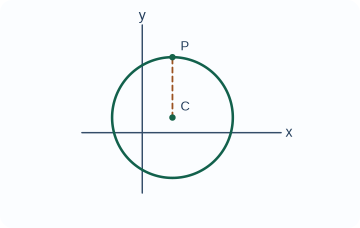
The distance from a point on the boundary to the centre is fixed. Squaring the distance gives the equation.

Circle with centre C and a radius to P

Every point on the circumference has the same distance from C.

Worked example

The centre hidden in an expanded circle

A circle has the equation x2+y2−20x−4y−65=0x^2+y^2-20x-4y-65=0.

  1. Give the coordinates of its centre.

    [2]
  2. Find the radius.

    [2]
  3. Write the equation in centre–radius form.

    [2]
  1. (a) Complete the square separately in x and y to get (x−10)2+(y−2)2=169(x-10)^2+(y-2)^2=169.

  2. Read each coordinate with the sign opposite to the constant in its bracket.

  3. (10,2)(10,2)

  4. (b) Completing the squares gives (x−10)2+(y−2)2=169(x-10)^2+(y-2)^2=169. The positive square root of 169169 is 1313.

  5. 1313

  6. (c) The centre is (10,2)(10,2) and the squared radius is 169169.

  7. Use (x−h)2+(y−k)2=r2(x-h)^2+(y-k)^2=r^2.

  8. (x−10)2+(y−2)2=169(x-10)^2+(y-2)^2=169

Your turn

A circle has the equation x2+y2+16x−6y−96=0x^2+y^2+16x-6y-96=0.

Give the coordinates of its centre.

Enter a point as (1, 2) or x = 1, y = 2. Separate complete pairs with commas or semicolons.

Worked example

The centre hidden in an expanded circle

A circle has the equation x2+y2+6x−6y−151=0x^2+y^2+6x-6y-151=0.

  1. Give the coordinates of its centre.

    [2]
  2. Find the radius.

    [2]
  3. Write the equation in centre–radius form.

    [2]

Try it on paper first.

  1. (a) Complete the square separately in x and y to get (x+3)2+(y−3)2=169(x+3)^2+(y-3)^2=169.

  2. Read each coordinate with the sign opposite to the constant in its bracket.

  3. (−3,3)(-3,3)

  4. (b) Completing the squares gives (x+3)2+(y−3)2=169(x+3)^2+(y-3)^2=169. The positive square root of 169169 is 1313.

  5. 1313

  6. (c) The centre is (−3,3)(-3,3) and the squared radius is 169169.

  7. Use (x−h)2+(y−k)2=r2(x-h)^2+(y-k)^2=r^2.

  8. (x+3)2+(y−3)2=169(x+3)^2+(y-3)^2=169

Your turn

A circle has the equation x2+y2+12x−6y−124=0x^2+y^2+12x-6y-124=0.

Give the coordinates of its centre.

Enter a point as (1, 2) or x = 1, y = 2. Separate complete pairs with commas or semicolons.

Section 2 of 3 · Lesson · about 8 min

How can a diameter tell me the centre?

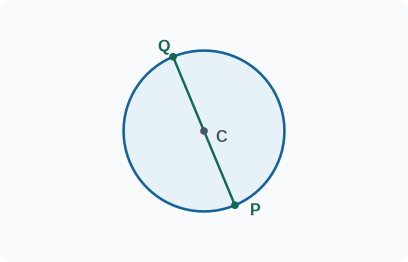
The centre lies halfway between the two ends. Use the midpoint first, then find the distance from there to either end.

A segment from P to Q passes through C at the midpoint. P and Q lie on the circle.
Find the midpoint first. The radius is the distance from that midpoint to either endpoint.

Worked example

Find a circle from the ends of its diameter

The points P(10,−7)P(10,-7) and Q(0,17)Q(0,17) are the ends of a circle's diameter.

  1. Find the centre.

    [2]
  2. Find the squared radius.

    [2]
  3. Write the equation in centre–radius form.

    [2]
  1. (a) Average the x-coordinates of the endpoints and average their y-coordinates.

  2. (5,5)(5,5)

  3. (b) From (5,5)(5,5) to (10,−7)(10,-7), the coordinate changes are 55 and −12-12.

  4. Add their squares to get 169169.

  5. 169169

  6. (c) The centre is (5,5)(5,5) and the squared radius is 169169.

  7. Use (x−h)2+(y−k)2=r2(x-h)^2+(y-k)^2=r^2.

  8. (x−5)2+(y−5)2=169(x-5)^2+(y-5)^2=169

Your turn

The points P(11,−7)P(11,-7) and Q(1,17)Q(1,17) are the ends of a circle's diameter.

Find the centre.

Enter a point as (1, 2) or x = 1, y = 2. Separate complete pairs with commas or semicolons.

Worked example

Find a circle from the ends of its diameter

The points P(−3,−6)P(-3,-6) and Q(−13,18)Q(-13,18) are the ends of a circle's diameter.

  1. Find the centre.

    [2]
  2. Find the squared radius.

    [2]
  3. Write the equation in centre–radius form.

    [2]

Try it on paper first.

  1. (a) Average the x-coordinates of the endpoints and average their y-coordinates.

  2. (−8,6)(-8,6)

  3. (b) From (−8,6)(-8,6) to (−3,−6)(-3,-6), the coordinate changes are 55 and −12-12.

  4. Add their squares to get 169169.

  5. 169169

  6. (c) The centre is (−8,6)(-8,6) and the squared radius is 169169.

  7. Use (x−h)2+(y−k)2=r2(x-h)^2+(y-k)^2=r^2.

  8. (x+8)2+(y−6)2=169(x+8)^2+(y-6)^2=169

Your turn

The points P(13,−7)P(13,-7) and Q(3,17)Q(3,17) are the ends of a circle's diameter.

Find the centre.

Enter a point as (1, 2) or x = 1, y = 2. Separate complete pairs with commas or semicolons.

Section 3 of 3 · Further practice · about 8 min

How do I use a point on the circle?

Subtract matched coordinates from centre to point. Pythagoras uses these signed changes after squaring.

Worked example

From a centre and a boundary point

A circle with centre C(0,8)C(0,8) passes through P(5,−4)P(5,-4).

  1. Find its radius.

    [2]
  2. Write the equation in centre–radius form.

    [2]
  3. Write the equation in expanded form.

    [2]
  1. (a) The displacement from centre to boundary has components 55 and −12-12. Use Pythagoras for its length.

  2. 1313

  3. (b) The centre is (0,8)(0,8) and the squared radius is 169169.

  4. Use (x−h)2+(y−k)2=r2(x-h)^2+(y-k)^2=r^2.

  5. x2+(y−8)2=169x^2+(y-8)^2=169

  6. (c) Expand both squared brackets in x2+(y−8)2=169x^2+(y-8)^2=169, then bring the constant to the left.

  7. x2+y2−16y−105=0x^2+y^2-16y-105=0

Your turn

A circle with centre C(1,8)C(1,8) passes through P(6,−4)P(6,-4).

Find its radius.

Enter one number. Fractions and decimals are accepted.

Worked example

From a centre and a boundary point

A circle with centre C(6,8)C(6,8) passes through P(11,−4)P(11,-4).

  1. Find its radius.

    [2]
  2. Write the equation in centre–radius form.

    [2]
  3. Write the equation in expanded form.

    [2]

Try it on paper first.

  1. (a) The displacement from centre to boundary has components 55 and −12-12. Use Pythagoras for its length.

  2. 1313

  3. (b) The centre is (6,8)(6,8) and the squared radius is 169169.

  4. Use (x−h)2+(y−k)2=r2(x-h)^2+(y-k)^2=r^2.

  5. (x−6)2+(y−8)2=169(x-6)^2+(y-8)^2=169

  6. (c) Expand both squared brackets in (x−6)2+(y−8)2=169(x-6)^2+(y-8)^2=169, then bring the constant to the left.

  7. x2+y2−12x−16y−69=0x^2+y^2-12x-16y-69=0

Your turn

A circle with centre C(3,8)C(3,8) passes through P(8,−4)P(8,-4).

Find its radius.

Enter one number. Fractions and decimals are accepted.

Worked examples

Practise the method

Core practice

Question 1 of 5

0 / 5 checked in this collection

Question list

Core practice

Fresh variants

Exam-style

The centre hidden in an expanded circle

1 mark

A circle has the equation x2+y2−6x−16y−603=0x^2+y^2-6x-16y-603=0.

Give the coordinates of its centre.

Enter a point as (1, 2) or x = 1, y = 2. Separate complete pairs with commas or semicolons.

Full answer-format guide

Exact numbers: 3/2, sqrt(5), 2-sqrt(3), pi/6, 3*pi/2. Sets: {1,4}. Intervals: (3,5]; a round bracket excludes the endpoint. Infinity: inf; union: U; no solutions: empty. Separate coordinate pairs or triples with semicolons. Expressions: 2x^2+3x-1; equations: x^2=3x+1 or the polynomial equal to zero. Factors: x-1 ; x+2. Parameter fraction: numerator ; denominator. List integer answers individually.

Review the method

Progress stays in this browser. Create an account to save it or sign in.

Extra practice from this lesson

A circle has the equation x2+y2−6y−160=0x^2+y^2-6y-160=0.

Give the coordinates of its centre.

Enter a point as (1, 2) or x = 1, y = 2. Separate complete pairs with commas or semicolons.

A circle has the equation x2+y2−2x−6y−159=0x^2+y^2-2x-6y-159=0.

Give the coordinates of its centre.

Enter a point as (1, 2) or x = 1, y = 2. Separate complete pairs with commas or semicolons.

The points P(0,−6)P(0,-6) and Q(−10,18)Q(-10,18) are the ends of a circle's diameter.

Find the centre.

Enter a point as (1, 2) or x = 1, y = 2. Separate complete pairs with commas or semicolons.

The points P(1,−6)P(1,-6) and Q(−9,18)Q(-9,18) are the ends of a circle's diameter.

Find the centre.

Enter a point as (1, 2) or x = 1, y = 2. Separate complete pairs with commas or semicolons.

A circle with centre C(9,8)C(9,8) passes through P(14,−4)P(14,-4).

Find its radius.

Enter one number. Fractions and decimals are accepted.

A circle with centre C(10,8)C(10,8) passes through P(15,−4)P(15,-4).

Find its radius.

Enter one number. Fractions and decimals are accepted.

Apply it · original exam-style problems

Show your working on paper and compare it with the worked solution and marking guidance.

Come back to what needs practice

Quick revision sheet (A4)

Your review plan starts after your first check.