Maths4UBETA

Trigonometric equations

Isolate sine, cosine or tangent and use its graph to find every solution in a full turn.

Try the quick check →
Lesson 7 of 10

Section 1 of 3 · Extension · about 6 min

How do I turn an equation into a graph problem?

An equation such as 2sin⁡x=12\sin x=1 asks where the sine curve reaches a particular height.

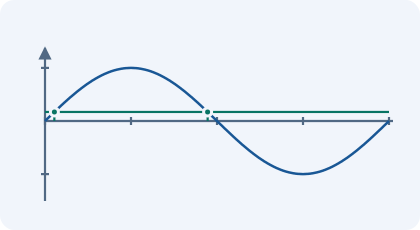
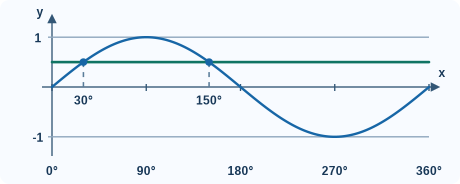
A horizontal line above zero meets the sine curve twice between 0 and 180 degrees.

Read the two x-coordinates where a positive horizontal line meets the sine curve.

Worked example

Solve for every angle on a full turn

Solve 3sin⁡x=−323\sin x=- \frac{3}{2} for 0∘≤x≤360∘0^\circ\le x\le360^\circ. Give any non-integer angle to 1 decimal place.

  1. Isolate the trigonometric term to get sin⁡x=−12\sin x=- \frac{1}{2}.

  2. A principal solution is x=−30∘x=-30^\circ.

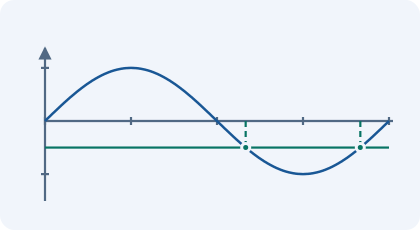
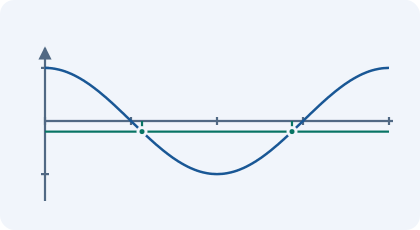
  3. Draw the horizontal line on sine. Include both crossings in the matching half-turn and any endpoints that work.

  4. Take 180∘+30.0∘180^\circ+30.0^\circ and 360∘−30.0∘360^\circ-30.0^\circ in the negative half-turn.

  5. Solutions {210∘,330∘}\{210^\circ, 330^\circ\}.

  6. The sin graph from 0 to 360 degrees. The marked angles are 210 degrees, 330 degrees.

Your turn

Solve 9sin⁡x=9229\sin x=\frac{9 \sqrt{2}}{2} for 0∘≤x≤360∘0^\circ\le x\le360^\circ. Give any non-integer angle to 1 decimal place.

Give the complete set: {1, 4} for separate values, (1, 5] for an interval, U for union or empty for no real solutions. Use sqrt(...) for exact roots.

Worked example

Solve for every angle on a full turn

Solve 2sin⁡x+6=317502\sin x+6=\frac{317}{50} for 0∘≤x≤360∘0^\circ\le x\le360^\circ. Give any non-integer angle to 1 decimal place.

Try it on paper first.

  1. Isolate the trigonometric term to get sin⁡x=17100\sin x=\frac{17}{100}.

  2. A principal solution is x=9.7878∘x=9.7878^\circ (before final rounding).

  3. Draw the horizontal line on sine. Include both crossings in the matching half-turn and any endpoints that work.

  4. The other sine angle is 180∘−9.7878∘180^\circ-9.7878^\circ.

  5. Solutions {9.8∘,170.2∘}\{9.8^\circ, 170.2^\circ\}.

  6. The sin graph from 0 to 360 degrees. The marked angles are 9.8 degrees, 170.2 degrees.

Your turn

Solve 2sin⁡x+9=207252\sin x+9=\frac{207}{25} for 0∘≤x≤360∘0^\circ\le x\le360^\circ. Give any non-integer angle to 1 decimal place.

Give the complete set: {1, 4} for separate values, (1, 5] for an interval, U for union or empty for no real solutions. Use sqrt(...) for exact roots.

Section 2 of 3 · Extension · about 7 min

How do cosine symmetry and tangent's period help?

Cosine has symmetry about x=180∘x=180^\circ. Tangent repeats at intervals of 180°.

Worked example

Solve for every angle on a full turn

Solve 3cos⁡x+7=1123\cos x+7=\frac{11}{2} for 0∘≤x≤360∘0^\circ\le x\le360^\circ. Give any non-integer angle to 1 decimal place.

  1. Isolate the trigonometric term to get cos⁡x=−12\cos x=- \frac{1}{2}.

  2. A principal solution is x=120∘x=120^\circ.

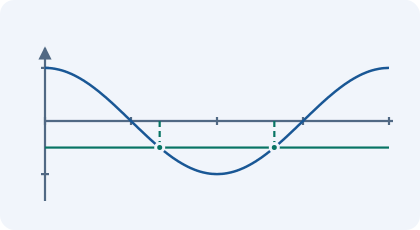
  3. Draw the horizontal line on cosine. Use the two sides of the mirror line through 180В° when both are distinct.

  4. The other cosine angle is 360∘−120∘360^\circ-120^\circ.

  5. Solutions {120∘,240∘}\{120^\circ, 240^\circ\}.

  6. The cos graph from 0 to 360 degrees. The marked angles are 120 degrees, 240 degrees.

Your turn

Solve 10cos⁡x+2=2+5310\cos x+2=2 + 5 \sqrt{3} for 0∘≤x≤360∘0^\circ\le x\le360^\circ. Give any non-integer angle to 1 decimal place.

Give the complete set: {1, 4} for separate values, (1, 5] for an interval, U for union or empty for no real solutions. Use sqrt(...) for exact roots.

Worked example

Solve for every angle on a full turn

Solve 4tan⁡x=4334\tan x=\frac{4 \sqrt{3}}{3} for 0∘≤x≤360∘0^\circ\le x\le360^\circ. Give any non-integer angle to 1 decimal place.

Try it on paper first.

  1. Isolate the trigonometric term to get tan⁡x=33\tan x=\frac{\sqrt{3}}{3}.

  2. A principal solution is x=30∘x=30^\circ.

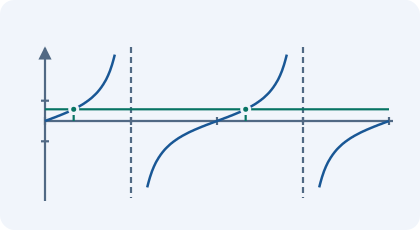
  3. Use the tangent branches separated by 180В°. Include a boundary only when its tangent equals the required value.

  4. Repeat the principal angle after 180° to obtain 180∘+30∘180^\circ+30^\circ.

  5. Solutions {30∘,210∘}\{30^\circ, 210^\circ\}.

  6. The tan graph from 0 to 360 degrees. The marked angles are 30 degrees, 210 degrees.

Your turn

Solve 10tan⁡x=−1010\tan x=-10 for 0∘≤x≤360∘0^\circ\le x\le360^\circ. Give any non-integer angle to 1 decimal place.

Give the complete set: {1, 4} for separate values, (1, 5] for an interval, U for union or empty for no real solutions. Use sqrt(...) for exact roots.

Section 3 of 3 · Extension · about 8 min

What happens at the endpoints or at rounded values?

A full turn from 0° to 360° includes both endpoints when the inequality allows equality.

Worked example

Solve for every angle on a full turn

Solve 2cos⁡x=−252\cos x=- \frac{2}{5} for 0∘≤x≤360∘0^\circ\le x\le360^\circ. Give any non-integer angle to 1 decimal place.

  1. Isolate the trigonometric term to get cos⁡x=−15\cos x=- \frac{1}{5}.

  2. A principal solution is x=101.537∘x=101.537^\circ (before final rounding).

  3. Draw the horizontal line on cosine. Use the two sides of the mirror line through 180В° when both are distinct.

  4. The other cosine angle is 360∘−101.537∘360^\circ-101.537^\circ.

  5. Solutions {101.5∘,258.5∘}\{101.5^\circ, 258.5^\circ\}.

  6. The cos graph from 0 to 360 degrees. The marked angles are 101.5 degrees, 258.5 degrees.

Your turn

Solve 2cos⁡x=39502\cos x=\frac{39}{50} for 0∘≤x≤360∘0^\circ\le x\le360^\circ. Give any non-integer angle to 1 decimal place.

Give the complete set: {1, 4} for separate values, (1, 5] for an interval, U for union or empty for no real solutions. Use sqrt(...) for exact roots.

Worked example

Solve for every angle on a full turn

Solve 2tan⁡x+2=22\tan x+2=2 for 0∘≤x≤360∘0^\circ\le x\le360^\circ. Give any non-integer angle to 1 decimal place.

Try it on paper first.

  1. Isolate the trigonometric term to get tan⁡x=0\tan x=0.

  2. A principal solution is x=0∘x=0^\circ.

  3. Use the tangent branches separated by 180В°. Include a boundary only when its tangent equals the required value.

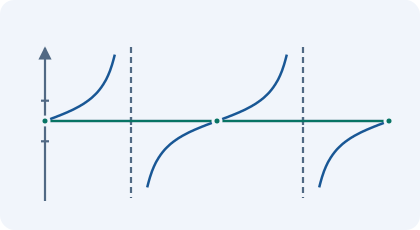
  4. Include all the zeros of the graph on the closed interval.

  5. Solutions {0∘,180∘,360∘}\{0^\circ, 180^\circ, 360^\circ\}.

  6. The tan graph from 0 to 360 degrees. The marked angles are 0 degrees, 180 degrees, 360 degrees.

Your turn

Solve 5sin⁡x+5=05\sin x+5=0 for 0∘≤x≤360∘0^\circ\le x\le360^\circ. Give any non-integer angle to 1 decimal place.

Give the complete set: {1, 4} for separate values, (1, 5] for an interval, U for union or empty for no real solutions. Use sqrt(...) for exact roots.

Worked examples

Practise the method

Core practice

Question 1 of 5

0 / 5 checked in this collection

Question list

Core practice

Fresh variants

Exam-style

Solve for every angle on a full turn

1 mark

Solve 27sin⁡x=−27227\sin x=- \frac{27}{2} for 0∘≤x≤360∘0^\circ\le x\le360^\circ. Give any non-integer angle to 1 decimal place.

Give the complete set: {1, 4} for separate values, (1, 5] for an interval, U for union or empty for no real solutions. Use sqrt(...) for exact roots.

Full answer-format guide

Exact numbers: 3/2, sqrt(5), 2-sqrt(3), pi/6, 3*pi/2. Sets: {1,4}. Intervals: (3,5]; a round bracket excludes the endpoint. Infinity: inf; union: U; no solutions: empty. Separate coordinate pairs or triples with semicolons. Expressions: 2x^2+3x-1; equations: x^2=3x+1 or the polynomial equal to zero. Factors: x-1 ; x+2. Parameter fraction: numerator ; denominator. List integer answers individually.

Review the method

Progress stays in this browser. Create an account to save it or sign in.

Extra practice from this lesson

Solve for every angle on a full turn

Solve 19sin⁡x=−19219\sin x=- \frac{19}{2} for 0∘≤x≤360∘0^\circ\le x\le360^\circ. Give any non-integer angle to 1 decimal place.

Give the complete set: {1, 4} for separate values, (1, 5] for an interval, U for union or empty for no real solutions. Use sqrt(...) for exact roots.

Solve for every angle on a full turn

Solve 2sin⁡x+6=73102\sin x+6=\frac{73}{10} for 0∘≤x≤360∘0^\circ\le x\le360^\circ. Give any non-integer angle to 1 decimal place.

Give the complete set: {1, 4} for separate values, (1, 5] for an interval, U for union or empty for no real solutions. Use sqrt(...) for exact roots.

Solve for every angle on a full turn

Solve 19cos⁡x+7=−5219\cos x+7=- \frac{5}{2} for 0∘≤x≤360∘0^\circ\le x\le360^\circ. Give any non-integer angle to 1 decimal place.

Give the complete set: {1, 4} for separate values, (1, 5] for an interval, U for union or empty for no real solutions. Use sqrt(...) for exact roots.

Solve for every angle on a full turn

Solve 20tan⁡x=203320\tan x=\frac{20 \sqrt{3}}{3} for 0∘≤x≤360∘0^\circ\le x\le360^\circ. Give any non-integer angle to 1 decimal place.

Give the complete set: {1, 4} for separate values, (1, 5] for an interval, U for union or empty for no real solutions. Use sqrt(...) for exact roots.

Solve for every angle on a full turn

Solve 2cos⁡x=−34252\cos x=- \frac{34}{25} for 0∘≤x≤360∘0^\circ\le x\le360^\circ. Give any non-integer angle to 1 decimal place.

Give the complete set: {1, 4} for separate values, (1, 5] for an interval, U for union or empty for no real solutions. Use sqrt(...) for exact roots.

Solve for every angle on a full turn

Solve 8tan⁡x+2=28\tan x+2=2 for 0∘≤x≤360∘0^\circ\le x\le360^\circ. Give any non-integer angle to 1 decimal place.

Give the complete set: {1, 4} for separate values, (1, 5] for an interval, U for union or empty for no real solutions. Use sqrt(...) for exact roots.

Apply it · original exam-style problems

Show your working on paper and compare it with the worked solution and marking guidance.

Come back to what needs practice

Quick revision sheet (A4)

Your review plan starts after your first check.