Maths4UBETA

Elevation, depression and shortest distance

Use a horizontal reference to solve sight-line problems and draw the perpendicular distance to a line.

Try the quick check →
Lesson 4 of 10

Section 1 of 3 · Extension · about 6 min

Where is the angle of elevation or depression measured?

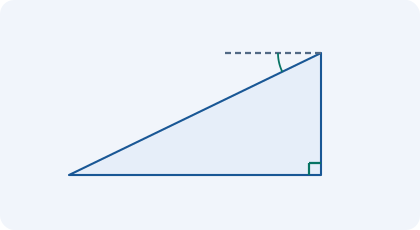
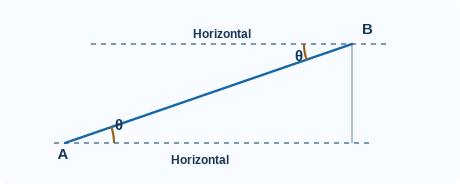
The angle of elevation is measured upwards from the horizontal through the observer. The angle of depression is measured downwards from that horizontal.

A slope joins an observer on the left to a target higher on the right. A dashed horizontal through each point shows equal elevation and depression angles.

Each marked angle is measured from a horizontal line. The two horizontal lines are parallel.

Worked example

Measure an elevation from the horizontal

From a point on level ground 12 cm12\,\mathrm{cm} from a vertical pole, the angle of elevation to the top is 42∘42^\circ. Find the pole height to 3 significant figures.
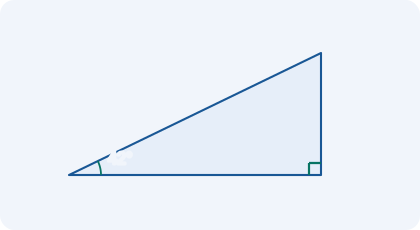
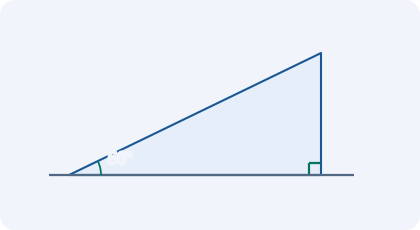
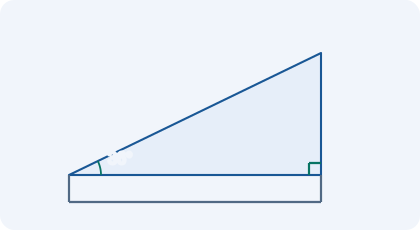
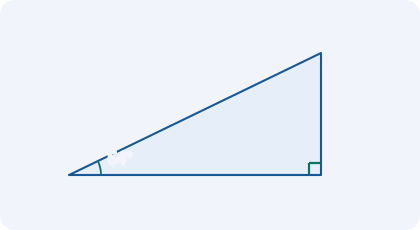
Right triangle with the supplied 12 cm on the horizontal leg and a 42 degree angle.

  1. The angle starts at the horizontal through the observer's point on the ground.

  2. tan⁡42∘=h12\tan 42^\circ=\frac{h}{12}

  3. h=12tan⁡42∘h=12\tan 42^\circ

  4. Answer 10.8 cm10.8\,\mathrm{cm} to 3 significant figures.

Your turn

From a point on level ground 18 cm18\,\mathrm{cm} from a vertical pole, the angle of elevation to the top is 52∘52^\circ. Find the pole height to 3 significant figures.

Right triangle with the supplied 18 cm on the horizontal leg and a 52 degree angle.

Round as requested in the label, or enter your calculator value. Decimal or fraction input is accepted.

Worked example

Measure a depression from the horizontal

From the top of a vertical platform 8 cm8\,\mathrm{cm} above a level floor, the angle of depression to a marker on the floor is 49∘49^\circ. Find the marker's horizontal distance from the base to 3 significant figures.

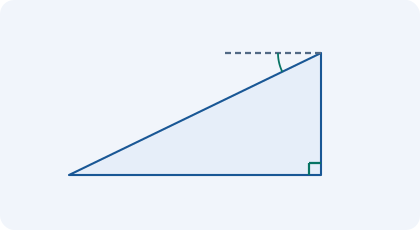
Line of sight slopes down from the observer. The angle of depression is measured from the observer’s horizontal. Vertical height 8 cm.

Try it on paper first.

  1. The horizontal lines through the observer and marker are parallel. The angle of elevation at the marker is also 49∘49^\circ.

  2. tan⁡49∘=8d\tan 49^\circ=\frac{8}{d}

  3. d=8tan⁡49∘d=\frac{8}{\tan 49^\circ}

  4. Answer 6.95 cm6.95\,\mathrm{cm} to 3 significant figures.

Your turn

From the top of a vertical platform 11 cm11\,\mathrm{cm} above a level floor, the angle of depression to a marker on the floor is 59∘59^\circ. Find the marker's horizontal distance from the base to 3 significant figures.

Line of sight slopes down from the observer. The angle of depression is measured from the observer’s horizontal. Vertical height 11 cm.

Round as requested in the label, or enter your calculator value. Decimal or fraction input is accepted.

Section 2 of 3 · Extension · about 7 min

What makes the shortest distance to a line?

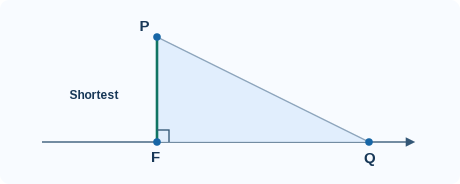
Drop a perpendicular from the point to the line. Every sloping segment from that point to another point on the line would be the hypotenuse of a right triangle.

Point P lies above a straight line. PF meets it at ninety degrees. The sloping segment PQ is the hypotenuse.

The length PF is the shortest distance to the line. A sloping route to another point is longer.

Worked example

Draw the shortest path to a line

A straight path passes through AA. Point PP is at distance 8 cm8\,\mathrm{cm} from AA. The acute angle between APAP and the path is 56∘56^\circ. Find the shortest distance from PP to the path to 3 significant figures.

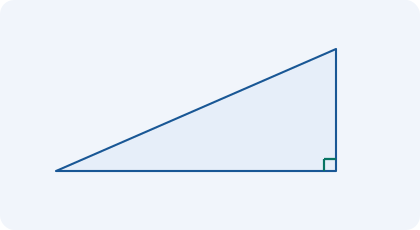
Right triangle with the supplied 8 cm on the sloping line and a 56 degree angle.

  1. Drop a perpendicular from P to the straight path. The perpendicular is opposite the given angle.

  2. d=8sin⁡56∘d=8\sin 56^\circ

  3. Answer 6.63 cm6.63\,\mathrm{cm} to 3 significant figures.

Your turn

A straight path passes through AA. Point PP is at distance 15 cm15\,\mathrm{cm} from AA. The acute angle between APAP and the path is 63∘63^\circ. Find the shortest distance from PP to the path to 3 significant figures.

Right triangle with the supplied 15 cm on the sloping line and a 63 degree angle.

Round as requested in the label, or enter your calculator value. Decimal or fraction input is accepted.

Worked example

Compare a direct sloping path with the perpendicular

Point PP is 9 cm9\,\mathrm{cm} from the foot FF of its perpendicular to a line. Point QQ is 9 cm9\,\mathrm{cm} along the line from FF. Find the exact length PQPQ.

F is the foot of the perpendicular. PF is 9 cm, FQ is 9 cm, and PQ is the sloping side.

Try it on paper first.

  1. PFQ is a right-angled triangle. PQ is its hypotenuse and is longer than PF.

  2. PQ2=92+92PQ^2=9^2+9^2

  3. PQ=162PQ=\sqrt{162}

  4. Answer 92 cm9 \sqrt{2}\,\mathrm{cm}.

Your turn

Point PP is 7 cm7\,\mathrm{cm} from the foot FF of its perpendicular to a line. Point QQ is 12 cm12\,\mathrm{cm} along the line from FF. Find the exact length PQPQ.

F is the foot of the perpendicular. PF is 7 cm, FQ is 12 cm, and PQ is the sloping side.

Enter one number. Fractions and decimals are accepted.

Section 3 of 3 · Extension · about 8 min

How can the observer's height change the result?

A sight-line triangle starts at the observer's horizontal level. Its vertical leg measures the difference in height between observer and target.

Worked example

Account for the height of the observer

An observer's camera is 2 cm2\,\mathrm{cm} above a level bench. The foot of a vertical model tower is 13 cm13\,\mathrm{cm} horizontally away. The angle of elevation from the camera to the top is 36∘36^\circ. Find the tower height to 3 significant figures.

Right triangle with the supplied 13 cm on the horizontal leg and a 36 degree angle. The lower platform is 2 cm high.

  1. The right triangle starts at camera level.

  2. habove camera=13tan⁡36∘h_{\text{above camera}}=13\tan 36^\circ

  3. htower=2+habove camerah_{\text{tower}}=2+h_{\text{above camera}}

  4. Answer 11.4 cm11.4\,\mathrm{cm} to 3 significant figures.

Your turn

An observer's camera is 92 cm\frac{9}{2}\,\mathrm{cm} above a level bench. The foot of a vertical model tower is 19 cm19\,\mathrm{cm} horizontally away. The angle of elevation from the camera to the top is 58∘58^\circ. Find the tower height to 3 significant figures.

Right triangle with the supplied 19 cm on the horizontal leg and a 58 degree angle. The lower platform is 4.5 cm high.

Round as requested in the label, or enter your calculator value. Decimal or fraction input is accepted.

Worked example

Find an angle of depression

A small observation camera is 8 cm8\,\mathrm{cm} vertically above a flat floor. A target is 13 cm13\,\mathrm{cm} horizontally from the point directly below the camera. Find the angle of depression to 1 decimal place.

Line of sight slopes down from the observer. The angle of depression is measured from the observer’s horizontal. Vertical height 8 cm.

Try it on paper first.

  1. Use the angle from the horizontal along the line of sight.

  2. tan⁡θ=813\tan \theta=\frac{8}{13}

  3. θ=tan⁡−1(813)\theta=\tan^{-1}\left(\frac{8}{13}\right)

  4. Answer 31.6∘31.6^\circ to 1 decimal place.

Your turn

A small observation camera is 12 cm12\,\mathrm{cm} vertically above a flat floor. A target is 20 cm20\,\mathrm{cm} horizontally from the point directly below the camera. Find the angle of depression to 1 decimal place.

Line of sight slopes down from the observer. The angle of depression is measured from the observer’s horizontal. Vertical height 12 cm.

Round as requested in the label, or enter your calculator value. Decimal or fraction input is accepted.

Worked examples

Practise the method

Core practice

Question 1 of 5

0 / 5 checked in this collection

Question list

Core practice

Fresh variants

Exam-style

Measure an elevation from the horizontal

1 mark

From a point on level ground 36 cm36\,\mathrm{cm} from a vertical pole, the angle of elevation to the top is 54∘54^\circ. Find the pole height to 3 significant figures.

Right triangle with the supplied 36 cm on the horizontal leg and a 54 degree angle.

Round as requested in the label, or enter your calculator value. Decimal or fraction input is accepted.

Full answer-format guide

Exact numbers: 3/2, sqrt(5), 2-sqrt(3), pi/6, 3*pi/2. Sets: {1,4}. Intervals: (3,5]; a round bracket excludes the endpoint. Infinity: inf; union: U; no solutions: empty. Separate coordinate pairs or triples with semicolons. Expressions: 2x^2+3x-1; equations: x^2=3x+1 or the polynomial equal to zero. Factors: x-1 ; x+2. Parameter fraction: numerator ; denominator. List integer answers individually.

Review the method

Progress stays in this browser. Create an account to save it or sign in.

Extra practice from this lesson

Measure an elevation from the horizontal

From a point on level ground 28 cm28\,\mathrm{cm} from a vertical pole, the angle of elevation to the top is 50∘50^\circ. Find the pole height to 3 significant figures.

Right triangle with the supplied 28 cm on the horizontal leg and a 50 degree angle.

Round as requested in the label, or enter your calculator value. Decimal or fraction input is accepted.

Measure a depression from the horizontal

From the top of a vertical platform 8 cm8\,\mathrm{cm} above a level floor, the angle of depression to a marker on the floor is 57∘57^\circ. Find the marker's horizontal distance from the base to 3 significant figures.

Line of sight slopes down from the observer. The angle of depression is measured from the observer’s horizontal. Vertical height 8 cm.

Round as requested in the label, or enter your calculator value. Decimal or fraction input is accepted.

Draw the shortest path to a line

A straight path passes through AA. Point PP is at distance 24 cm24\,\mathrm{cm} from AA. The acute angle between APAP and the path is 32∘32^\circ. Find the shortest distance from PP to the path to 3 significant figures.

Right triangle with the supplied 24 cm on the sloping line and a 32 degree angle.

Round as requested in the label, or enter your calculator value. Decimal or fraction input is accepted.

Compare a direct sloping path with the perpendicular

Point PP is 8 cm8\,\mathrm{cm} from the foot FF of its perpendicular to a line. Point QQ is 16 cm16\,\mathrm{cm} along the line from FF. Find the exact length PQPQ.

F is the foot of the perpendicular. PF is 8 cm, FQ is 16 cm, and PQ is the sloping side.

Enter one number. Fractions and decimals are accepted.

Account for the height of the observer

An observer's camera is 5 cm5\,\mathrm{cm} above a level bench. The foot of a vertical model tower is 29 cm29\,\mathrm{cm} horizontally away. The angle of elevation from the camera to the top is 39∘39^\circ. Find the tower height to 3 significant figures.

Right triangle with the supplied 29 cm on the horizontal leg and a 39 degree angle. The lower platform is 5 cm high.

Round as requested in the label, or enter your calculator value. Decimal or fraction input is accepted.

Find an angle of depression

A small observation camera is 8 cm8\,\mathrm{cm} vertically above a flat floor. A target is 29 cm29\,\mathrm{cm} horizontally from the point directly below the camera. Find the angle of depression to 1 decimal place.

Line of sight slopes down from the observer. The angle of depression is measured from the observer’s horizontal. Vertical height 8 cm.

Round as requested in the label, or enter your calculator value. Decimal or fraction input is accepted.

Apply it · original exam-style problems

Show your working on paper and compare it with the worked solution and marking guidance.

Come back to what needs practice

Quick revision sheet (A4)

Your review plan starts after your first check.