Maths4UBETA

The sine rule and the ambiguous case

Pair opposite sides and angles, choose valid inverse-sine solutions and recognise when two triangles fit.

Try the quick check →
Lesson 8 of 10

Section 1 of 3 · Extension · about 6 min

When do I use the sine rule?

An opposite pair consists of a known side and its opposite angle. A second pair includes the unknown length or angle.
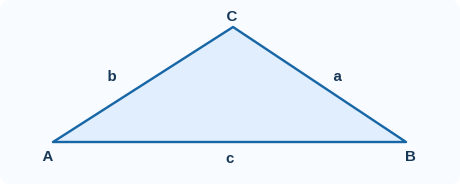
Triangle ABC is not right-angled. Side a faces A, side b faces B, and side c faces C.

Lower-case side labels are paired with the opposite upper-case angles.

Worked example

Use two opposite pairs to find a side

In triangle ABCABC, A=26∘A=26^\circ, B=61∘B=61^\circ and a=10 cma=10\,\mathrm{cm}.

Find bb to 3 significant figures.

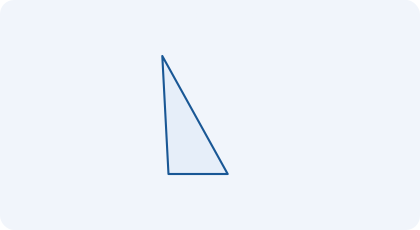
Triangle ABC. Lowercase side labels are opposite the matching uppercase vertices. Given A=26, B=61, a=10.

  1. Match each side with the angle opposite it.

  2. bsin⁡61∘=10sin⁡26∘\frac{b}{\sin 61^\circ}=\frac{10}{\sin 26^\circ}

  3. b=10sin⁡61∘sin⁡26∘b=\frac{10\sin 61^\circ}{\sin 26^\circ}

  4. Answer 20 cm20\,\mathrm{cm} to 3 significant figures.

Your turn

In triangle ABCABC, A=45∘A=45^\circ, B=98∘B=98^\circ and a=13 cma=13\,\mathrm{cm}.

Find bb to 3 significant figures.

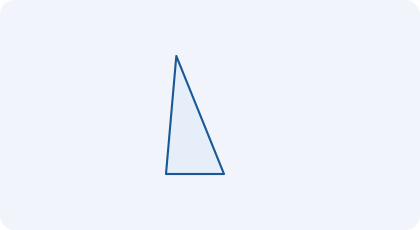
Triangle ABC. Lowercase side labels are opposite the matching uppercase vertices. Given A=45, B=98, a=13.

Round as requested in the label, or enter your calculator value. Decimal or fraction input is accepted.

Worked example

Use two opposite pairs to find a side

In triangle ABCABC, A=27∘A=27^\circ, B=68∘B=68^\circ and a=10 cma=10\,\mathrm{cm}.

Find cc to 3 significant figures.

Triangle ABC. Lowercase side labels are opposite the matching uppercase vertices. Given A=27, B=68, a=10.

Try it on paper first.

  1. C=180∘−27∘−68∘=85∘C=180^\circ-27^\circ-68^\circ=85^\circ

  2. Match each side with the angle opposite it.

  3. csin⁡85∘=10sin⁡27∘\frac{c}{\sin 85^\circ}=\frac{10}{\sin 27^\circ}

  4. c=10sin⁡85∘sin⁡27∘c=\frac{10\sin 85^\circ}{\sin 27^\circ}

  5. Answer 21.9 cm21.9\,\mathrm{cm} to 3 significant figures.

Your turn

In triangle ABCABC, A=46∘A=46^\circ, B=105∘B=105^\circ and a=13 cma=13\,\mathrm{cm}.

Find cc to 3 significant figures.

Triangle ABC. Lowercase side labels are opposite the matching uppercase vertices. Given A=46, B=105, a=13.

Round as requested in the label, or enter your calculator value. Decimal or fraction input is accepted.

Section 2 of 3 · Extension · about 7 min

Why can there be two answers for an angle?

Within a triangle, an acute angle and its obtuse supplement have the same sine. Two side lengths and a non-included angle can sometimes fit two triangles.
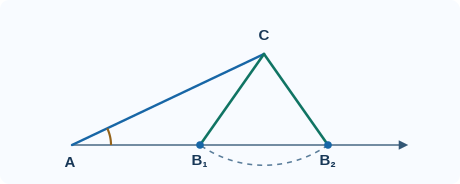
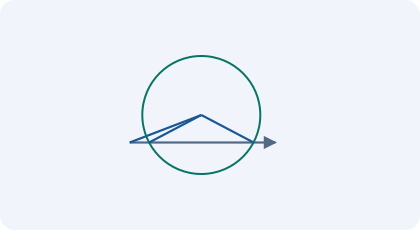
Two triangles share a fixed angle at A, the side AC and equal-length sides from C to two possible positions of B.

Two positions of B can produce the same opposite-side data. Test their angle sums.

Worked example

Find both triangles in the ambiguous case

In triangle ABCABC, A=21∘A=21^\circ, a=10 cma=10\,\mathrm{cm} and b=13 cmb=13\,\mathrm{cm}.

Find all possible values of BB, to 1 decimal place.

  1. sin⁡B13=sin⁡21∘10\frac{\sin B}{13}=\frac{\sin 21^\circ}{10}

  2. sin⁡B=13sin⁡21∘10\sin B=\frac{13\sin 21^\circ}{10}

  3. The sine value gives one acute angle and its supplement. Both candidates satisfy A+B<180∘A+B<180^\circ.

  4. Solutions {27.8∘,152.2∘}\{27.8^\circ, 152.2^\circ\}.

  5. Sine-rule construction. AC has length 13 cm and the circle about C has radius 10 cm. There are 2 intersections on the ray.

Your turn

In triangle ABCABC, A=24∘A=24^\circ, a=13 cma=13\,\mathrm{cm} and b=20 cmb=20\,\mathrm{cm}.

Find all possible values of BB, to 1 decimal place.

Give the complete set: {1, 4} for separate values, (1, 5] for an interval, U for union or empty for no real solutions. Use sqrt(...) for exact roots.

Worked example

Choose the valid angle from the sine rule

In triangle ABCABC, B=41∘B=41^\circ, a=10 cma=10\,\mathrm{cm} and b=16 cmb=16\,\mathrm{cm}.

Find AA to 1 decimal place.

Try it on paper first.

  1. sin⁡A10=sin⁡41∘16\frac{\sin A}{10}=\frac{\sin 41^\circ}{16}

  2. sin⁡A=10sin⁡41∘16\sin A=\frac{10\sin 41^\circ}{16}

  3. Since a is shorter than b, A is smaller than B. The supplementary angle would be too large.

  4. A=sin⁡−1(10sin⁡41∘16)A=\sin^{-1}\left(\frac{10\sin 41^\circ}{16}\right)

  5. Answer 24.2∘24.2^\circ to 1 decimal place.

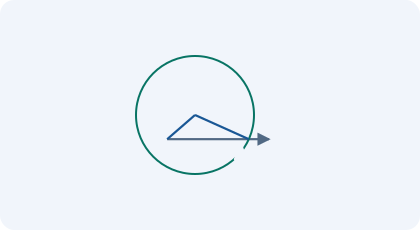
  6. Sine-rule construction. BC has length 10 cm and the circle about C has radius 16 cm. There are 1 intersections on the ray.

Your turn

In triangle ABCABC, B=60∘B=60^\circ, a=13 cma=13\,\mathrm{cm} and b=18 cmb=18\,\mathrm{cm}.

Find AA to 1 decimal place.

Round as requested in the label, or enter your calculator value. Decimal or fraction input is accepted.

Section 3 of 3 · Extension · about 8 min

How do I know whether the data can make a triangle?

An interior angle lies between 0° and 180°. Its sine is positive and at most 1.

Worked example

Choose the valid angle from the sine rule

In triangle ABCABC, B=110∘B=110^\circ, a=11 cma=11\,\mathrm{cm} and b=18 cmb=18\,\mathrm{cm}.

Find AA to 1 decimal place.

  1. sin⁡A11=sin⁡110∘18\frac{\sin A}{11}=\frac{\sin 110^\circ}{18}

  2. sin⁡A=11sin⁡110∘18\sin A=\frac{11\sin 110^\circ}{18}

  3. B is obtuse, so the other angle must be acute.

  4. A=sin⁡−1(11sin⁡110∘18)A=\sin^{-1}\left(\frac{11\sin 110^\circ}{18}\right)

  5. Answer 35.0∘35.0^\circ to 1 decimal place.

  6. Sine-rule construction. BC has length 11 cm and the circle about C has radius 18 cm. There are 1 intersections on the ray.

Your turn

In triangle ABCABC, B=129∘B=129^\circ, a=13 cma=13\,\mathrm{cm} and b=19 cmb=19\,\mathrm{cm}.

Find AA to 1 decimal place.

Round as requested in the label, or enter your calculator value. Decimal or fraction input is accepted.

Worked example

Decide when the sine rule has no solution

In triangle ABCABC, A=60∘A=60^\circ, a=11 cma=11\,\mathrm{cm} and b=22 cmb=22\,\mathrm{cm}.

How many triangles satisfy these data?

  1. No triangle
  2. One acute triangle
  3. One obtuse triangle
  4. Two distinct triangles

Try it on paper first.

  1. sin⁡B=22sin⁡60∘11\sin B=\frac{22\sin 60^\circ}{11}

  2. The calculated sine is greater than 1. No angle has this sine.

  3. Answer No triangle.

  4. Sine-rule construction. AC has length 22 cm and the circle about C has radius 11 cm. There are 0 intersections on the ray.

Your turn

In triangle ABCABC, A=79∘A=79^\circ, a=13 cma=13\,\mathrm{cm} and b=29 cmb=29\,\mathrm{cm}.

How many triangles satisfy these data?

Choose one answer

Worked examples

Practise the method

Core practice

Question 1 of 5

0 / 5 checked in this collection

Question list

Core practice

Fresh variants

Exam-style

Use two opposite pairs to find a side

1 mark

In triangle ABCABC, A=34∘A=34^\circ, B=85∘B=85^\circ and a=20 cma=20\,\mathrm{cm}.

Find bb to 3 significant figures.

Triangle ABC. Lowercase side labels are opposite the matching uppercase vertices. Given A=34, B=85, a=20.

Round as requested in the label, or enter your calculator value. Decimal or fraction input is accepted.

Full answer-format guide

Exact numbers: 3/2, sqrt(5), 2-sqrt(3), pi/6, 3*pi/2. Sets: {1,4}. Intervals: (3,5]; a round bracket excludes the endpoint. Infinity: inf; union: U; no solutions: empty. Separate coordinate pairs or triples with semicolons. Expressions: 2x^2+3x-1; equations: x^2=3x+1 or the polynomial equal to zero. Factors: x-1 ; x+2. Parameter fraction: numerator ; denominator. List integer answers individually.

Review the method

Progress stays in this browser. Create an account to save it or sign in.

Extra practice from this lesson

Use two opposite pairs to find a side

In triangle ABCABC, A=42∘A=42^\circ, B=109∘B=109^\circ and a=17 cma=17\,\mathrm{cm}.

Find bb to 3 significant figures.

Triangle ABC. Lowercase side labels are opposite the matching uppercase vertices. Given A=42, B=109, a=17.

Round as requested in the label, or enter your calculator value. Decimal or fraction input is accepted.

Use two opposite pairs to find a side

In triangle ABCABC, A=43∘A=43^\circ, B=116∘B=116^\circ and a=17 cma=17\,\mathrm{cm}.

Find cc to 3 significant figures.

Triangle ABC. Lowercase side labels are opposite the matching uppercase vertices. Given A=43, B=116, a=17.

Round as requested in the label, or enter your calculator value. Decimal or fraction input is accepted.

Find both triangles in the ambiguous case

In triangle ABCABC, A=31∘A=31^\circ, a=17 cma=17\,\mathrm{cm} and b=23 cmb=23\,\mathrm{cm}.

Find all possible values of BB, to 1 decimal place.

Give the complete set: {1, 4} for separate values, (1, 5] for an interval, U for union or empty for no real solutions. Use sqrt(...) for exact roots.

Choose the valid angle from the sine rule

In triangle ABCABC, B=59∘B=59^\circ, a=17 cma=17\,\mathrm{cm} and b=23 cmb=23\,\mathrm{cm}.

Find AA to 1 decimal place.

Round as requested in the label, or enter your calculator value. Decimal or fraction input is accepted.

Choose the valid angle from the sine rule

In triangle ABCABC, B=113∘B=113^\circ, a=17 cma=17\,\mathrm{cm} and b=24 cmb=24\,\mathrm{cm}.

Find AA to 1 decimal place.

Round as requested in the label, or enter your calculator value. Decimal or fraction input is accepted.

Decide when the sine rule has no solution

In triangle ABCABC, A=76∘A=76^\circ, a=18 cma=18\,\mathrm{cm} and b=36 cmb=36\,\mathrm{cm}.

How many triangles satisfy these data?

Choose one answer

Apply it · original exam-style problems

Show your working on paper and compare it with the worked solution and marking guidance.

Come back to what needs practice

Quick revision sheet (A4)

Your review plan starts after your first check.