Maths4UBETA

Recognise and continue patterns

Count the fixed and repeated parts of diagrams, follow a term-to-term rule and compare two patterns.

Try the quick check →
Lesson 1 of 6

Section 1 of 4 · Core · about 8 min

How do I count the part that grows?

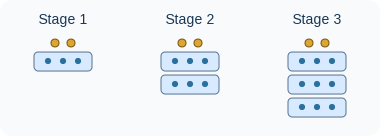
Stages 1, 2 and 3 use one, two and three panels respectively. Each panel has three lights. Each stage has two gold end lights.

The end lights stay fixed, while each new stage adds another three-light panel.

Practise the method

In the lights diagram each stage adds one panel containing three lights. The two end lights stay in every stage. The first three totals are 5, 8 and 11.

Worked example

Count the fixed and repeated parts of a pattern

A row of signs has 9 end lights altogether. At stage nn it also has 3 lights in each of nn repeated panels. The first three totals are 12,  15,  1812,\;15,\;18. How many lights are there at stage 14?

  1. The panels give 3n3n lights at stage nn. The end lights do not change.

  2. Use 3n+93n+9. For stage 14, the total is 5151.

Your turn

A row of signs has 10 end lights altogether. At stage nn it also has 4 lights in each of nn repeated panels. The first three totals are 14,  18,  2214,\;18,\;22. How many lights are there at stage 15?

Enter the whole-number count.

Worked example

Use a relationship between two patterns

Two strips grow in stages. Strip A has 16,  20,  2416,\;20,\;24 tiles at stages 1 to 3 and grows by 4 tiles each stage. At the same stage, strip B has twice as many tiles as A, plus 4. Find the number of tiles in strip B at stage 4.

Try it on paper first.

  1. Strip A has 2828 tiles at stage 4.

  2. Double that stage's value and add 4. Strip B has 6060 tiles.

Your turn

Two strips grow in stages. Strip A has 17,  22,  2717,\;22,\;27 tiles at stages 1 to 3 and grows by 5 tiles each stage. At the same stage, strip B has twice as many tiles as A, plus 5. Find the number of tiles in strip B at stage 4.

Enter the whole-number count.

Section 2 of 4 · Core · about 8 min

What operation takes me to the next term?

Practise the method

For a constant-step pattern, subtract the earlier term from the later one. Keep the sign. For alternating rules, identify which of the two actions comes next.

Worked example

Continue a constant-step sequence

These terms have a constant difference. Write the next term in −19,  −15,  −11,  −7-19,\;-15,\;-11,\;-7.

  1. Subtract one term from the term that follows it. Each change is 44.

  2. Add that signed change to −7-7 to get −3-3.

Your turn

These terms have a constant difference. Write the next term in 19,  14,  9,  419,\;14,\;9,\;4.

Enter one number. Fractions and decimals are accepted.

Worked example

Continue an alternating rule

The sequence starts 32,  39,  36,  4332,\;39,\;36,\;43. The rule alternates between adding 7 and subtracting 3, beginning with addition. Write the next term.

Try it on paper first.

  1. The last step shown adds 7. The next step subtracts 3.

  2. The next term is 43−3=4043-3=40.

Your turn

The sequence starts 33,  41,  37,  4533,\;41,\;37,\;45. The rule alternates between adding 8 and subtracting 4, beginning with addition. Write the next term.

Enter one number. Fractions and decimals are accepted.

Section 3 of 4 · Core · about 9 min

What if the gaps change or I need two terms?

Practise the method

If the gaps increase by the same amount, extend the row of gaps first. If the rule says to add the two previous terms, use their values directly.

Worked example

Continue a pattern of changing gaps

The sequence starts 17,  24,  32,  4117,\;24,\;32,\;41. Its positive gaps form a linear sequence. Find the next term.

  1. The first three gaps are 7,  8,  97,\;8,\;9. They go up by 1 each time, so the next gap is 10.

  2. Add it to the last term, 4141, to get 5151.

Your turn

The sequence starts 18,  26,  36,  4818,\;26,\;36,\;48. Its positive gaps form a linear sequence. Find the next term.

Enter one number. Fractions and decimals are accepted.

Worked example

Use the two preceding terms

The sequence begins 11,  6,  17,  23,  4011,\;6,\;17,\;23,\;40. Each term after the second is the sum of the preceding two. Find the next term.

Try it on paper first.

  1. Use the final two terms shown, 2323 and 4040.

  2. Their sum is 6363.

Your turn

The sequence begins 12,  7,  19,  26,  4512,\;7,\;19,\;26,\;45. Each term after the second is the sum of the preceding two. Find the next term.

Enter one number. Fractions and decimals are accepted.

Section 4 of 4 · Core · about 9 min

How can I compare two patterns?

Practise the method

If pattern B has twice as many pieces as A plus three more, find A at the required stage first. Double its count and add three.

Worked example

Use a relationship between two patterns

Two strips grow in stages. Strip A has 26,  32,  3826,\;32,\;38 tiles at stages 1 to 3 and grows by 6 tiles each stage. At the same stage, strip B has twice as many tiles as A, plus 9. Find the number of tiles in strip B at stage 4.

  1. Strip A has 4444 tiles at stage 4.

  2. Double that stage's value and add 9. Strip B has 9797 tiles.

Your turn

Two strips grow in stages. Strip A has 27,  34,  4127,\;34,\;41 tiles at stages 1 to 3 and grows by 7 tiles each stage. At the same stage, strip B has twice as many tiles as A, plus 10. Find the number of tiles in strip B at stage 4.

Enter the whole-number count.

Worked example

Count the fixed and repeated parts of a pattern

A row of signs has 5 end lights altogether. At stage nn it also has 2 lights in each of nn repeated panels. The first three totals are 7,  9,  117,\;9,\;11. How many lights are there at stage 10?

Try it on paper first.

  1. The panels give 2n2n lights at stage nn. The end lights do not change.

  2. Use 2n+52n+5. For stage 10, the total is 2525.

Your turn

A row of signs has 6 end lights altogether. At stage nn it also has 3 lights in each of nn repeated panels. The first three totals are 9,  12,  159,\;12,\;15. How many lights are there at stage 11?

Enter the whole-number count.

Worked examples

Practise the method

Core practice

Question 1 of 5

0 / 5 checked in this collection

Question list

Core practice

Fresh variants

Exam-style

Continue a constant-step sequence

1 mark

These terms have a constant difference. Write the next term in 19,  22,  25,  2819,\;22,\;25,\;28.

Enter one number. Fractions and decimals are accepted.

Full answer-format guide

Exact numbers: 3/2, sqrt(5), 2-sqrt(3), pi/6, 3*pi/2. Sets: {1,4}. Intervals: (3,5]; a round bracket excludes the endpoint. Infinity: inf; union: U; no solutions: empty. Separate coordinate pairs or triples with semicolons. Expressions: 2x^2+3x-1; equations: x^2=3x+1 or the polynomial equal to zero. Factors: x-1 ; x+2. Parameter fraction: numerator ; denominator. List integer answers individually.

Review the method

Progress stays in this browser. Create an account to save it or sign in.

Extra practice from this lesson

Count the fixed and repeated parts of a pattern

A row of signs has 6 end lights altogether. At stage nn it also has 3 lights in each of nn repeated panels. The first three totals are 9,  12,  159,\;12,\;15. How many lights are there at stage 20?

Enter the whole-number count.

Use a relationship between two patterns

Two strips grow in stages. Strip A has 22,  25,  2822,\;25,\;28 tiles at stages 1 to 3 and grows by 3 tiles each stage. At the same stage, strip B has twice as many tiles as A, plus 10. Find the number of tiles in strip B at stage 4.

Enter the whole-number count.

Continue a constant-step sequence

These terms have a constant difference. Write the next term in 16,  26,  36,  4616,\;26,\;36,\;46.

Enter one number. Fractions and decimals are accepted.

Continue an alternating rule

The sequence starts 38,  42,  38,  4238,\;42,\;38,\;42. The rule alternates between adding 4 and subtracting 4, beginning with addition. Write the next term.

Enter one number. Fractions and decimals are accepted.

Continue a pattern of changing gaps

The sequence starts 4,  10,  17,  254,\;10,\;17,\;25. Its positive gaps form a linear sequence. Find the next term.

Enter one number. Fractions and decimals are accepted.

Use the two preceding terms

The sequence begins 4,  12,  16,  28,  444,\;12,\;16,\;28,\;44. Each term after the second is the sum of the preceding two. Find the next term.

Enter one number. Fractions and decimals are accepted.

Use a relationship between two patterns

Two strips grow in stages. Strip A has 32,  37,  4232,\;37,\;42 tiles at stages 1 to 3 and grows by 5 tiles each stage. At the same stage, strip B has twice as many tiles as A, plus 7. Find the number of tiles in strip B at stage 4.

Enter the whole-number count.

Count the fixed and repeated parts of a pattern

A row of signs has 2 end lights altogether. At stage nn it also has 2 lights in each of nn repeated panels. The first three totals are 4,  6,  84,\;6,\;8. How many lights are there at stage 16?

Enter the whole-number count.

Apply it · original exam-style problems

Show your working on paper and compare it with the worked solution and marking guidance.

Come back to what needs practice

Quick revision sheet (A4)

Your review plan starts after your first check.