Maths4UBETA

Find and use a linear nth term

Find the common difference and constant, then evaluate a later term or decide whether a value occurs.

Try the quick check →
Lesson 2 of 6

Section 1 of 3 · Core · about 8 min

How can I write one rule for every position?

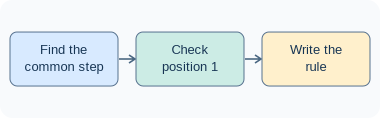
Find the common step. Check position 1. Write the rule.

The step fixes the coefficient. The first term fixes the constant.

Practise the method

Find the common difference first. At position 1, dndn already gives dd. Use the gap between that value and the actual first term to find cc.

Adjusting a linear rule
Position1234
Target7121722
5n5n5101520
Gap2222

Worked example

Find the rule for any position

Find the nn-th term of the linear sequence 9,  7,  5,  39,\;7,\;5,\;3. Give an expression in nn.

  1. The difference is −2-2. Start with −2n-2n.

  2. When n=1n=1, the formula must give 99. The adjustment is 1111, so the rule is −2n+11-2n+11.

Your turn

Find the nn-th term of the linear sequence 15,  18,  21,  2415,\;18,\;21,\;24. Give an expression in nn.

Enter an expression in n; use ^ for powers and / for fractions.

Worked example

Use a formula to jump to a later position

Sequence AA has An=4n−13A_n=4n-13. Find A20A_{20}.

Try it on paper first.

  1. The subscript tells you which position to use. Substitute n=20n=20.

  2. The result is 6767.

Your turn

Sequence AA has An=−5n+14A_n=-5n+14. Find A21A_{21}.

Enter one number. Fractions and decimals are accepted.

Section 2 of 3 · Core · about 8 min

How do I find a term far down the sequence?

Practise the method

Use the nth-term rule directly. For example, if Tn=37−4nT_n=37-4n, substitute n=9n=9 to give T9=1T_9=1.

Worked example

Use a formula to jump to a later position

Sequence AA has An=6n+24A_n=6n+24. Find A16A_{16}.

  1. The subscript tells you which position to use. Substitute n=16n=16.

  2. The result is 120120.

Your turn

Sequence AA has An=7n−25A_n=7n-25. Find A17A_{17}.

Enter one number. Fractions and decimals are accepted.

Worked example

Find the position of a given term

A sequence has Tn=−8n+3T_n=-8n+3. At which position does the term −117-117 occur?

Try it on paper first.

  1. Set the term formula equal to −117-117. Solve −8n+3=−117-8n+3=-117.

  2. After removing the constant, divide by the common difference to get n=15n=15.

Your turn

A sequence has Tn=9n+4T_n=9n+4. At which position does the term 148148 occur?

Enter one number. Fractions and decimals are accepted.

Section 3 of 3 · Core · about 9 min

How can I tell whether a value occurs?

Practise the method

If solving gives a fractional or non-positive position, explain what this means for the sequence. Substitute a possible position back into the rule to check it.

Worked example

Find the position of a given term

A sequence has Tn=10n−14T_n=10n-14. At which position does the term 9696 occur?

  1. Set the term formula equal to 9696. Solve 10n−14=9610n-14=96.

  2. After removing the constant, divide by the common difference to get n=11n=11.

Your turn

A sequence has Tn=−2n+15T_n=-2n+15. At which position does the term −9-9 occur?

Enter one number. Fractions and decimals are accepted.

Worked example

Check whether a value belongs to a sequence

A sequence has Tn=3n+16T_n=3n+16. Explain whether 5656 is a term. Which statement is correct?

  1. Yes. The term is at position 14.
  2. Yes. Every number between two terms is in the sequence.
  3. No. It is strictly between the values at positions 13 and 14.
  4. Yes. The term is at position 13.

Try it on paper first.

  1. Solving 3n+16=563n+16=56 gives n=403n=\frac{40}{3}.

  2. This is between two whole-number positions. The value is not a term.

Your turn

A sequence has Tn=4n+17T_n=4n+17. Explain whether 7474 is a term. Which statement is correct?

Choose one answer

Worked examples

Practise the method

Core practice

Question 1 of 5

0 / 5 checked in this collection

Question list

Core practice

Fresh variants

Exam-style

Find the rule for any position

1 mark

Find the nn-th term of the linear sequence 21,  19,  17,  1521,\;19,\;17,\;15. Give an expression in nn.

Enter an expression in n; use ^ for powers and / for fractions.

Full answer-format guide

Exact numbers: 3/2, sqrt(5), 2-sqrt(3), pi/6, 3*pi/2. Sets: {1,4}. Intervals: (3,5]; a round bracket excludes the endpoint. Infinity: inf; union: U; no solutions: empty. Separate coordinate pairs or triples with semicolons. Expressions: 2x^2+3x-1; equations: x^2=3x+1 or the polynomial equal to zero. Factors: x-1 ; x+2. Parameter fraction: numerator ; denominator. List integer answers individually.

Review the method

Progress stays in this browser. Create an account to save it or sign in.

Extra practice from this lesson

Find the rule for any position

Find the nn-th term of the linear sequence −25,  −33,  −41,  −49-25,\;-33,\;-41,\;-49. Give an expression in nn.

Enter an expression in n; use ^ for powers and / for fractions.

Use a formula to jump to a later position

Sequence AA has An=10n+19A_n=10n+19. Find A11A_{11}.

Enter one number. Fractions and decimals are accepted.

Use a formula to jump to a later position

Sequence AA has An=3n+7A_n=3n+7. Find A22A_{22}.

Enter one number. Fractions and decimals are accepted.

Find the position of a given term

A sequence has Tn=−5n+9T_n=-5n+9. At which position does the term −21-21 occur?

Enter one number. Fractions and decimals are accepted.

Find the position of a given term

A sequence has Tn=7n+20T_n=7n+20. At which position does the term 139139 occur?

Enter one number. Fractions and decimals are accepted.

Check whether a value belongs to a sequence

A sequence has Tn=9n−22T_n=9n-22. Explain whether 150150 is a term. Which statement is correct?

Choose one answer

Apply it · original exam-style problems

Show your working on paper and compare it with the worked solution and marking guidance.

Come back to what needs practice

Quick revision sheet (A4)

Your review plan starts after your first check.