Cambridge IGCSE Mathematics (0580) · Sequences · Quick revision
Recognise and continue patterns
How do I count the part that grows?
A drawing can change in one place and stay the same somewhere else. Count those two parts separately.
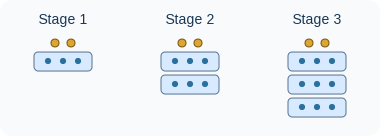
In the lights diagram each stage adds one panel containing three lights. The two end lights stay in every stage. The first three totals are 5, 8 and 11.
What operation takes me to the next term?
A term-to-term rule tells you what to do to one value to get the next. It needs a starting value before you can use it.
For a constant-step pattern, subtract the earlier term from the later one. Keep the sign. For alternating rules, identify which of the two actions comes next.
What if the gaps change or I need two terms?
Some patterns have their own rule for the gaps. For other patterns, add the two terms immediately before the gap.
If the gaps increase by the same amount, extend the row of gaps first. If the rule says to add the two previous terms, use their values directly.
How can I compare two patterns?
Place the position numbers above the terms before you compare. A relationship between two patterns usually refers to matching positions.
If pattern B has twice as many pieces as A plus three more, find A at the required stage first. Double its count and add three.
Quick worked example
A row of signs has 8 end lights altogether. At stage it also has 2 lights in each of repeated panels. The first three totals are . How many lights are there at stage 13?
The panels give lights at stage . The end lights do not change.
Use . For stage 13, the total is .