Worked example
Use prime factorisation
Use prime factorisation to find the exponent on 2 in 84.
Split off 2 while the remaining number is even.
The prime factors in order are .
The compact form is . The exponent on 2 is 2.
Find the prime building blocks of a number and record them with powers.
Try the quick check →Section 1 of 3 · Core · about 6 min
Split a number into two factors greater than 1. Split any composite factor again. Mark the prime tips and read those tips together.
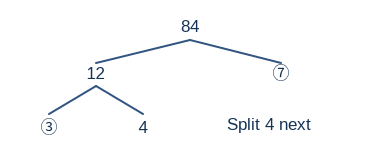
The tips 3 and 7 are prime. Split 4 into two more prime tips.
Worked example
Use prime factorisation to find the exponent on 2 in 84.
Split off 2 while the remaining number is even.
The prime factors in order are .
The compact form is . The exponent on 2 is 2.
Worked example
Use prime factorisation to find the exponent on 2 in 1056.
Try it on paper first.
Split off 2 while the remaining number is even.
The prime factors in order are .
The compact form is . The exponent on 2 is 5.
Section 2 of 3 · Core · about 6 min
An exponent counts repeated factors. When you multiply two products, the prime copies from both go into the same list.
Worked example
. What is the exponent of 2 in the prime factorisation of ?
The factor list for A has 3 copies of 2. The list for B has 2.
Putting the lists together makes copies of 2.
The result is .
Worked example
. What is the exponent of 2 in the prime factorisation of ?
Try it on paper first.
The factor list for A has 6 copies of 2. The list for B has 1.
Putting the lists together makes copies of 2.
The result is .
Section 3 of 3 · Core · about 6 min
A square uses the same factor list twice. So every prime copy must have a matching partner. Add one copy wherever the exponent is odd.
Worked example
Let . Find the smallest positive integer that makes a square when multiplied by .
A square repeats the same list of factors twice. Every prime exponent must be even.
These primes have odd exponents: 3, 5. Each needs one more copy.
Multiply the needed primes. The smallest multiplier is 15.
Worked example
Let . Find the smallest positive integer that makes a square when multiplied by .
Try it on paper first.
A square repeats the same list of factors twice. Every prime exponent must be even.
These primes have odd exponents: 2, 5, 7. Each needs one more copy.
Multiply the needed primes. The smallest multiplier is 70.
Question 1 of 5
0 / 5 checked in this collection
Use prime factorisation to find the exponent on 2 in 624.
Progress stays in this browser. Create an account to save it or sign in.
Show your working on paper and compare it with the worked solution and marking guidance.
Your review plan starts after your first check.