Maths4UBETA

Highest common factor and lowest common multiple

Choose the right operation for equal groups and repeating cycles.

Try the quick check →
Lesson 4 of 5

Section 1 of 3 · Core · about 6 min

What is the largest number of identical groups?

The number of groups divides each of the supplies. The highest common factor gives the greatest possible number of identical groups.

Worked example

Make the most identical packs

A workshop has 27 brass clips and 45 steel clips. It makes identical packs and uses every clip. What is the greatest possible number of packs?

  1. The number of packs must divide both 27 and 45 exactly.

  2. Write 27=3327=3^{3} and 45=32×545=3^{2}\times 5. Keep only the shared copies of primes.

  3. The HCF is 9. Each pack uses 3 brass and 5 steel clips.
Your turn

A workshop has 80 brass clips and 112 steel clips. It makes identical packs and uses every clip. What is the greatest possible number of packs?

Enter the whole-number count.

Worked example

Make the most identical packs

A workshop has 60 brass clips and 84 steel clips. It makes identical packs and uses every clip. What is the greatest possible number of packs?

Try it on paper first.

  1. The number of packs must divide both 60 and 84 exactly.

  2. Write 60=22×3×560=2^{2}\times 3\times 5 and 84=22×3×784=2^{2}\times 3\times 7. Keep only the shared copies of primes.

  3. The HCF is 12. Each pack uses 5 brass and 7 steel clips.

Your turn

A workshop has 95 brass clips and 152 steel clips. It makes identical packs and uses every clip. What is the greatest possible number of packs?

Enter the whole-number count.

Section 2 of 3 · Core · about 6 min

When do the two events next meet?

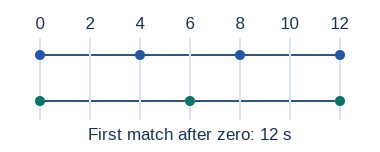
Start both timelines at zero. Mark the times of each repeating event on its own line. The first positive time marked on both lines is the lowest common multiple.

Two timelines with markers every four and six seconds. Their first common positive marker is twelve seconds.

The two repeating events next meet 12 seconds after they start.

Worked example

Find the next shared finish

Two machines finish jobs together. One finishes every 9 seconds and the other every 12 seconds. After how many seconds do they next finish together?

  1. The first machine finishes after 9, 18, 27, and so on.

  2. The other finishes after 12, 24, 36, and so on.

  3. The first positive time in both lists is 36 seconds.

Your turn

Two machines finish jobs together. One finishes every 20 seconds and the other every 30 seconds. After how many seconds do they next finish together?

Enter the whole-number count.

Worked example

Find the next shared finish

Two machines finish jobs together. One finishes every 12 seconds and the other every 18 seconds. After how many seconds do they next finish together?

Try it on paper first.

  1. The first machine finishes after 12, 24, 36, and so on.

  2. The other finishes after 18, 36, 54, and so on.

  3. The first positive time in both lists is 36 seconds.

Your turn

Two machines finish jobs together. One finishes every 52 seconds and the other every 65 seconds. After how many seconds do they next finish together?

Enter the whole-number count.

Section 3 of 3 · Core · about 6 min

How do I choose between HCF and LCM?

Ask which way the division goes. A group count divides both totals. A shared elapsed time can be divided by both periods.

Worked example

Choose the correct prime copies

Find the lowest common multiple of 24 and 40.

  1. The two prime products are 24=23×324=2^{3}\times 3 and 40=23×540=2^{3}\times 5.

  2. Keep the greater count of every prime that appears.

  3. Multiplying the selected copies gives 23×3×5=1202^{3}\times 3\times 5=120.

Your turn

Find the highest common factor of 45 and 75.

Enter one number. Fractions and decimals are accepted.

Worked example

Choose the correct prime copies

Find the highest common factor of 33 and 55.

Try it on paper first.

  1. The two prime products are 33=3×1133=3\times 11 and 55=5×1155=5\times 11.

  2. Keep the smaller count of each shared prime.

  3. Multiplying the selected copies gives 11=1111=11.

Your turn

Find the lowest common multiple of 54 and 90.

Enter one number. Fractions and decimals are accepted.

Worked examples

Practise the method

Core practice

Question 1 of 5

0 / 5 checked in this collection

Question list

Core practice

Fresh variants

Exam-style

Make the most identical packs

1 mark

A workshop has 75 brass clips and 120 steel clips. It makes identical packs and uses every clip. What is the greatest possible number of packs?

Enter the whole-number count.

Full answer-format guide

Exact numbers: 3/2, sqrt(5), 2-sqrt(3), pi/6, 3*pi/2. Sets: {1,4}. Intervals: (3,5]; a round bracket excludes the endpoint. Infinity: inf; union: U; no solutions: empty. Separate coordinate pairs or triples with semicolons. Expressions: 2x^2+3x-1; equations: x^2=3x+1 or the polynomial equal to zero. Factors: x-1 ; x+2. Parameter fraction: numerator ; denominator. List integer answers individually.

Review the method

Progress stays in this browser. Create an account to save it or sign in.

Extra practice from this lesson

A workshop has 115 brass clips and 184 steel clips. It makes identical packs and uses every clip. What is the greatest possible number of packs?

Enter the whole-number count.

A workshop has 120 brass clips and 168 steel clips. It makes identical packs and uses every clip. What is the greatest possible number of packs?

Enter the whole-number count.

Two machines finish jobs together. One finishes every 36 seconds and the other every 54 seconds. After how many seconds do they next finish together?

Enter the whole-number count.

Two machines finish jobs together. One finishes every 57 seconds and the other every 76 seconds. After how many seconds do they next finish together?

Enter the whole-number count.

Find the lowest common multiple of 72 and 120.

Enter one number. Fractions and decimals are accepted.

Find the highest common factor of 75 and 125.

Enter one number. Fractions and decimals are accepted.

Apply it · original exam-style problems

Show your working on paper and compare it with the worked solution and marking guidance.

Come back to what needs practice

Quick revision sheet (A4)

Your review plan starts after your first check.