Maths4UBETA

Factors, multiples and prime numbers

Use factor pairs and multiplication lists to decide what kind of whole number you have.

Try the quick check →
Lesson 2 of 5

Section 1 of 3 · Core · about 6 min

How do I find every factor?

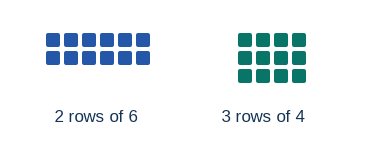
Arrange objects in equal rows with none left over. A possible row count and its column count give a factor pair.

Two arrays of twelve objects. One has two rows of six and the other has three rows of four.

Each array contains twelve objects. Each arrangement gives a different pair of factors.

Worked example

List every positive factor

List all the positive factors of 12.

  1. Start with 1×121\times12. Try the next possible small divisors in order.

  2. The full list of pairs is 1×121\times12, 2×62\times6, 3×43\times4. Stop when the next pair would reverse one you already have.

  3. Collect both numbers from each pair: 1,2,3,4,6,121,2,3,4,6,12.

Your turn

List all the positive factors of 40.

Give the complete set: {1, 4} for separate values, (1, 5] for an interval, U for union or empty for no real solutions. Use sqrt(...) for exact roots.

Worked example

List every positive factor

List all the positive factors of 24.

Try it on paper first.

  1. Start with 1×241\times24. Try the next possible small divisors in order.

  2. The full list of pairs is 1×241\times24, 2×122\times12, 3×83\times8, 4×64\times6. Stop when the next pair would reverse one you already have.

  3. Collect both numbers from each pair: 1,2,3,4,6,8,12,241,2,3,4,6,8,12,24.

Your turn

List all the positive factors of 52.

Give the complete set: {1, 4} for separate values, (1, 5] for an interval, U for union or empty for no real solutions. Use sqrt(...) for exact roots.

Section 2 of 3 · Core · about 6 min

How can I find a multiple inside a range?

A multiple is made by multiplying. Step along a times table and choose the values inside the bounds given in the question.

Worked example

Find a multiple inside a range

Find the multiple of 8 that is greater than 30 and less than 35.

  1. The multiples of 8 are its times-table values.

  2. The value 8×3=248\times3=24 is too small.

  3. The next value is 8×4=328\times4=32 and it lies inside the range. The following value is too large.

Your turn

Find the multiple of 15 that is greater than 88 and less than 93.

Enter one number. Fractions and decimals are accepted.

Worked example

Find a multiple inside a range

Find the multiple of 11 that is greater than 75 and less than 80.

Try it on paper first.

  1. The multiples of 11 are its times-table values.

  2. The value 11×6=6611\times6=66 is too small.

  3. The next value is 11×7=7711\times7=77 and it lies inside the range. The following value is too large.

Your turn

Find the multiple of 18 that is greater than 70 and less than 75.

Enter one number. Fractions and decimals are accepted.

Section 3 of 3 · Core · about 6 min

How can I tell whether a number is prime?

A prime is a positive integer with exactly two positive factors. A composite has an extra factor pair. If a larger factor exists beyond the square root, it has a smaller partner you have already tested.

Worked example

Identify a prime

Which number is prime?

A. 2727   B. 2929   C. 11

  1. 27 is composite because 27=3×927=3\times9.

  2. One has only one positive factor, so it is neither prime nor composite.

  3. No prime up to 5 divides 29, so 29 has exactly two positive factors.

Your turn

Which number is prime?

Prime number

Worked example

Identify a prime

Which number is prime?

A. 3636   B. 3737   C. 11

Try it on paper first.

  1. 36 is composite because 36=3×1236=3\times12.

  2. One has only one positive factor, so it is neither prime nor composite.

  3. No prime up to 6 divides 37, so 37 has exactly two positive factors.

Your turn

Which number is prime?

Prime number

Worked examples

Practise the method

Core practice

Question 1 of 5

0 / 5 checked in this collection

Question list

Core practice

Fresh variants

Exam-style

List every positive factor

1 mark

List all the positive factors of 36.

Give the complete set: {1, 4} for separate values, (1, 5] for an interval, U for union or empty for no real solutions. Use sqrt(...) for exact roots.

Full answer-format guide

Exact numbers: 3/2, sqrt(5), 2-sqrt(3), pi/6, 3*pi/2. Sets: {1,4}. Intervals: (3,5]; a round bracket excludes the endpoint. Infinity: inf; union: U; no solutions: empty. Separate coordinate pairs or triples with semicolons. Expressions: 2x^2+3x-1; equations: x^2=3x+1 or the polynomial equal to zero. Factors: x-1 ; x+2. Parameter fraction: numerator ; denominator. List integer answers individually.

Review the method

Progress stays in this browser. Create an account to save it or sign in.

Extra practice from this lesson

List all the positive factors of 68.

Give the complete set: {1, 4} for separate values, (1, 5] for an interval, U for union or empty for no real solutions. Use sqrt(...) for exact roots.

List all the positive factors of 72.

Give the complete set: {1, 4} for separate values, (1, 5] for an interval, U for union or empty for no real solutions. Use sqrt(...) for exact roots.

Find the multiple of 23 that is greater than 90 and less than 95.

Enter one number. Fractions and decimals are accepted.

Find the multiple of 24 that is greater than 118 and less than 123.

Enter one number. Fractions and decimals are accepted.

Which number is prime?

Prime number

Which number is prime?

Prime number

Apply it · original exam-style problems

Show your working on paper and compare it with the worked solution and marking guidance.

Come back to what needs practice

Quick revision sheet (A4)

Your review plan starts after your first check.