Maths4UBETA

Reverse moments, feasible summaries and all valid branches

Use variance to reconstruct missing information, retaining every feasible count or sign before applying extra conditions.

Try the quick check →
Lesson 3 of 5

Section 1 of 5 · Core · about 7 min

Could these summaries come from real observations?

Write nn for a positive integer count, T=∑xT=\sum x, Q=∑x2Q=\sum x^2, mean μ=Tn\mu=\frac{T}{n}, and descriptive variance

V=Qn−(Tn)2.V=\frac{Q}{n}-\left(\frac{T}{n}\right)^2.

The centred sum of squares is D=Q−T2nD=Q-\frac{T^2}{n}, so real observations require

Q≥T2n.Q\ge\frac{T^2}{n}.

Equality means every record equals μ\mu, giving zero variance. If n=1n=1, equality is compulsory: the single record is TT, so Q=T2Q=T^2 and V=0V=0.

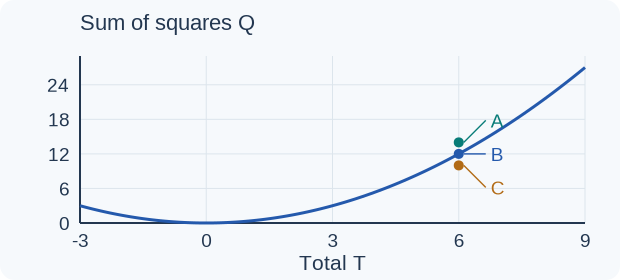
Point A lies above the boundary, B on it, and C below it.

Q−T2n=∑(xi−xˉ)2≥0.Q-\frac{T^2}{n}=\sum(x_i-\bar x)^2\ge0.
PointSum of squaresAt total 6
A14Possible, e.g. 1, 2, 3
B12Possible, all records equal 2
C10Impossible

For n≥2n\ge2 and Q≥T2nQ\ge\frac{T^2}{n}, one construction is μ−d, μ+d\mu-d,\ \mu+d and n−2n-2 copies of μ=Tn\mu=\frac{T}{n}, where d=Q−T2n2d=\sqrt{\frac{Q-\tfrac{T^2}{n}}{2}}. For one record, equality Q=T2Q=T^2 is required.

Extra restrictions such as integers or nonnegative observations require a separate check.

With n=3n=3 and T=6T=6, the boundary is Q=12Q=12. Below it no real records exist; at it all records equal 22; above it real constructions are possible.

Worked example

Test a proposed sum of squares

Three unrestricted real observations have total T=6T=6. Determine whether each proposed sum of squares Q=10,12,14Q=10,12,14 is possible. Give a possible dataset when it exists, and find the variance when Q=14Q=14.

  1. μ=63=2,D=Q−623=Q−12.\mu=\frac{6}{3}=2,\qquad D=Q-\frac{6^2}{3}=Q-12.

    A centred sum of squares cannot be negative.

  2. For Q=10Q=10, D=−2D=-2, so no real dataset exists. For Q=12Q=12, D=0D=0, so all observations must equal 22: the list is 2,2,22,2,2.

  3. For Q=14Q=14, one possible list is 1,2,31,2,3. It has total 66 and sum of squares 1+4+9=141+4+9=14.

  4. V=143−22=23.V=\frac{14}{3}-2^2=\frac{2}{3}.

    A possible list proves existence; the moment totals do not generally recover a unique original dataset.

Your turn

Four unrestricted real observations have total T=8T=8. Find the least possible sum of squares QQ, and identify the observations at equality. For a separate dataset with this same count and total but Q=24Q=24, find the descriptive variance.

Enter an exact number, for example 3/2 or 2-sqrt(3).

Records when equality holds

Enter an exact number, for example 3/2 or 2-sqrt(3).

Section 2 of 5 · Core · about 7 min

How do I recover every possible count?

If T,Q,VT,Q,V are known but nn is not, start from the descriptive variance equation. Multiplying by n2n^2 gives

Vn2−Qn+T2=0.Vn^2-Qn+T^2=0.

Solve for every algebraic value, then keep only positive integers. Check each retained count in the original formula and the real-data conditions. In particular, a count of one must give zero variance and Q=T2Q=T^2, even if it satisfies the rearranged equation.

60n−(12n)2=6⇒(n−4)(n−6)=0.\frac{60}{n}-\left(\frac{12}{n}\right)^2=6\quad\Rightarrow\quad(n-4)(n-6)=0.
CountMeanVarianceExample records
43604−32=6\frac{60}4-3^2=61, 1, 3, 7
62606−22=6\frac{60}6-2^2=60, 0, 1, 1, 3, 7

Each example has total 1212 and sum of squares 6060. Both counts are positive integers and give feasible records.

For T=12T=12, Q=60Q=60, V=6V=6, both n=4n=4 and n=6n=6 pass. Their means are 33 and 22, respectively.

Worked example

Keep both feasible counts

Unrestricted real observations have total T=12T=12, sum of squares Q=60Q=60 and descriptive variance 66. Find every possible positive integer count. Then select the count if the mean is known to exceed 52\frac{5}{2}.

  1. 6=60n−(12n)2⟹6n2−60n+144=0.6=\frac{60}{n}-\left(\frac{12}{n}\right)^2\Longrightarrow6n^2-60n+144=0.
  2. n2−10n+24=(n−4)(n−6)=0.n^2-10n+24=(n-4)(n-6)=0.

    The algebra gives n=4n=4 or n=6n=6.

  3. n=4:μ=3,V=604−32=6.n=4:\quad\mu=3,\quad V=\frac{60}{4}-3^2=6.n=6:μ=2,V=606−22=6.n=6:\quad\mu=2,\quad V=\frac{60}{6}-2^2=6.
  4. Both are feasible positive integer counts. For example, 1,1,3,71,1,3,7 works for four records, and 0,0,1,1,3,70,0,1,1,3,7 works for six. Both lists have total 1212 and sum of squares 6060.

  5. Without the additional condition, retain both counts. Requiring μ>52\mu>\frac{5}{2} selects n=4n=4, whose mean is 33.

If V=0V=0, the equation is no longer quadratic. For Q>0Q>0, solve n=T2Qn=\frac{T^2}{Q} and enforce the count conditions; all records must then equal Tn\frac{T}{n}. If Q=0Q=0, every real record must be zero: T=0T=0 allows any positive integer count, while T≠0T\ne0 is impossible. Negative variance or a negative sum of squares is invalid from the start.

Your turn

Unrestricted real observations have T=6T=6, Q=45Q=45 and descriptive variance V=9V=9. Find all valid positive integer counts. Separately, a dataset has T=10T=10, Q=20Q=20 and V=0V=0: find its count. Finally, which counts are possible when T=Q=V=0T=Q=V=0?

Give the complete set: {1, 4} for separate values, (1, 5] for an interval, U for union or empty for no real solutions. Use sqrt(...) for exact roots.

Enter an exact number, for example 3/2 or 2-sqrt(3).

Counts when all three summaries are zero

Section 3 of 5 · Core · about 5 min

Why can an unknown mean have two signs?

Rearrange the variance formula to obtain

μ2=Qn−V.\mu^2=\frac{Q}{n}-V.

A positive right-hand side gives both square-root signs; zero gives the single mean 00; a negative value gives no real mean. Each branch has its own total T=nμT=n\mu. Apply sign or context information only after identifying every branch.

Worked example

Recover a mean from its square

Four unrestricted real observations have sum of squares 148148 and descriptive variance 1212. Find every possible mean and corresponding total. Explain which branch could remain if all observations must be non-negative.

  1. μ2=1484−12=25⟹μ=5 or μ=−5.\mu^2=\frac{148}{4}-12=25\Longrightarrow\mu=5\text{ or }\mu=-5.
  2. T=4μ=20 or −20.T=4\mu=20\text{ or }-20.

    Keep each total with its corresponding mean.

  3. Both real branches are feasible. One positive-mean example is

    5−26,5,5,5+26.5-2\sqrt{6},\quad5,\quad5,\quad5+2\sqrt{6}.

    Its total is 2020, centred sum of squares is 4848, and original sum of squares is 148148. Negating all four records gives the negative branch.

  4. Non-negative observations cannot have mean −5-5. The positive example is itself non-negative because 5>265>2\sqrt{6}, so mean 55 remains feasible under that extra condition.

Your turn

Five unrestricted real observations have Q=100Q=100 and descriptive variance 1616. Find all possible means, then select the mean if the total is positive. Could a separate dataset instead have the same count and variance but Q=70Q=70?

Give the complete set: {1, 4} for separate values, (1, 5] for an interval, U for union or empty for no real solutions. Use sqrt(...) for exact roots.

Enter an exact number, for example 3/2 or 2-sqrt(3).

Feasibility of the separate proposal

Section 4 of 5 · Core · about 6 min

How do I recover a hidden coding origin?

For Dc=∑(x−c)D_c=\sum(x-c) and Ec=∑(x−c)2E_c=\sum(x-c)^2, the first moment gives

Dc=n(μ−c),c=μ−Dcn.D_c=n(\mu-c),\qquad c=\mu-\frac{D_c}{n}.

The coded moments also determine the original variance:

V=Ecn−(Dcn)2.V=\frac{E_c}{n}-\left(\frac{D_c}{n}\right)^2.

If μ\mu is unknown, use other supplied moments to recover all possible means first, then pair each one with its origin. Check the second moment as well:

Q=Ec+2cDc+nc2.Q=E_c+2cD_c+nc^2.

Worked example

Recover both an unknown mean and a hidden origin

Five numerical observations have original sum of squares Q=65Q=65. Relative to an unknown origin cc,

Dc=10,Ec=40.D_c=10,\qquad E_c=40.

Find all pairs (c,μ)(c,\mu), and check each against both moments. Then select the pair if c>0c>0.

  1. V=405−(105)2=4.V=\frac{40}{5}-\left(\frac{10}{5}\right)^2=4.
  2. μ2=655−4=9⟹μ=3 or μ=−3.\mu^2=\frac{65}{5}-4=9\Longrightarrow\mu=3\text{ or }\mu=-3.
  3. Dc=n(μ−c)⟹10=5(μ−c)⟹c=μ−2.D_c=n(\mu-c)\Longrightarrow10=5(\mu-c)\Longrightarrow c=\mu-2.

    The pairs are (1,3)(1,3) and (−5,−3)(-5,-3).

  4. The original sum of squares must satisfy Q=Ec+2cDc+nc2Q=E_c+2cD_c+nc^2. For the two origins,

    c=1:40+2(1)(10)+5(12)=65,c=1:\quad40+2(1)(10)+5(1^2)=65,c=−5:40+2(−5)(10)+5(−5)2=65.c=-5:\quad40+2(-5)(10)+5(-5)^2=65.
  5. Both first moments also satisfy Dc=5(μ−c)=10D_c=5(\mu-c)=10. Example lists are 0,2,3,4,60,2,3,4,6 for c=1c=1, and −6,−4,−3,−2,0-6,-4,-3,-2,0 for c=−5c=-5. The extra condition c>0c>0 selects (c,μ)=(1,3)(c,\mu)=(1,3).

Your turn

Four numerical observations have mean 77. Relative to an unknown origin cc,

Dc=∑(x−c)=−8,Ec=∑(x−c)2=24.D_c=\sum(x-c)=-8,\qquad E_c=\sum(x-c)^2=24.

Find cc, the descriptive variance and the original sum of squares.

Enter an exact number, for example 3/2 or 2-sqrt(3).

Enter an exact number, for example 3/2 or 2-sqrt(3).

Enter an exact number, for example 3/2 or 2-sqrt(3).

Section 5 of 5 · Further applications · about 6 min

What changes when observations must be counts or non-negative?

The real-data bound does not by itself settle extra restrictions. Non-negative observations require T≥0T\ge0 and Q≤T2Q\le T^2: expanding the square of their total gives all their squares plus non-negative cross terms.

Integer observations must have integer totals and sums of squares, but those tests alone may still be insufficient. Solve for the values when possible, or list all small allowed combinations. Apply the actual restrictions to the observations, not just to the recovered mean or count.

Worked example

Apply restrictions to the actual records

Consider two separate proposals. A has n=3,T=4,Q=18n=3,T=4,Q=18. B has n=2,T=5,Q=14n=2,T=5,Q=14. For A, decide whether real records and non-negative records are possible. For B, compare non-negative real records with non-negative integer counts.

  1. A has a real witness −1,1,4-1,1,4, with total 44 and sum of squares 1818. However, non-negative records would require Q≤T2=16Q\le T^2=16, so A cannot satisfy that restriction.

  2. For B, let the observations be a,ba,b. Then

    a+b=5,a2+b2=14,ab=25−142=112.a+b=5,\qquad a^2+b^2=14,\qquad ab=\frac{25-14}{2}=\frac{11}{2}.
  3. z2−5z+112=0⟹z=5±32.z^2-5z+\frac{11}{2}=0\Longrightarrow z=\frac{5\pm\sqrt{3}}{2}.

    Both values are positive, so non-negative real records exist.

  4. The non-negative integer pairs with total 55, up to order, are (0,5),(1,4),(2,3)(0,5),(1,4),(2,3). Their sums of squares are 25,17,1325,17,13. None gives 1414, so integer counts are impossible.

Your turn

Two observations have total 77 and sum of squares 2727. Find both observation values, without assigning labels. Decide whether these summaries are possible for non-negative real observations and whether they are possible for non-negative integer counts.

Give the complete set: {1, 4} for separate values, (1, 5] for an interval, U for union or empty for no real solutions. Use sqrt(...) for exact roots.

Which data restrictions are compatible?

A constructed real example proves real feasibility. If that particular example contains a negative or non-integer value, it does not automatically rule out every alternative construction. Use a necessary bound, an exhaustive list or the complete set of solutions to justify impossibility under extra conditions.

Worked examples

Practise the method

Core practice

Question 1 of 4

0 / 4 checked in this collection

Question list

Core practice

Fresh variants

Exam-style

Keep every feasible sample count

3 marks

Real observations have ∑x=20\sum x=20, ∑x2=120\sum x^2=120 and descriptive variance 8. Find every possible count. Then select the count and mean if xˉ>3\bar{x}>3.

Give the complete set: {1, 4} for separate values, (1, 5] for an interval, U for union or empty for no real solutions. Use sqrt(...) for exact roots.

Enter an exact number, for example 3/2 or 2-sqrt(3).

Enter an exact number, for example 3/2 or 2-sqrt(3).

Full answer-format guide

Exact numbers: 3/2, sqrt(5), 2-sqrt(3), pi/6, 3*pi/2. Sets: {1,4}. Intervals: (3,5]; a round bracket excludes the endpoint. Infinity: inf; union: U; no solutions: empty. Separate coordinate pairs or triples with semicolons. Expressions: 2x^2+3x-1; equations: x^2=3x+1 or the polynomial equal to zero. Factors: x-1 ; x+2. Parameter fraction: numerator ; denominator. List integer answers individually.

Review the method

Progress stays in this browser. Create an account to save it or sign in.

Extra practice from this lesson

Two counts can describe the same totals

A nonempty list of real observations has total T=24T=24, sum of squares Q=144Q=144 and descriptive variance V=8V=8. Find every possible number of observations. Then find the count and mean if additional information says that the mean exceeds 33.

Give the complete set: {1, 4} for separate values, (1, 5] for an interval, U for union or empty for no real solutions. Use sqrt(...) for exact roots.

Enter an exact number, for example 3/2 or 2-sqrt(3).

Enter an exact number, for example 3/2 or 2-sqrt(3).

Keep both signs until the condition selects one

Five real observations have sum of squares 8585 and descriptive variance 88. Find every possible mean. If their total is negative, find the mean and total.

Give the complete set: {1, 4} for separate values, (1, 5] for an interval, U for union or empty for no real solutions. Use sqrt(...) for exact roots.

Enter an exact number, for example 3/2 or 2-sqrt(3).

Enter an exact number, for example 3/2 or 2-sqrt(3).

A real-data bound need not be attainable by integers

A report claims that four real observations have T=10T=10 and Q=24Q=24. Calculate the implied variance and explain whether the report is possible. Find the smallest possible QQ for four real observations with total 1010. Can this minimum be attained if all four observations must be integers?

Enter an exact value or round to 3 significant figures.

Can the reported moments occur?

Enter an exact number, for example 3/2 or 2-sqrt(3).

Can integer observations attain this minimum?

An origin must satisfy both coded totals

Seven real observations have mean 1010, ∑(x−c)=−21\sum(x-c)=-21 and ∑(x−c)2=91\sum(x-c)^2=91. Find the unknown origin cc, original descriptive variance and SD, original total and original sum of squares. Explain why c=7c=7 cannot replace your answer even though it gives the same squared total for this dataset.

Enter an exact number, for example 3/2 or 2-sqrt(3).

Enter an exact number, for example 3/2 or 2-sqrt(3).

Enter an exact number, for example 3/2 or 2-sqrt(3).

Enter an exact number, for example 3/2 or 2-sqrt(3).

Enter an exact number, for example 3/2 or 2-sqrt(3).

Handle a single observation and zero variance separately

Each case below describes a separate nonempty list of real observations. Decide the possible number of records in each case.

A: T=0, Q=4, V=4T=0,\ Q=4,\ V=4.
B: T=6, Q=36, V=0T=6,\ Q=36,\ V=0.
C: T=0, Q=0, V=0T=0,\ Q=0,\ V=0.

Case A

Enter the value on its own or write b = … . Fractions and exact square roots are accepted.

Case C

Apply it · original exam-style problems

Show your working on paper and compare it with the worked solution and marking guidance.

Start after this lesson

Reject a fractional count before coding the records 7 marks

A nonempty list of real observations has T=9T=9, Q=45Q=45 and descriptive variance 66. Find both algebraic candidates for its count, then identify every feasible count. Find the mean and exact SD. The observations are coded by u=x−52u=\frac{x-5}{2}; find ∑u\sum u and ∑u2\sum u^2.

Hint

Clear denominators in the variance equation. Keep both algebraic candidates long enough to explain which fails the count condition. Expand the coding square before summing.

Worked solution
  1. 6n2−45n+81=0⟹3(n−3)(2n−9)=0.6n^2-45n+81=0\quad\Longrightarrow\quad3(n-3)(2n-9)=0.
  2. The algebraic candidates are 33 and 92\frac{9}{2}. Only n=3n=3 is an integer count. It is feasible: the list 0,3,60,3,6 has T=9T=9, Q=45Q=45 and variance 66.

  3. xˉ=93=3,σ=6.\bar{x}=\frac{9}{3}=3,\qquad \sigma=\sqrt{6}.
  4. ∑u=T−5n2=9−152=−3.\sum u=\frac{T-5n}{2}=\frac{9-15}{2}=-3.
  5. ∑u2=Q−10T+25n4=45−90+754=152.\sum u^2=\frac{Q-10T+25n}{4}=\frac{45-90+75}{4}=\frac{15}{2}.
  6. A final scale check gives

    Vu=1523−(−33)2=32,Vx=22(32)=6.V_u=\frac{\frac{15}{2}}{3}-\left(\frac{-3}{3}\right)^2=\frac{3}{2},\qquad V_x=2^2\left(\frac{3}{2}\right)=6.
Marking guidance
  • 1 mark: form the count equation from both moment terms.
  • 1 mark: solve for both algebraic candidates.
  • 1 mark: reject the fractional count and verify the integer count is feasible.
  • 1 mark: obtain the original mean and exact SD.
  • 1 mark: calculate the coded first total.
  • 1 mark: expand the coded square and calculate its total.
  • 1 mark: verify the original variance through the coding scale.
Match each mean sign to its own origin 6 marks

Four real observations have Q=116Q=116, descriptive variance 44 and Dc=∑(x−c)=−12D_c=\sum(x-c)=-12, where the origin cc is unknown. Find every ordered pair (xˉ,c)(\bar{x},c), then select the pair if c>0c>0. Calculate the required squared coded total Ec=∑(x−c)2E_c=\sum(x-c)^2. Could a separate report with the same n,Q,V,Dcn,Q,V,D_c but Ec=48E_c=48 be correct?

Hint

Recover both signs of the mean from QQ and the variance. Then use Dc=n(xˉ−c)D_c=n(\bar{x}-c) for each branch. Translation must leave the variance unchanged.

Worked solution
  1. xˉ 2=1164−4=25⟹xˉ=±5.\bar{x}^{\,2}=\frac{116}{4}-4=25\quad\Longrightarrow\quad\bar{x}=\pm5.
  2. −12=4(xˉ−c)⟹c=xˉ+3.-12=4(\bar{x}-c)\quad\Longrightarrow\quad c=\bar{x}+3.

    The pairs are (−5,−2)(-5,-2) and (5,8)(5,8). The lists −7,−7,−3,−3-7,-7,-3,-3 and 3,3,7,73,3,7,7 confirm that both branches can occur.

  3. The condition c>0c>0 selects (xˉ,c)=(5,8)(\bar{x},c)=(5,8).

  4. Ec=nV+Dc2n=4(4)+(−12)24=52.E_c=nV+\frac{D_c^2}{n}=4(4)+\frac{(-12)^2}{4}=52.
  5. This value is the same on both branches because each origin lies three above its own mean. For example, the positive-mean branch gives

    E8=116−2(8)(20)+4(82)=52.E_8=116-2(8)(20)+4(8^2)=52.
  6. The separate report would imply

    V=484−(−124)2=12−9=3.V=\frac{48}{4}-\left(\frac{-12}{4}\right)^2=12-9=3.

    That contradicts the stated variance 44, so no choice of origin can repair it while keeping the other summaries unchanged.

Marking guidance
  • 1 mark: recover both possible signs of the mean.
  • 1 mark: derive the matching origin for each sign.
  • 1 mark: verify both branches and apply the positive-origin condition.
  • 1 mark: recover the required squared coded total.
  • 1 mark: check that coded total against the original moments.
  • 1 mark: identify the variance contradiction in the separate report.

Come back to what needs practice

Quick revision sheet (A4)

Your review plan starts after your first check.

Question bank and saved work