Maths4UBETA

Changed records and pooled variation

Update complete moments when records change, and retain between-group variation when combining two samples.

Try the quick check →
Lesson 4 of 5

Section 1 of 6 · Core · about 7 min

What changes when a record is corrected, added or removed?

Track three quantities: the positive integer count nn, total T=∑xT=\sum x, and sum of squares Q=∑x2Q=\sum x^2. The descriptive summaries are

μ=Tn,V=Qn−μ2,σ=V.\mu=\frac{T}{n},\qquad V=\frac{Q}{n}-\mu^2,\qquad\sigma=\sqrt{V}.

Variance uses squared data units; SD uses the original units. A supplied SD must be squared before using Q=n(V+μ2)Q=n(V+\mu^2).

ChangeNew countNew totalNew sum of squares
Replace one rr by ttnnT−r+tT-r+tQ−r2+t2Q-r^2+t^2
Add one zzn+1n+1T+zT+zQ+z2Q+z^2
Remove one existing rrn−1n-1T−rT-rQ−r2Q-r^2

Recalculate from the new totals and count. Mean and variance require a nonempty remaining list. If an entry is an accidental duplicate, remove one extra copy only.

Worked example

A correction, an addition and a removal are different operations

Start with 2,6,6,102,6,6,10. Find the new mean and variance for each separate change: replace 1010 by 1414; add one new record 66; remove one of the two records 66. Each change starts from the original list.

  1. n=4,T=24,Q=176,μ=6,V=8.n=4,\quad T=24,\quad Q=176,\quad\mu=6,\quad V=8.
  2. Replacement keeps four records:

    Tnew=24−10+14=28,Qnew=176−102+142=272.T_{\mathrm{new}}=24-10+14=28,\quad Q_{\mathrm{new}}=176-10^2+14^2=272.μnew=7,Vnew=2724−72=19.\mu_{\mathrm{new}}=7,\qquad V_{\mathrm{new}}=\frac{272}{4}-7^2=19.
  3. Adding one 66 gives five records:

    Tnew=30,Qnew=212,μnew=6,Vnew=2125−62=325.T_{\mathrm{new}}=30,\quad Q_{\mathrm{new}}=212,\quad\mu_{\mathrm{new}}=6,\quad V_{\mathrm{new}}=\frac{212}{5}-6^2=\frac{32}{5}.
  4. Removing just one 66 leaves 2,6,102,6,10:

    nnew=3,Tnew=18,Qnew=140,n_{\mathrm{new}}=3,\quad T_{\mathrm{new}}=18,\quad Q_{\mathrm{new}}=140,μnew=6,Vnew=1403−62=323.\mu_{\mathrm{new}}=6,\qquad V_{\mathrm{new}}=\frac{140}{3}-6^2=\frac{32}{3}.
  5. The addition and removal preserve the mean but change the variance. One repeated value is one record; removing one copy does not remove every occurrence.
Your turn

The records are 2,3,7,82,3,7,8. First correct 88 to 1010. Find the corrected count, mean and descriptive variance. Then remove the record 33 from that corrected list and find the remaining variance.

Enter an exact number, for example 3/2 or 2-sqrt(3).

Enter an exact value or round to 3 significant figures.

Enter an exact value or round to 3 significant figures.

Enter an exact value or round to 3 significant figures.

Section 2 of 6 · Core · about 7 min

How do I pool two groups on the same original scale?

Pooling joins two disjoint lists: each observation appears once, although different records may have equal values. For each group, reconstruct

Ti=niμi,Qi=ni(Vi+μi2).T_i=n_i\mu_i,\qquad Q_i=n_i(V_i+\mu_i^2).

Then add counts and moment totals:

N=nA+nB,T=TA+TB,Q=QA+QB,N=n_A+n_B,\quad T=T_A+T_B,\quad Q=Q_A+Q_B,μ=TN,V=QN−μ2,σ=V.\mu=\frac{T}{N},\qquad V=\frac{Q}{N}-\mu^2,\qquad\sigma=\sqrt{V}.

The mean is weighted by group size. An unweighted average of two means works when their counts are equal or their means are equal. An average of SDs is not a pooling rule.

Worked example

Restore the original scale, then pool the moments

Group A consists of four coded values 1,1,3,31,1,3,3, where u=x−12u=\frac{x-1}{2}. Disjoint group B consists of the six original values 8,8,8,12,12,128,8,8,12,12,12. Find the combined mean and descriptive SD on the original scale.

  1. Invert the code: x=1+2ux=1+2u. For A, ∑u=8\sum u=8, ∑u2=20\sum u^2=20, so

    TA=4(1)+2(8)=20,T_A=4(1)+2(8)=20,QA=4(12)+2(1)(2)(8)+22(20)=116.Q_A=4(1^2)+2(1)(2)(8)+2^2(20)=116.

    The original A records are 3,3,7,73,3,7,7, with mean 55 and variance 44.

  2. TB=60,QB=3(82)+3(122)=624.T_B=60,\qquad Q_B=3(8^2)+3(12^2)=624.

    B has mean 1010 and variance 44.

  3. N=4+6=10,T=20+60=80,Q=116+624=740.N=4+6=10,\quad T=20+60=80,\quad Q=116+624=740.
  4. μ=8010=8,V=74010−82=10,σ=10.\mu=\frac{80}{10}=8,\qquad V=\frac{740}{10}-8^2=10,\qquad\sigma=\sqrt{10}.
  5. The two original SDs are both 22, but their pooled SD is 10\sqrt{10}. The distinct group means contribute additional spread.

Your turn

Group A contains three observations coded by u=x−22u=\frac{x-2}{2}, with ∑u=3\sum u=3 and ∑u2=5\sum u^2=5. Disjoint group B contains two observations on the original scale, with mean 77 and descriptive variance 11. Find the combined mean and variance.

Enter an exact value or round to 3 significant figures.

Enter an exact value or round to 3 significant figures.

This joins observed records. It does not form pairwise sums of observations or use a rule for adding random variables. Disjoint groups may still contain repeated values.

Section 3 of 6 · Core · about 5 min

Why can combined spread exceed both group spreads?

Each record differs from the pooled mean because of its position inside its group and the position of that group’s mean. For two groups,

V=nAVA+nBVBN⏟within groups+nA(μA−μ)2+nB(μB−μ)2N⏟between groups.V=\underbrace{\frac{n_AV_A+n_BV_B}{N}}_{\text{within groups}}+\underbrace{\frac{n_A(\mu_A-\mu)^2+n_B(\mu_B-\mu)^2}{N}}_{\text{between groups}}.

The between-group term also equals

nAnBN2(μA−μB)2.\frac{n_An_B}{N^2}(\mu_A-\mu_B)^2.

It is non-negative and becomes zero when the group means agree. Then the combined variance is a weighted average of the variances; the combined SD is its square root.

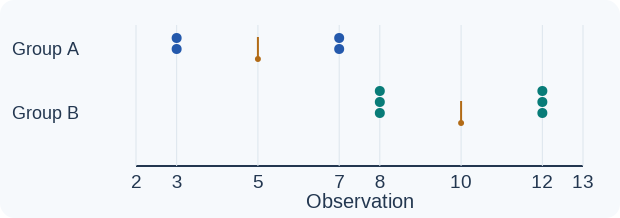
The mean of group A is five, the mean of B is ten, and the pooled mean is eight.

xˉ=4(5)+6(10)10=8,W=410(4)+610(4)=4.\bar x=\frac{4(5)+6(10)}{10}=8,\qquad W=\frac4{10}(4)+\frac6{10}(4)=4.B=410(5−8)2+610(10−8)2=6.B=\frac4{10}(5-8)^2+\frac6{10}(10-8)^2=6.Vpooled=W+B=10,σpooled=10.V_{\mathrm{pooled}}=W+B=10,\qquad \sigma_{\mathrm{pooled}}=\sqrt{10}.

The two within-group variances are equal. The separated group means add a further contribution.

The original groups 3,3,7,73,3,7,7 and 8,8,8,12,12,128,8,8,12,12,12 each have variance 44. Their pooled mean is 88, and pooled variance is 4+6=104+6=10.

Worked example

Zero spread inside each group can still give pooled variation

Group A contains three copies of 22. Group B contains two copies of 77. Calculate their within-group and between-group contributions to the combined variance.

  1. Each group is constant, so VA=VB=0V_A=V_B=0. The combined mean is

    μ=3(2)+2(7)5=4.\mu=\frac{3(2)+2(7)}{5}=4.
  2. W=3(0)+2(0)5=0.W=\frac{3(0)+2(0)}{5}=0.
  3. B=3(2−4)2+2(7−4)25=12+185=6.B=\frac{3(2-4)^2+2(7-4)^2}{5}=\frac{12+18}{5}=6.
  4. V=W+B=6,σ=6.V=W+B=6,\qquad\sigma=\sqrt{6}.

    All the pooled variation comes from the separation between the group means. Averaging the two zero SDs would miss it completely.

Your turn

Group A has two observations with mean 33 and variance 44. Disjoint group B has six observations with mean 77 and variance 44. Find the within-group contribution, between-group contribution and combined variance.

Enter an exact number, for example 3/2 or 2-sqrt(3).

Enter an exact number, for example 3/2 or 2-sqrt(3).

Enter an exact number, for example 3/2 or 2-sqrt(3).

Section 4 of 6 · Core · about 6 min

Can I recover a hidden group by subtraction?

If the complete dataset is exactly A together with B, subtract A’s count, total and sum of squares:

nB=N−nA,TB=T−TA,QB=Q−QA.n_B=N-n_A,\quad T_B=T-T_A,\quad Q_B=Q-Q_A.

For a positive remaining count, calculate μB=TBnB\mu_B=\frac{T_B}{n_B} and VB=QBnB−μB2V_B=\frac{Q_B}{n_B}-\mu_B^2. Check whether the records can exist:

  • For nB≥2n_B\ge2, unrestricted real records require QB≥TB2nBQ_B\ge\frac{T_B^2}{n_B}; this condition is also sufficient.
  • For nB=1n_B=1, require QB=TB2Q_B=T_B^2 and zero variance.
  • For nB=0n_B=0, both remaining totals must be zero. The remainder is empty, so its mean, variance and SD are undefined.

A negative or non-integer remaining count is invalid. Apply any extra integer or non-negative record restrictions as well.

Worked example

Subtract a known group from the whole dataset

A complete dataset has N=7,T=40,Q=260N=7,T=40,Q=260. A known subgroup A has three observations, mean 44 and descriptive variance 83\frac{8}{3}. Find the count, mean and variance of the remaining group B, and check its moment feasibility.

  1. TA=3(4)=12,QA=3(83+42)=56.T_A=3(4)=12,\qquad Q_A=3\left(\frac{8}{3}+4^2\right)=56.
  2. nB=7−3=4,TB=40−12=28,QB=260−56=204.n_B=7-3=4,\quad T_B=40-12=28,\quad Q_B=260-56=204.
  3. μB=284=7,VB=2044−72=2.\mu_B=\frac{28}{4}=7,\qquad V_B=\frac{204}{4}-7^2=2.
  4. QB−TB2nB=204−196=8≥0.Q_B-\frac{T_B^2}{n_B}=204-196=8\ge0.

    Four unrestricted real observations can have these moments. For example, 5,7,7,95,7,7,9 has total 2828 and sum of squares 204204.

  5. Combining this example with A’s possible list 2,4,62,4,6 restores the complete count and both original totals.

Your turn

A proposed complete dataset has N=5,T=21,Q=99N=5,T=21,Q=99. A known subgroup has nA=4,TA=16,QA=76n_A=4,T_A=16,Q_A=76. Find the remaining count, total and sum of squares, then decide whether the claim that A is a subgroup is possible. Separately, if subtraction leaves no records and both remaining totals are zero, what can be said about the remaining mean and SD?

Enter an exact number, for example 3/2 or 2-sqrt(3).

Enter an exact number, for example 3/2 or 2-sqrt(3).

Enter an exact number, for example 3/2 or 2-sqrt(3).

Can these summaries describe the claimed subgroup relation?
Mean and SD of an empty remainder

Section 5 of 6 · Core · about 6 min

Which new values preserve or change the SD?

Suppose the original list has n≥1n\ge1, mean μ\mu and descriptive variance VV. After adding one real value zz,

μnew=nμ+zn+1,\mu_{\mathrm{new}}=\frac{n\mu+z}{n+1},Vnew=nn+1V+n(n+1)2(z−μ)2.V_{\mathrm{new}}=\frac{n}{n+1}V+\frac{n}{(n+1)^2}(z-\mu)^2.

This follows by substituting T=nμT=n\mu and Q=n(V+μ2)Q=n(V+\mu^2) into the new moment formula. At z=μz=\mu, the mean stays fixed and positive variance decreases by the factor nn+1\frac{n}{n+1}; zero variance stays zero.

To preserve SD, set Vnew=VV_{\mathrm{new}}=V. Rearranging gives

(z−μ)2=n+1nV.(z-\mu)^2=\frac{n+1}{n}V.

There are two real additions when V>0V>0, and the single addition z=μz=\mu when V=0V=0. Check both branches against the question’s record restrictions.

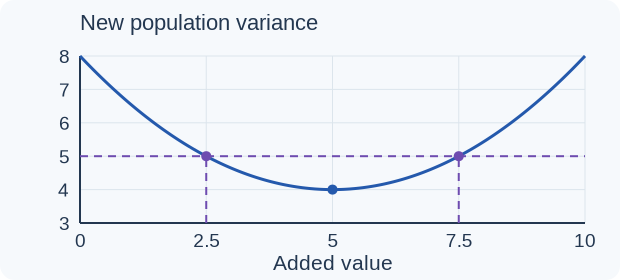
The variance curve meets the line at variance five when the observation is two and a half or seven and a half.

After adding zz, the count is 55, the total 20+z20+z and the sum of squares 120+z2120+z^2.

Vnew=120+z25−(20+z5)2=4+425(z−5)2.V_{\mathrm{new}}=\frac{120+z^2}{5}-\left(\frac{20+z}{5}\right)^2=4+\frac4{25}(z-5)^2.Vnew=5⟹(z−5)2=254⟹z=5±52.V_{\mathrm{new}}=5\Longrightarrow(z-5)^2=\frac{25}{4}\Longrightarrow z=5\pm\frac52.
Added valueNew meanNew SD
52\frac5292\frac925\sqrt5
152\frac{15}2112\frac{11}25\sqrt5

Adding 52\frac{5}{2} or 152\frac{15}{2} to 2,4,6,82,4,6,8 preserves variance 55, while changing the mean to 92\frac{9}{2} or 112\frac{11}{2}.

Worked example

Add a value while keeping the same SD

The records are 2,4,6,82,4,6,8. Find every real value zz that can be added without changing the descriptive SD. Give the corresponding new means.

  1. n=4,μ=5,V=4+16+36+644−52=5.n=4,\qquad\mu=5,\qquad V=\frac{4+16+36+64}{4}-5^2=5.
  2. Equal SDs give equal variances. The addition identity gives

    5=45(5)+425(z−5)2.5=\frac{4}{5}(5)+\frac{4}{25}(z-5)^2.
  3. (z−5)2=254⟹z=5±52.(z-5)^2=\frac{25}{4}\Longrightarrow z=5\pm\frac{5}{2}.

    Both z=52z=\frac{5}{2} and z=152z=\frac{15}{2} are valid.

  4. z=52:μnew=20+525=92,z=\frac{5}{2}:\quad\mu_{\mathrm{new}}=\frac{20+\frac{5}{2}}{5}=\frac{9}{2},z=152:μnew=20+1525=112.z=\frac{15}{2}:\quad\mu_{\mathrm{new}}=\frac{20+\frac{15}{2}}{5}=\frac{11}{2}.
  5. Substitution in the addition identity gives variance 55 for both branches. Inserting the old mean 55 instead would give variance 44, so it would not preserve the original SD.

Your turn

The original records are 0,0,30,0,3. Add one real observation zz so that the descriptive SD remains unchanged. Find every possible zz, then select the value if all records must be non-negative.

Give the complete set: {1, 4} for separate values, (1, 5] for an interval, U for union or empty for no real solutions. Use sqrt(...) for exact roots.

Enter an exact value or round to 3 significant figures.

Section 6 of 6 · Further applications · about 6 min

How do I control spread when a symmetric pair moves?

Suppose two existing records are μ−d\mu-d and μ+d\mu+d, where d≥0d\ge0 and μ\mu is the whole list’s mean. Replace them by μ−(d+t)\mu-(d+t) and μ+(d+t)\mu+(d+t), with t≥0t\ge0. Their sum is unchanged, so the count and mean stay fixed. The increase in centred sum of squares is

2(d+t)2−2d2=4dt+2t2.2(d+t)^2-2d^2=4dt+2t^2.

Therefore, for the original count n≥2n\ge2,

Vnew=V+4dt+2t2n.V_{\mathrm{new}}=V+\frac{4dt+2t^2}{n}.

For an SD bound σnew≤s\sigma_{\mathrm{new}}\le s, first check s≥0s\ge0, then solve Vnew≤s2V_{\mathrm{new}}\le s^2. A negative bound is impossible. Intersect the algebraic answer with t≥0t\ge0 and any restrictions on the changed records. Keep or exclude endpoints according to the stated inequality.

Worked example

Move a symmetric pair and enforce a spread limit

The records are 1,3,7,91,3,7,9. Replace the pair 1,91,9 by 1−t,9+t1-t,9+t, with t≥0t\ge0, keeping the other records fixed. Find all tt for which the new SD does not exceed 44. Then require every record to be non-negative.

  1. The original mean is 55, and the pair has deviations ±4\pm4. Its sum remains 1010, so the mean stays fixed. Initially,

    V=16+4+4+164=10.V=\frac{16+4+4+16}{4}=10.
  2. Vnew=10+4(4)t+2t24=10+4t+t22.V_{\mathrm{new}}=10+\frac{4(4)t+2t^2}{4}=10+4t+\frac{t^2}{2}.
  3. The SD bound is non-negative, so squaring is valid:

    σnew≤4⟺10+4t+t22≤16.\sigma_{\mathrm{new}}\le4\Longleftrightarrow10+4t+\frac{t^2}{2}\le16.
  4. t2+8t−12≤0⟺(t+4)2≤28.t^2+8t-12\le0\Longleftrightarrow(t+4)^2\le28.

    Intersecting with t≥0t\ge0 gives

    0≤t≤27−4.0\le t\le2\sqrt{7}-4.
  5. Non-negative records also require 1−t≥01-t\ge0. Since 27−4>12\sqrt{7}-4>1, the final interval is

    0≤t≤1.0\le t\le1.
  6. At t=1t=1, the records are 0,3,7,100,3,7,10, with variance 292<16\frac{29}{2}<16, confirming that the included endpoint meets the SD condition.

Your turn

The records 1,4,4,71,4,4,7 have their outer pair replaced by 1−t,7+t1-t,7+t, where t≥0t\ge0. Find the greatest allowed tt if the new SD must not exceed 33. Then impose the additional condition that every record is non-negative and give the new greatest allowed tt.

Enter an exact value or round to 3 significant figures.

Enter an exact number, for example 3/2 or 2-sqrt(3).

Worked examples

Practise the method

Core practice

Question 1 of 4

0 / 4 checked in this collection

Question list

Core practice

Fresh variants

Exam-style

Correct the record and its square

3 marks

n=5, sum=60, square-total=760. An entry 8 should be 13. Find the corrected mean, variance and SD.

Enter an exact number, for example 3/2 or 2-sqrt(3).

Enter an exact number, for example 3/2 or 2-sqrt(3).

Enter an exact number, for example 3/2 or 2-sqrt(3).

Full answer-format guide

Exact numbers: 3/2, sqrt(5), 2-sqrt(3), pi/6, 3*pi/2. Sets: {1,4}. Intervals: (3,5]; a round bracket excludes the endpoint. Infinity: inf; union: U; no solutions: empty. Separate coordinate pairs or triples with semicolons. Expressions: 2x^2+3x-1; equations: x^2=3x+1 or the polynomial equal to zero. Factors: x-1 ; x+2. Parameter fraction: numerator ; denominator. List integer answers individually.

Review the method

Progress stays in this browser. Create an account to save it or sign in.

Extra practice from this lesson

Replace the erroneous square as well as the record

Five numerical readings have total 3030 and sum of squares 254254. One recorded reading of 1212 should have been 77. Find the corrected mean, descriptive variance and exact SD.

Enter an exact number, for example 3/2 or 2-sqrt(3).

Enter an exact value or round to 3 significant figures.

Enter an exact number, for example 3/2 or 2-sqrt(3).

Distinguish removing a record from adding the old mean

The original numerical list is 4,4,7,94,4,7,9. First remove just one record equal to 44: find the remaining count, mean and descriptive variance. In a separate experiment, start again from the original four records and add their original mean as one new record. Find this second list’s mean and variance.

Enter an exact number, for example 3/2 or 2-sqrt(3).

Enter an exact value or round to 3 significant figures.

Enter an exact value or round to 3 significant figures.

Enter an exact number, for example 3/2 or 2-sqrt(3).

Enter an exact value or round to 3 significant figures.

Separate variation within and between two groups

Two disjoint groups of numerical observations use the same scale. A has count 44, mean 1010 and descriptive variance 44. B has count 66, mean 1515 and descriptive variance 99. Find the pooled mean, the within-group and between-group contributions to pooled variance, the pooled variance and the exact pooled SD.

Enter an exact number, for example 3/2 or 2-sqrt(3).

Enter an exact number, for example 3/2 or 2-sqrt(3).

Enter an exact number, for example 3/2 or 2-sqrt(3).

Enter an exact number, for example 3/2 or 2-sqrt(3).

Enter an exact number, for example 3/2 or 2-sqrt(3).

Recover a missing group by subtraction of moments

Eight numerical observations have mean 99 and descriptive variance 394\frac{39}{4}. Three of them form group A, with mean 66 and descriptive variance 83\frac{8}{3}. Find the count, mean and variance of the remaining group B. The two groups are disjoint and together contain all eight records.

Enter an exact number, for example 3/2 or 2-sqrt(3).

Enter an exact value or round to 3 significant figures.

Enter an exact value or round to 3 significant figures.

Retain both additions that preserve the SD

Four numerical observations have mean 1010 and descriptive variance 1616. Find every real value zz that can be added as one new observation without changing the SD. If z>10z>10, select the new observation and find the new mean. Separately, if the original four records all equal 1010, which added value preserves their zero SD?

Give the complete set: {1, 4} for separate values, (1, 5] for an interval, U for union or empty for no real solutions. Use sqrt(...) for exact roots.

Enter an exact value or round to 3 significant figures.

Enter an exact value or round to 3 significant figures.

Enter an exact number, for example 3/2 or 2-sqrt(3).

Apply it · original exam-style problems

Show your working on paper and compare it with the worked solution and marking guidance.

Start after this lesson

Decode two groups, then correct one original reading 8 marks

Two disjoint groups contain masses xx, in grams. A uses u=x−202u=\frac{x-20}{2} and has nA=4n_A=4, ∑u=4\sum u=4, ∑u2=12\sum u^2=12. B uses v=x−30−2v=\frac{x-30}{-2} and has nB=6n_B=6, ∑v=6\sum v=6, ∑v2=10\sum v^2=10. Find the pooled original mean and descriptive variance. One original mass of 26 g26\,\mathrm{g} in B was then found to be a transcription error for 22 g22\,\mathrm{g}. Find the corrected pooled mean, variance and exact SD.

Hint

The two coded lists use different origins and opposite scales, so first recover both groups on the original gram scale. Replace the erroneous original mass and its square only after the scales agree.

Worked solution
  1. For A, x=20+2ux=20+2u, giving

    TA=4(20)+2(4)=88,T_A=4(20)+2(4)=88,QA=4(202)+2(20)(2)(4)+22(12)=1968.Q_A=4(20^2)+2(20)(2)(4)+2^2(12)=1968.
  2. For B, x=30−2vx=30-2v, giving

    TB=6(30)−2(6)=168,T_B=6(30)-2(6)=168,QB=6(302)+2(30)(−2)(6)+(−2)2(10)=4720.Q_B=6(30^2)+2(30)(-2)(6)+(-2)^2(10)=4720.
  3. N=10,T=256,Q=6688,xˉ=1285 g.N=10,\quad T=256,\quad Q=6688,\quad\bar{x}=\frac{128}{5}\,\mathrm{g}.
  4. V=668810−(1285)2=33625 g2.V=\frac{6688}{10}-\left(\frac{128}{5}\right)^2=\frac{336}{25}\,\mathrm{g}^2.
  5. The correction keeps the total count at ten:

    Tnew=256−26+22=252,T_{\mathrm{new}}=256-26+22=252,Qnew=6688−262+222=6496.Q_{\mathrm{new}}=6688-26^2+22^2=6496.
  6. xˉnew=1265 g,Vnew=649610−(1265)2=36425 g2.\bar{x}_{\mathrm{new}}=\frac{126}{5}\,\mathrm{g},\qquad V_{\mathrm{new}}=\frac{6496}{10}-\left(\frac{126}{5}\right)^2=\frac{364}{25}\,\mathrm{g}^2.
  7. σnew=2915 g.\sigma_{\mathrm{new}}=\frac{2\sqrt{91}}{5}\,\mathrm{g}.

    The corrected mean decreases, but the variance increases. A change in the total alone does not determine what happens to spread.

Marking guidance
  • 1 mark: write both inverse codes on the original scale.
  • 1 mark: recover both original first totals.
  • 1 mark: recover both original sums of squares, retaining signed cross terms.
  • 1 mark: pool the original counts and moments and calculate the mean.
  • 1 mark: calculate the original pooled variance.
  • 1 mark: replace the erroneous value and its square with count unchanged.
  • 1 mark: calculate the corrected pooled mean and variance.
  • 1 mark: give the exact corrected SD with its original unit.
Use an SD bound on symmetric outward changes 8 marks

The original numerical observations are 2,5,5,82,5,5,8. Replace the first and last records by 2−t2-t and 8+t8+t, where t≥0t\ge0. Observations are allowed to be any real numbers. Find the new mean and the formula for descriptive variance V(t)V(t). The new SD must be at most 44. Find the two real roots of the boundary equation before applying the domain, then give the complete allowed interval for tt. Finally, list all allowed values if the adjustment tt is also required to be an integer.

Hint

The pair’s sum stays fixed, so the mean is still 55. Their deviations become −(3+t)-(3+t) and 3+t3+t. An SD bound of four gives a variance bound of sixteen.

Worked solution
  1. (2−t)+5+5+(8+t)=20⟹xˉ=5.(2-t)+5+5+(8+t)=20\quad\Longrightarrow\quad\bar{x}=5.
  2. V(t)=(−(3+t))2+0+0+(3+t)24=(t+3)22.V(t)=\frac{(-(3+t))^2+0+0+(3+t)^2}{4}=\frac{(t+3)^2}{2}.
  3. Both the SD and the bound are non-negative, so

    σ≤4⟺V(t)≤16⟺(t+3)2≤32.\sigma\le4\quad\Longleftrightarrow\quad V(t)\le16\quad\Longleftrightarrow\quad(t+3)^2\le32.
  4. The boundary equation has the two real roots

    t=−3±42.t=-3\pm4\sqrt{2}.

    The unrestricted real inequality holds between these roots, including the endpoints.

  5. Intersect with the original domain t≥0t\ge0:

    0≤t≤42−3.0\le t\le4\sqrt{2}-3.

    The upper endpoint gives SD exactly 44, so it is included.

  6. Since 2<42−3<32<4\sqrt{2}-3<3, the allowed integer adjustments are exactly 0,1,20,1,2. The negative boundary root is not an allowed outward adjustment.

Marking guidance
  • 1 mark: show that the total and mean remain unchanged.
  • 1 mark: identify both changed deviations from the mean.
  • 1 mark: obtain the complete variance expression, including its cross term.
  • 1 mark: convert the non-negative SD bound to a variance bound.
  • 1 mark: solve for both real boundary roots.
  • 1 mark: choose the interval between the roots with equality included.
  • 1 mark: intersect with the original non-negative adjustment domain.
  • 1 mark: list the complete allowed integer set.

Come back to what needs practice

Quick revision sheet (A4)

Your review plan starts after your first check.

Question bank and saved work