Maths4UBETA

Initial conditions and particular solutions

Use a given point to find the integration constant, choose a branch, and state where a particular solution is valid.

Try the quick check →
Lesson 4 of 5

Section 1 of 5 · Core · about 5 min

How do I choose one curve from the family?

The initial point gives an input and output on the same curve. Put both into the integrated relation before using it to predict further values.

Worked example

Use a condition away from zero

Solve dydx=4x+3\frac{\mathrm dy}{\mathrm dx}=4 x + 3 with y=11y=11 at x=1x=1. Find the integration constant in y=C+2x2+3xy=C + 2 x^{2} + 3 x and the value at x=2x=2.

  1. Integrate first to obtain y=C+2x2+3xy=C + 2 x^{2} + 3 x.

  2. Insert both coordinates of the given condition. The resulting constant is C=6C=6.

  3. Use that value to obtain y=2x2+3x+6y=2 x^{2} + 3 x + 6, then find y=20y=20 at the requested input.

Your turn

Solve dydx=6x+4\frac{\mathrm dy}{\mathrm dx}=6 x + 4 with y=15y=15 at x=2x=2. Find the integration constant in y=C+3x2+4xy=C + 3 x^{2} + 4 x and the value at x=3x=3.

Enter the value on its own or write c = … . Fractions and exact square roots are accepted.

Enter an exact number, for example 3/2 or 2-sqrt(3).

Section 2 of 5 · Core · about 5 min

How do I choose the coefficient after exponentiating?

Exponentiating a logarithm of an absolute value determines a magnitude. A signed coefficient lets the curve match the initial value.

Worked example

Choose the correct sign after exponentiating

Solve dydx=2y\frac{\mathrm dy}{\mathrm dx}=2 y with y=6y=6 at x=0x=0. Give the coefficient AA in y=Ae2xy=A\mathrm e^{2x} and state its sign.

  1. On a branch with ye0y e0, separation gives ln⁡∣y∣=C+2x\ln|y|=C + 2 x.

  2. Exponentiating gives ∣y∣=eCe2x|y|=\mathrm e^C\mathrm e^{2x}. Restore the sign as part of the coefficient AA.

  3. At x=0x=0 the exponential is one, so A=6A=6 and y=6e2xy=6 e^{2 x}.

Your turn

Solve dydx=3y\frac{\mathrm dy}{\mathrm dx}=3 y with y=−3y=-3 at x=0x=0. Give the coefficient AA in y=Ae3xy=A\mathrm e^{3x} and state its sign.

Enter the value on its own or write a = … . Fractions and exact square roots are accepted.

Sign of A

Section 3 of 5 · Core · about 7 min

Which square root fits the solution?

Solving a squared relation for yy yields two algebraic signs. The chosen function must pass through the given point and stay on its admissible interval.

Worked example

Select the square-root branch

For dydx=xy\frac{\mathrm dy}{\mathrm dx}=\frac{x}{y}, use y=5y=5 at x=1x=1. Find CC in y2=C+x2y^2=C + x^{2}, then give the exact value at x=2x=2.

  1. Multiply by yy and integrate. After multiplying through by two, y2=C+x2y^2=C + x^{2}.

  2. The initial point gives C=24C=24.

  3. The positive square root agrees with the given point. Use y=x2+24y=\sqrt{x^{2} + 24} to obtain y=27y=2 \sqrt{7}.

Your turn

For dydx=2xy\frac{\mathrm dy}{\mathrm dx}=\frac{2 x}{y}, use y=−6y=-6 at x=2x=2. Find CC in y2=C+2x2y^2=C + 2 x^{2}, then give the exact value at x=3x=3.

Enter the value on its own or write c = … . Fractions and exact square roots are accepted.

Enter an exact number, for example 3/2 or 2-sqrt(3).

Worked example

Select the square-root branch

For dydx=3xy\frac{\mathrm dy}{\mathrm dx}=\frac{3 x}{y}, use y=7y=7 at x=3x=3. Find CC in y2=C+3x2y^2=C + 3 x^{2}, then give the exact value at x=4x=4.

Try it on paper first.

  1. Multiply by yy and integrate. After multiplying through by two, y2=C+3x2y^2=C + 3 x^{2}.

  2. The initial point gives C=22C=22.

  3. The positive square root agrees with the given point. Use y=3x2+22y=\sqrt{3 x^{2} + 22} to obtain y=70y=\sqrt{70}.

Your turn

For dydx=6xy\frac{\mathrm dy}{\mathrm dx}=\frac{6 x}{y}, use y=−10y=-10 at x=0x=0. Find CC in y2=C+6x2y^2=C + 6 x^{2}, then give the exact value at x=1x=1.

Enter the value on its own or write c = … . Fractions and exact square roots are accepted.

Enter an exact number, for example 3/2 or 2-sqrt(3).

Section 4 of 5 · Core · about 5 min

Why can a real square root still be outside the domain?

The integrated relation can be meaningful at a point where the original derivative equation is not defined. Check both expressions.

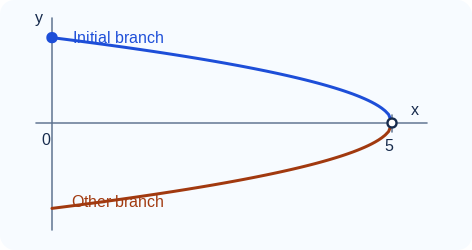
Two square-root branches meet the x-axis at the open point (5, 0). The marked initial point is on the upper branch at x = 0.

The initial point selects the upper branch.

Worked example

Exclude a singular endpoint

The equation dydx=−1y\frac{\mathrm dy}{\mathrm dx}=- \frac{1}{y} has a solution with y=10y=\sqrt{10} at x=0x=0. Give the complete x-interval containing zero on which this solution satisfies the differential equation.

  1. Separate and integrate to obtain y2=C−2xy^2=C - 2 x. Using the condition gives C=10C=10.

  2. Choose the positive root to agree with the initial point. The radicand must be strictly positive, since the equation divides by yy.

  3. Hence the interval is x<5x<5. The equality endpoint is excluded.

Your turn

The equation dydx=−32y\frac{\mathrm dy}{\mathrm dx}=- \frac{3}{2 y} has a solution with y=32y=3 \sqrt{2} at x=0x=0. Give the complete x-interval containing zero on which this solution satisfies the differential equation.

Use inequalities in x or interval notation. Join intervals with ‘or’ or ∪. Enter an isolated value on its own.

Section 5 of 5 · Core · about 7 min

When is an implicit relation useful?

An implicit relation may be simpler for calculating a quantity or giving the required answer. Use the correct branch if the question asks for an explicit result.

Worked example

Keep an implicit answer when allowed

Given dydx=2y+3\frac{\mathrm dy}{\mathrm dx}=\frac{2}{y + 3} and y=1y=1 at x=0x=0, find CC in (y+3)2=C+4x(y + 3)^2=C + 4 x. Also find the value of the squared left side at x=1x=1.

  1. Multiply through by y+3y + 3 and integrate. Completing the square gives the stated relation with one free constant.

  2. At the initial point, C=16C=16. An implicit particular solution is (y+3)2=4x+16(y + 3)^2=4 x + 16.

  3. Substituting the requested x-value gives the squared quantity 2020.

Your turn

Given dydx=3y+4\frac{\mathrm dy}{\mathrm dx}=\frac{3}{y + 4} and y=2y=2 at x=0x=0, find CC in (y+4)2=C+6x(y + 4)^2=C + 6 x. Also find the value of the squared left side at x=2x=2.

Enter the value on its own or write c = … . Fractions and exact square roots are accepted.

Enter an exact number, for example 3/2 or 2-sqrt(3).

Worked example

Keep an implicit answer when allowed

Given dydx=4y+5\frac{\mathrm dy}{\mathrm dx}=\frac{4}{y + 5} and y=3y=3 at x=0x=0, find CC in (y+5)2=C+8x(y + 5)^2=C + 8 x. Also find the value of the squared left side at x=3x=3.

Try it on paper first.

  1. Multiply through by y+5y + 5 and integrate. Completing the square gives the stated relation with one free constant.

  2. At the initial point, C=64C=64. An implicit particular solution is (y+5)2=8x+64(y + 5)^2=8 x + 64.

  3. Substituting the requested x-value gives the squared quantity 8888.

Your turn

Given dydx=7y+8\frac{\mathrm dy}{\mathrm dx}=\frac{7}{y + 8} and y=6y=6 at x=0x=0, find CC in (y+8)2=C+14x(y + 8)^2=C + 14 x. Also find the value of the squared left side at x=6x=6.

Enter the value on its own or write c = … . Fractions and exact square roots are accepted.

Enter an exact number, for example 3/2 or 2-sqrt(3).

Worked examples

Practise the method

Core practice

Question 1 of 4

0 / 4 checked in this collection

Question list

Core practice

Fresh variants

Exam-style

Use a condition away from zero

2 marks

Solve dydx=10x+6\frac{\mathrm dy}{\mathrm dx}=10 x + 6 with y=16y=16 at x=−1x=-1. Find the integration constant in y=C+5x2+6xy=C + 5 x^{2} + 6 x and the value at x=0x=0.

Enter the value on its own or write c = … . Fractions and exact square roots are accepted.

Enter an exact number, for example 3/2 or 2-sqrt(3).

Full answer-format guide

Exact numbers: 3/2, sqrt(5), 2-sqrt(3), pi/6, 3*pi/2. Sets: {1,4}. Intervals: (3,5]; a round bracket excludes the endpoint. Infinity: inf; union: U; no solutions: empty. Separate coordinate pairs or triples with semicolons. Expressions: 2x^2+3x-1; equations: x^2=3x+1 or the polynomial equal to zero. Factors: x-1 ; x+2. Parameter fraction: numerator ; denominator. List integer answers individually.

Review the method

Progress stays in this browser. Create an account to save it or sign in.

Extra practice from this lesson

Use a condition away from zero

Solve dydx=8x+5\frac{\mathrm dy}{\mathrm dx}=8 x + 5 with y=59y=59 at x=3x=3. Find the integration constant in y=C+4x2+5xy=C + 4 x^{2} + 5 x and the value at x=4x=4.

Enter the value on its own or write c = … . Fractions and exact square roots are accepted.

Enter an exact number, for example 3/2 or 2-sqrt(3).

Choose the correct sign after exponentiating

Solve dydx=4y\frac{\mathrm dy}{\mathrm dx}=4 y with y=4y=4 at x=0x=0. Give the coefficient AA in y=Ae4xy=A\mathrm e^{4x} and state its sign.

Enter the value on its own or write a = … . Fractions and exact square roots are accepted.

Sign of A

Select the square-root branch

For dydx=7xy\frac{\mathrm dy}{\mathrm dx}=\frac{7 x}{y}, use y=11y=11 at x=0x=0. Find CC in y2=C+7x2y^2=C + 7 x^{2}, then give the exact value at x=1x=1.

Enter the value on its own or write c = … . Fractions and exact square roots are accepted.

Enter an exact number, for example 3/2 or 2-sqrt(3).

Exclude a singular endpoint

The equation dydx=−2y\frac{\mathrm dy}{\mathrm dx}=- \frac{2}{y} has a solution with y=42y=4 \sqrt{2} at x=0x=0. Give the complete x-interval containing zero on which this solution satisfies the differential equation.

Use inequalities in x or interval notation. Join intervals with ‘or’ or ∪. Enter an isolated value on its own.

Keep an implicit answer when allowed

Given dydx=8y+9\frac{\mathrm dy}{\mathrm dx}=\frac{8}{y + 9} and y=7y=7 at x=0x=0, find CC in (y+9)2=C+16x(y + 9)^2=C + 16 x. Also find the value of the squared left side at x=7x=7.

Enter the value on its own or write c = … . Fractions and exact square roots are accepted.

Enter an exact number, for example 3/2 or 2-sqrt(3).

Apply it · original exam-style problems

Show your working on paper and compare it with the worked solution and marking guidance.

Come back to what needs practice

Quick revision sheet (A4)

Your review plan starts after your first check.