Maths4UBETA

Interpreting solutions in context

Use a solved model to find times and rates, distinguish limits from thresholds, and state where a model remains meaningful.

Try the quick check →
Lesson 5 of 5

Section 1 of 5 · Core · about 5 min

How do I read the limiting level and the direction of approach?

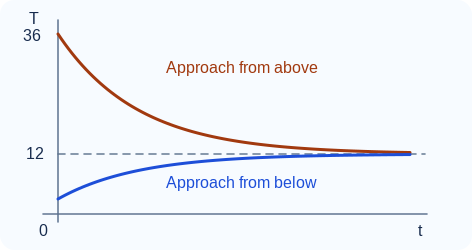
A decaying exponential correction to a level shrinks towards zero. Its sign locates the curve above or below the level.

Temperature versus time. An upper curve starts at 36 and decreases towards 12. A lower curve rises towards 12. Neither touches the dashed line T = 12.

The sign of the correction tells you which side of the limit the model stays on.

Worked example

Identify the limiting level and the direction

A temperature model is T=12+24e−2t5T=12 + 24 e^{- \frac{2 t}{5}} for t≥0t\ge0. Find the limiting temperature and decide whether the temperature approaches it from above or below.

  1. The exponential has a negative exponent coefficient, so it tends to zero as time increases.

  2. The constant term remains, giving a limiting temperature of 1212 degrees Celsius.

  3. The correction term is positive at every finite time, so the temperature approaches from above.

Your turn

A temperature model is T=15−15e−t2T=15 - 15 e^{- \frac{t}{2}} for t≥0t\ge0. Find the limiting temperature and decide whether the temperature approaches it from above or below.

Enter an exact number, for example 3/2 or 2-sqrt(3).

Side of the limiting level

Section 2 of 5 · Core · about 5 min

How can I find the time a target is reached?

Work with the difference from the limiting level. A threshold is reachable only if it lies on the modelled branch and between its initial and limiting levels, with the correct endpoint inclusion.

Worked example

Calculate a threshold time exactly

A sampling signal is S=15+16e−t2S=15 + 16 e^{- \frac{t}{2}} for t≥0t\ge0. It reaches 2323 at t=aln⁡bt=a\ln b with b>1b>1. Give a,ba,b, using the integer bb obtained by isolating the exponential and taking its reciprocal.

  1. Subtract the constant level and divide by the initial offset. This gives e−t2=12e^{- \frac{t}{2}}=\frac{1}{2}.

  2. Take logarithms. Equivalently, invert first to make the exponent positive and the argument an integer.

  3. The time is t=2log⁡(2)t=2 \log{\left(2 \right)}. It is positive because the signal falls towards its limit.

Your turn

A sampling signal is S=18+20e−2t3S=18 + 20 e^{- \frac{2 t}{3}} for t≥0t\ge0. It reaches 743\frac{74}{3} at t=aln⁡bt=a\ln b with b>1b>1. Give a,ba,b, using the integer bb obtained by isolating the exponential and taking its reciprocal.

Enter the value on its own or write a = … . Fractions and exact square roots are accepted.

Enter the value on its own or write b = … . Fractions and exact square roots are accepted.

Section 3 of 5 · Core · about 7 min

When should a model stop at a finite time?

A solution may produce a negative quantity after a certain time even though the equation is algebraically defined there. Use the context to decide where the description stops.

Worked example

Stop a model when its quantity reaches zero

An ice layer melts according to h=3−th=3 - t, where hh is its thickness in millimetres and tt is time in minutes. Include the instant it disappears. Give the valid time interval from the start and the thickness after one minute.

  1. The model starts at t=0t=0 with positive thickness.

  2. Solve h=0h=0 to find t=3t=3. The interval of validity is 0≤t≤30\le t\le 3.

  3. At one minute, the thickness is 22 millimetres.

Your turn

An ice layer melts according to h=6−3t2h=6 - \frac{3 t}{2}, where hh is its thickness in millimetres and tt is time in minutes. Include the instant it disappears. Give the valid time interval from the start and the thickness after one minute.

Use inequalities in t or interval notation. Join intervals with ‘or’ or ∪. Enter an isolated value on its own.

Enter an exact number, for example 3/2 or 2-sqrt(3).

Worked example

Stop a model when its quantity reaches zero

An ice layer melts according to h=10−2th=10 - 2 t, where hh is its thickness in millimetres and tt is time in minutes. Include the instant it disappears. Give the valid time interval from the start and the thickness after one minute.

Try it on paper first.

  1. The model starts at t=0t=0 with positive thickness.

  2. Solve h=0h=0 to find t=5t=5. The interval of validity is 0≤t≤50\le t\le 5.

  3. At one minute, the thickness is 88 millimetres.

Your turn

An ice layer melts according to h=28−7t2h=28 - \frac{7 t}{2}, where hh is its thickness in millimetres and tt is time in minutes. Include the instant it disappears. Give the valid time interval from the start and the thickness after one minute.

Use inequalities in t or interval notation. Join intervals with ‘or’ or ∪. Enter an isolated value on its own.

Enter an exact number, for example 3/2 or 2-sqrt(3).

Section 4 of 5 · Core · about 5 min

How can I give a rate at a given level?

The value of the function and its rate of change answer different questions. At a requested level, substitute that level into the differential equation or differentiate the explicit solution.

Worked example

Evaluate the rate at a specified level

A coating thickness follows h=12t+14h=\frac{1}{2 t + \frac{1}{4}} for t≥0t\ge0. Give the time when h=1h=1 and the signed rate at that time.

  1. Take reciprocals to solve 2t+14=12 t + \frac{1}{4}=1. This gives t=38t=\frac{3}{8}.

  2. Differentiate the reciprocal using the chain rule to get dhdt=−2h2\frac{\mathrm dh}{\mathrm dt}=-2h^2.

  3. The signed rate at the specified level is dhdt=−2\frac{\mathrm dh}{\mathrm dt}=-2.

Your turn

A coating thickness follows h=13t+15h=\frac{1}{3 t + \frac{1}{5}} for t≥0t\ge0. Give the time when h=2h=2 and the signed rate at that time.

Enter an exact number, for example 3/2 or 2-sqrt(3).

Enter an exact number, for example 3/2 or 2-sqrt(3).

Section 5 of 5 · Core · about 7 min

How do I explain a model limitation precisely?

Name the feature of the model that causes a conflict with the real situation. A finite capacity cannot support unlimited exponential growth.

Worked example

Recognise when extrapolation fails

A preview service predicts N=2et3N=2 e^{\frac{t}{3}} simultaneous streams at time tt. The hardware can serve at most 1212 streams. Would continuing the same exponential model indefinitely be valid? Give the positive multiplier aa in the capacity time t=aln⁡bt=a\ln b after isolating the original exponential.

  1. The exponential increases without bound. The hardware capacity is fixed and finite.

  2. Solving the threshold equation gives et3=6e^{\frac{t}{3}}=6.

  3. Then t=113ln⁡(6)t=\frac1{\frac{1}{3}}\ln\left(6\right), so a=3a=3. This is where the model first reaches the capacity.

Your turn

A preview service predicts N=3et4N=3 e^{\frac{t}{4}} simultaneous streams at time tt. The hardware can serve at most 1515 streams. Would continuing the same exponential model indefinitely be valid? Give the positive multiplier aa in the capacity time t=aln⁡bt=a\ln b after isolating the original exponential.

Is unlimited extrapolation valid?

Enter the value on its own or write a = … . Fractions and exact square roots are accepted.

Worked example

Recognise when extrapolation fails

A preview service predicts N=4et5N=4 e^{\frac{t}{5}} simultaneous streams at time tt. The hardware can serve at most 1818 streams. Would continuing the same exponential model indefinitely be valid? Give the positive multiplier aa in the capacity time t=aln⁡bt=a\ln b after isolating the original exponential.

Try it on paper first.

  1. The exponential increases without bound. The hardware capacity is fixed and finite.

  2. Solving the threshold equation gives et5=92e^{\frac{t}{5}}=\frac{9}{2}.

  3. Then t=115ln⁡(92)t=\frac1{\frac{1}{5}}\ln\left(\frac{9}{2}\right), so a=5a=5. This is where the model first reaches the capacity.

Your turn

A preview service predicts N=7et8N=7 e^{\frac{t}{8}} simultaneous streams at time tt. The hardware can serve at most 2727 streams. Would continuing the same exponential model indefinitely be valid? Give the positive multiplier aa in the capacity time t=aln⁡bt=a\ln b after isolating the original exponential.

Is unlimited extrapolation valid?

Enter the value on its own or write a = … . Fractions and exact square roots are accepted.

Worked examples

Practise the method

Core practice

Question 1 of 4

0 / 4 checked in this collection

Question list

Core practice

Fresh variants

Exam-style

Identify the limiting level and the direction

2 marks

A temperature model is T=21−12e−5t8T=21 - 12 e^{- \frac{5 t}{8}} for t≥0t\ge0. Find the limiting temperature and decide whether the temperature approaches it from above or below.

Enter an exact number, for example 3/2 or 2-sqrt(3).

Side of the limiting level

Choose one option. Explain your reasoning on paper.

Full answer-format guide

Exact numbers: 3/2, sqrt(5), 2-sqrt(3), pi/6, 3*pi/2. Sets: {1,4}. Intervals: (3,5]; a round bracket excludes the endpoint. Infinity: inf; union: U; no solutions: empty. Separate coordinate pairs or triples with semicolons. Expressions: 2x^2+3x-1; equations: x^2=3x+1 or the polynomial equal to zero. Factors: x-1 ; x+2. Parameter fraction: numerator ; denominator. List integer answers individually.

Review the method

Progress stays in this browser. Create an account to save it or sign in.

Extra practice from this lesson

Identify the limiting level and the direction

A temperature model is T=18+30e−4t7T=18 + 30 e^{- \frac{4 t}{7}} for t≥0t\ge0. Find the limiting temperature and decide whether the temperature approaches it from above or below.

Enter an exact number, for example 3/2 or 2-sqrt(3).

Side of the limiting level

Calculate a threshold time exactly

A sampling signal is S=21+24e−3t4S=21 + 24 e^{- \frac{3 t}{4}} for t≥0t\ge0. It reaches 2727 at t=aln⁡bt=a\ln b with b>1b>1. Give a,ba,b, using the integer bb obtained by isolating the exponential and taking its reciprocal.

Enter the value on its own or write a = … . Fractions and exact square roots are accepted.

Enter the value on its own or write b = … . Fractions and exact square roots are accepted.

Stop a model when its quantity reaches zero

An ice layer melts according to h=36−4th=36 - 4 t, where hh is its thickness in millimetres and tt is time in minutes. Include the instant it disappears. Give the valid time interval from the start and the thickness after one minute.

Use inequalities in t or interval notation. Join intervals with ‘or’ or ∪. Enter an isolated value on its own.

Enter an exact number, for example 3/2 or 2-sqrt(3).

Evaluate the rate at a specified level

A coating thickness follows h=14t+16h=\frac{1}{4 t + \frac{1}{6}} for t≥0t\ge0. Give the time when h=3h=3 and the signed rate at that time.

Enter an exact number, for example 3/2 or 2-sqrt(3).

Enter an exact number, for example 3/2 or 2-sqrt(3).

Recognise when extrapolation fails

A preview service predicts N=8et9N=8 e^{\frac{t}{9}} simultaneous streams at time tt. The hardware can serve at most 3030 streams. Would continuing the same exponential model indefinitely be valid? Give the positive multiplier aa in the capacity time t=aln⁡bt=a\ln b after isolating the original exponential.

Is unlimited extrapolation valid?

Enter the value on its own or write a = … . Fractions and exact square roots are accepted.

Apply it · original exam-style problems

Show your working on paper and compare it with the worked solution and marking guidance.

Come back to what needs practice

Quick revision sheet (A4)

Your review plan starts after your first check.