Maths4UBETA

Distance, displacement and position–time graphs

Use signed positions and velocity on a straight line. Find distances, average rates and crossings from a position–time graph.

Try the quick check →
Lesson 1 of 5

Section 1 of 5 · Core · about 5 min

How do I decide which quantities need a sign?

Motion is along one line. Set an origin and declare an orientation before tracing the movements. Motion opposite that orientation makes a negative contribution to displacement.

Worked example

Distinguish position, displacement and distance

Positions on a straight track are measured east of a fixed marker. A trolley starts 3 m3\,\mathrm m east of the marker, travels 7 m7\,\mathrm m east, then 11 m11\,\mathrm m west. Find its final position, displacement from its start and total distance travelled. Give signed positions and displacements.

  1. East is positive. The westward displacement is −11 m-11\,\mathrm m.

  2. The two legs give 7−11=−47-11=-4 so the displacement from the start is −4 m-4\,\mathrm m. Add the starting position for −1 m-1\,\mathrm m.

  3. Add the path lengths for a distance of 18 m18\,\mathrm m.

Your turn

Positions on a straight track are measured east of a fixed marker. A trolley starts 4 m4\,\mathrm m east of the marker, travels 9 m9\,\mathrm m east, then 14 m14\,\mathrm m west. Find its final position, displacement from its start and total distance travelled. Give signed positions and displacements.

Enter an exact number, for example 3/2 or 2-sqrt(3).

Enter an exact number, for example 3/2 or 2-sqrt(3).

Enter an exact number, for example 3/2 or 2-sqrt(3).

Section 2 of 5 · Core · about 5 min

Why can average speed differ from average velocity?

Both averages use the whole elapsed time. The numerators measure different things after a reversal.

Worked example

Compare average speed and average velocity

A carrier moves 8 m8\,\mathrm m east and then 10 m10\,\mathrm m west. The whole journey lasts 3 s3\,\mathrm s. Take east as positive. Find its signed average velocity and average speed.

  1. Positive and negative legs give a net displacement of −2 m-2\,\mathrm m.

  2. Average velocity is displacement divided by elapsed time, giving −23 m s−1- \frac{2}{3}\,\mathrm{m\,s^{-1}}.

  3. Average speed uses the total path length 18 m18\,\mathrm m, giving 6 m s−16\,\mathrm{m\,s^{-1}}.

Your turn

A carrier moves 11 m11\,\mathrm m east and then 14 m14\,\mathrm m west. The whole journey lasts 4 s4\,\mathrm s. Take east as positive. Find its signed average velocity and average speed.

Enter an exact value or round to 3 significant figures.

Enter an exact value or round to 3 significant figures.

Section 3 of 5 · Core · about 7 min

What does a sloping position graph tell me?

The horizontal axis measures time. The vertical axis in a position graph measures signed position. A straight segment has a constant slope.

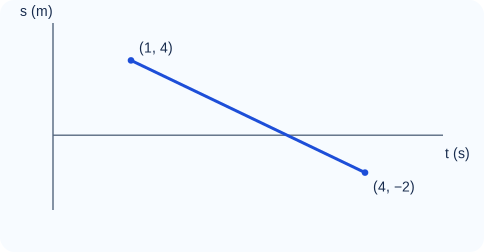
A falling straight position–time segment joins (1, 4) to (4, −2). It passes through position zero between these endpoints.

The sign of the gradient gives the direction of motion.

Worked example

Get velocity from a straight position segment

A straight segment of a position–time graph joins (1,4)(1,4) and (4,−2)(4,-2), with time in seconds and position in metres. Find the velocity and speed on the segment.

  1. Find the signed change in position, −6 m-6\,\mathrm m, and the positive elapsed time, 3 s3\,\mathrm s.

  2. Their quotient gives the gradient, −2 m s−1-2\,\mathrm{m\,s^{-1}}, which is the velocity.

  3. Speed is the magnitude of velocity, 2 m s−12\,\mathrm{m\,s^{-1}}.

Your turn

A straight segment of a position–time graph joins (2,5)(2,5) and (6,−7)(6,-7), with time in seconds and position in metres. Find the velocity and speed on the segment.

Enter an exact number, for example 3/2 or 2-sqrt(3).

Enter an exact number, for example 3/2 or 2-sqrt(3).

Worked example

Get velocity from a straight position segment

A straight segment of a position–time graph joins (3,6)(3,6) and (8,−14)(8,-14), with time in seconds and position in metres. Find the velocity and speed on the segment.

Try it on paper first.

  1. Find the signed change in position, −20 m-20\,\mathrm m, and the positive elapsed time, 5 s5\,\mathrm s.

  2. Their quotient gives the gradient, −4 m s−1-4\,\mathrm{m\,s^{-1}}, which is the velocity.

  3. Speed is the magnitude of velocity, 4 m s−14\,\mathrm{m\,s^{-1}}.

Your turn

A straight segment of a position–time graph joins (6,9)(6,9) and (14,−47)(14,-47), with time in seconds and position in metres. Find the velocity and speed on the segment.

Enter an exact number, for example 3/2 or 2-sqrt(3).

Enter an exact number, for example 3/2 or 2-sqrt(3).

Section 4 of 5 · Core · about 5 min

What does a horizontal line mean?

A level portion of a position–time graph means the position remains unchanged. It can appear at any height.

Worked example

Read a stay at a non-zero position

A position–time graph is horizontal at s=5s=5 for 2≤t≤52\le t\le 5. Time is in seconds and position is in metres. Find the velocity and the time spent at rest in this interval.

  1. Position remains fixed through the whole horizontal segment.

  2. The gradient is zero, so the velocity is 0 m s−10\,\mathrm{m\,s^{-1}}.

  3. The time spent at rest is the difference between the endpoints, 3 s3\,\mathrm s.

Your turn

A position–time graph is horizontal at s=7s=7 for 3≤t≤73\le t\le 7. Time is in seconds and position is in metres. Find the velocity and the time spent at rest in this interval.

Enter an exact number, for example 3/2 or 2-sqrt(3).

Enter an exact number, for example 3/2 or 2-sqrt(3).

Section 5 of 5 · Core · about 7 min

How can I find a crossing of the origin?

Passing the origin concerns position. Stopping or changing direction concerns velocity.

Worked example

Find when a particle passes the origin

A position–time straight line is given by s=2t−3s=2 t - 3 for t≥0t\ge0. Time is in seconds and position in metres. Find the time the particle passes the origin and its distance from the origin at t=3 st=3\,\mathrm s.

  1. Passing the origin means s=0s=0. The gradient 22 is non-zero.

  2. Solve the linear equation to obtain t=32 st=\frac{3}{2}\,\mathrm s.

  3. At the later time, substitute into the position equation and take its magnitude, giving 3 m3\,\mathrm m.

Your turn

A position–time straight line is given by s=3t−5s=3 t - 5 for t≥0t\ge0. Time is in seconds and position in metres. Find the time the particle passes the origin and its distance from the origin at t=4 st=4\,\mathrm s.

Enter an exact value or round to 3 significant figures.

Enter an exact number, for example 3/2 or 2-sqrt(3).

Worked example

Find when a particle passes the origin

A position–time straight line is given by s=4t−7s=4 t - 7 for t≥0t\ge0. Time is in seconds and position in metres. Find the time the particle passes the origin and its distance from the origin at t=5 st=5\,\mathrm s.

Try it on paper first.

  1. Passing the origin means s=0s=0. The gradient 44 is non-zero.

  2. Solve the linear equation to obtain t=74 st=\frac{7}{4}\,\mathrm s.

  3. At the later time, substitute into the position equation and take its magnitude, giving 13 m13\,\mathrm m.

Your turn

A position–time straight line is given by s=7t−13s=7 t - 13 for t≥0t\ge0. Time is in seconds and position in metres. Find the time the particle passes the origin and its distance from the origin at t=8 st=8\,\mathrm s.

Enter an exact value or round to 3 significant figures.

Enter an exact number, for example 3/2 or 2-sqrt(3).

Worked examples

Practise the method

Core practice

Question 1 of 4

0 / 4 checked in this collection

Question list

Core practice

Fresh variants

Exam-style

Distinguish position, displacement and distance

3 marks

Positions on a straight track are measured east of a fixed marker. A trolley starts 6 m6\,\mathrm m east of the marker, travels 13 m13\,\mathrm m east, then 20 m20\,\mathrm m west. Find its final position, displacement from its start and total distance travelled. Give signed positions and displacements.

Enter an exact number, for example 3/2 or 2-sqrt(3).

Enter an exact number, for example 3/2 or 2-sqrt(3).

Enter an exact number, for example 3/2 or 2-sqrt(3).

Full answer-format guide

Exact numbers: 3/2, sqrt(5), 2-sqrt(3), pi/6, 3*pi/2. Sets: {1,4}. Intervals: (3,5]; a round bracket excludes the endpoint. Infinity: inf; union: U; no solutions: empty. Separate coordinate pairs or triples with semicolons. Expressions: 2x^2+3x-1; equations: x^2=3x+1 or the polynomial equal to zero. Factors: x-1 ; x+2. Parameter fraction: numerator ; denominator. List integer answers individually.

Review the method

Progress stays in this browser. Create an account to save it or sign in.

Extra practice from this lesson

Distinguish position, displacement and distance

Positions on a straight track are measured east of a fixed marker. A trolley starts 5 m5\,\mathrm m east of the marker, travels 11 m11\,\mathrm m east, then 17 m17\,\mathrm m west. Find its final position, displacement from its start and total distance travelled. Give signed positions and displacements.

Enter an exact number, for example 3/2 or 2-sqrt(3).

Enter an exact number, for example 3/2 or 2-sqrt(3).

Enter an exact number, for example 3/2 or 2-sqrt(3).

Compare average speed and average velocity

A carrier moves 14 m14\,\mathrm m east and then 18 m18\,\mathrm m west. The whole journey lasts 5 s5\,\mathrm s. Take east as positive. Find its signed average velocity and average speed.

Enter an exact value or round to 3 significant figures.

Enter an exact value or round to 3 significant figures.

Get velocity from a straight position segment

A straight segment of a position–time graph joins (7,10)(7,10) and (16,−62)(16,-62), with time in seconds and position in metres. Find the velocity and speed on the segment.

Enter an exact number, for example 3/2 or 2-sqrt(3).

Enter an exact number, for example 3/2 or 2-sqrt(3).

Read a stay at a non-zero position

A position–time graph is horizontal at s=9s=9 for 4≤t≤94\le t\le 9. Time is in seconds and position is in metres. Find the velocity and the time spent at rest in this interval.

Enter an exact number, for example 3/2 or 2-sqrt(3).

Enter an exact number, for example 3/2 or 2-sqrt(3).

Find when a particle passes the origin

A position–time straight line is given by s=8t−15s=8 t - 15 for t≥0t\ge0. Time is in seconds and position in metres. Find the time the particle passes the origin and its distance from the origin at t=9 st=9\,\mathrm s.

Enter an exact value or round to 3 significant figures.

Enter an exact number, for example 3/2 or 2-sqrt(3).

Apply it · original exam-style problems

Show your working on paper and compare it with the worked solution and marking guidance.

Come back to what needs practice

Quick revision sheet (A4)

Your review plan starts after your first check.