Maths4UBETA

Constant acceleration and vertical motion

Choose a constant-acceleration equation, use signed quantities and calculate highest points and impact conditions in vertical motion.

Try the quick check →
Lesson 3 of 5

Section 1 of 5 · Core · about 5 min

When can I use the constant-acceleration formulae?

Write the five quantities and choose a positive direction. These equations apply to a single interval of uniform acceleration.

Worked example

Connect initial and final velocities

A trolley starts with velocity 3 m s−13\,\mathrm{m\,s^{-1}} and accelerates uniformly at 2 m s−22\,\mathrm{m\,s^{-2}} for 4 s4\,\mathrm s. Find the final velocity and displacement.

  1. The acceleration is constant. Use v=u+atv=u+at to find 11 m s−111\,\mathrm{m\,s^{-1}}.

  2. The velocity rises linearly. Its average is 7 m s−17\,\mathrm{m\,s^{-1}}.

  3. Multiply the average velocity by the duration for a displacement of 28 m28\,\mathrm m.

Your turn

A trolley starts with velocity 4 m s−14\,\mathrm{m\,s^{-1}} and accelerates uniformly at 4 m s−24\,\mathrm{m\,s^{-2}} for 5 s5\,\mathrm s. Find the final velocity and displacement.

Enter the value on its own or write v = … . Fractions and exact square roots are accepted.

Enter the value on its own or write s = … . Fractions and exact square roots are accepted.

Section 2 of 5 · Core · about 5 min

Which formula avoids the unknown final velocity?

When the final velocity is not given, substitute the linear velocity relation into the signed area formula.

Worked example

Use displacement without knowing the final velocity

A particle moves in the positive direction. From an initial velocity of 2 m s−12\,\mathrm{m\,s^{-1}} it accelerates at a constant 2 m s−22\,\mathrm{m\,s^{-2}} for 3 s3\,\mathrm s. Find the separate displacement terms due to the initial velocity and the acceleration, then the total.

  1. 2 m s−12\,\mathrm{m\,s^{-1}} maintained for the whole interval would give 6 m6\,\mathrm m.

  2. The increasing velocity adds the triangular area 12at2\frac12at^2, which is 9 m9\,\mathrm m.

  3. Together these give 15 m15\,\mathrm m.

Your turn

A particle moves in the positive direction. From an initial velocity of 3 m s−13\,\mathrm{m\,s^{-1}} it accelerates at a constant 4 m s−24\,\mathrm{m\,s^{-2}} for 4 s4\,\mathrm s. Find the separate displacement terms due to the initial velocity and the acceleration, then the total.

Enter an exact number, for example 3/2 or 2-sqrt(3).

Enter an exact number, for example 3/2 or 2-sqrt(3).

Enter an exact number, for example 3/2 or 2-sqrt(3).

Section 3 of 5 · Core · about 7 min

Which formula avoids time?

A distance marker gives an endpoint without specifying when it occurs. Eliminate time when u,v,a,su,v,a,s contain the information you need.

Worked example

Eliminate time in a braking calculation

On a straight track, a sled slows uniformly from 11 m s−111\,\mathrm{m\,s^{-1}} to 5 m s−15\,\mathrm{m\,s^{-1}} while moving 3 m3\,\mathrm m in the same positive direction. Find its signed acceleration and time spent slowing.

  1. Both velocities and the displacement are positive. Since no time is given, use v2=u2+2asv^2=u^2+2as.

  2. Rearranging gives −16 m s−2-16\,\mathrm{m\,s^{-2}}. The negative sign is consistent with the falling positive velocity.

  3. Use v=u+atv=u+at to obtain a duration of 38 s\frac{3}{8}\,\mathrm s.

Your turn

On a straight track, a sled slows uniformly from 13 m s−113\,\mathrm{m\,s^{-1}} to 6 m s−16\,\mathrm{m\,s^{-1}} while moving 4 m4\,\mathrm m in the same positive direction. Find its signed acceleration and time spent slowing.

Enter an exact value or round to 3 significant figures.

Enter an exact value or round to 3 significant figures.

Worked example

Eliminate time in a braking calculation

On a straight track, a sled slows uniformly from 15 m s−115\,\mathrm{m\,s^{-1}} to 7 m s−17\,\mathrm{m\,s^{-1}} while moving 5 m5\,\mathrm m in the same positive direction. Find its signed acceleration and time spent slowing.

Try it on paper first.

  1. Both velocities and the displacement are positive. Since no time is given, use v2=u2+2asv^2=u^2+2as.

  2. Rearranging gives −885 m s−2- \frac{88}{5}\,\mathrm{m\,s^{-2}}. The negative sign is consistent with the falling positive velocity.

  3. Use v=u+atv=u+at to obtain a duration of 511 s\frac{5}{11}\,\mathrm s.

Your turn

On a straight track, a sled slows uniformly from 21 m s−121\,\mathrm{m\,s^{-1}} to 10 m s−110\,\mathrm{m\,s^{-1}} while moving 8 m8\,\mathrm m in the same positive direction. Find its signed acceleration and time spent slowing.

Enter an exact value or round to 3 significant figures.

Enter an exact value or round to 3 significant figures.

Section 4 of 5 · Core · about 5 min

What is zero at the highest point?

For free vertical motion with up positive, take acceleration −g-g. This is the same while the object rises, stops momentarily and falls.

Worked example

Find the highest point above the ground

A marker is thrown vertically upwards from a height of 3 m3\,\mathrm m with speed 12 m s−112\,\mathrm{m\,s^{-1}}. Take the upward direction as positive. Throughout this motion, ignore air resistance and take g=10 m s−2g=10\,\mathrm{m\,s^{-2}}. Find the time and height above the ground at the highest point.

  1. At the highest point the velocity is zero. Acceleration is still −10 m s−2-10\,\mathrm{m\,s^{-2}}.

  2. Put v=0v=0 in v=12−10tv=12-10t to obtain t=65 st=\frac{6}{5}\,\mathrm s.

  3. The rise is 365 m\frac{36}{5}\,\mathrm m. Add the launch height for 515 m\frac{51}{5}\,\mathrm m.

Your turn

A marker is thrown vertically upwards from a height of 5 m5\,\mathrm m with speed 15 m s−115\,\mathrm{m\,s^{-1}}. Take the upward direction as positive. Throughout this motion, ignore air resistance and take g=10 m s−2g=10\,\mathrm{m\,s^{-2}}. Find the time and height above the ground at the highest point.

Enter an exact value or round to 3 significant figures.

Enter an exact value or round to 3 significant figures.

Section 5 of 5 · Core · about 7 min

How do I choose a time from a vertical-motion quadratic?

Choose an origin such as ground level. Use initial height plus displacement and stop the equation at the first impact unless a later stage is specified.

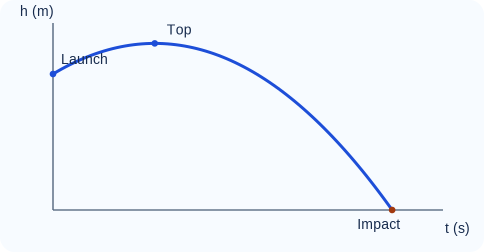
The model particle starts at height 8 m, reaches a maximum at 0.6 s, then lands at t = 2 s.

The time at the top is set by a horizontal tangent.

Worked example

Use the positive time and signed impact velocity

A particle is thrown vertically upwards at 6 m s−16\,\mathrm{m\,s^{-1}} from a platform 8 m8\,\mathrm m above the ground. Use upward positive. Throughout this motion, ignore air resistance and take g=10 m s−2g=10\,\mathrm{m\,s^{-2}}. Determine its impact time and signed velocity just before striking the ground.

  1. For height above ground, h=−5t2+6t+8h=- 5 t^{2} + 6 t + 8. Set height equal to zero at impact.

  2. The roots are 22 and −45- \frac{4}{5}. Only the positive one lies in the time after launch.

  3. Evaluate v=6−10tv=6 - 10 t at the accepted root to get −14 m s−1-14\,\mathrm{m\,s^{-1}}.

Your turn

A particle is thrown vertically upwards at 8 m s−18\,\mathrm{m\,s^{-1}} from a platform 21 m21\,\mathrm m above the ground. Use upward positive. Throughout this motion, ignore air resistance and take g=10 m s−2g=10\,\mathrm{m\,s^{-2}}. Determine its impact time and signed velocity just before striking the ground.

Enter an exact number, for example 3/2 or 2-sqrt(3).

Enter the value on its own or write v = … . Fractions and exact square roots are accepted.

Worked example

Use the positive time and signed impact velocity

A particle is thrown vertically upwards at 12 m s−112\,\mathrm{m\,s^{-1}} from a platform 32 m32\,\mathrm m above the ground. Use upward positive. Throughout this motion, ignore air resistance and take g=10 m s−2g=10\,\mathrm{m\,s^{-2}}. Determine its impact time and signed velocity just before striking the ground.

Try it on paper first.

  1. For height above ground, h=−5t2+12t+32h=- 5 t^{2} + 12 t + 32. Set height equal to zero at impact.

  2. The roots are 44 and −85- \frac{8}{5}. Only the positive one lies in the time after launch.

  3. Evaluate v=12−10tv=12 - 10 t at the accepted root to get −28 m s−1-28\,\mathrm{m\,s^{-1}}.

Your turn

A particle is thrown vertically upwards at 14 m s−114\,\mathrm{m\,s^{-1}} from a platform 147 m147\,\mathrm m above the ground. Use upward positive. Throughout this motion, ignore air resistance and take g=10 m s−2g=10\,\mathrm{m\,s^{-2}}. Determine its impact time and signed velocity just before striking the ground.

Enter an exact number, for example 3/2 or 2-sqrt(3).

Enter the value on its own or write v = … . Fractions and exact square roots are accepted.

Worked examples

Practise the method

Core practice

Question 1 of 4

0 / 4 checked in this collection

Question list

Core practice

Fresh variants

Exam-style

Connect initial and final velocities

2 marks

A trolley starts with velocity 6 m s−16\,\mathrm{m\,s^{-1}} and accelerates uniformly at 8 m s−28\,\mathrm{m\,s^{-2}} for 7 s7\,\mathrm s. Find the final velocity and displacement.

Enter the value on its own or write v = … . Fractions and exact square roots are accepted.

Enter the value on its own or write s = … . Fractions and exact square roots are accepted.

Full answer-format guide

Exact numbers: 3/2, sqrt(5), 2-sqrt(3), pi/6, 3*pi/2. Sets: {1,4}. Intervals: (3,5]; a round bracket excludes the endpoint. Infinity: inf; union: U; no solutions: empty. Separate coordinate pairs or triples with semicolons. Expressions: 2x^2+3x-1; equations: x^2=3x+1 or the polynomial equal to zero. Factors: x-1 ; x+2. Parameter fraction: numerator ; denominator. List integer answers individually.

Review the method

Progress stays in this browser. Create an account to save it or sign in.

Extra practice from this lesson

Connect initial and final velocities

A trolley starts with velocity 5 m s−15\,\mathrm{m\,s^{-1}} and accelerates uniformly at 6 m s−26\,\mathrm{m\,s^{-2}} for 6 s6\,\mathrm s. Find the final velocity and displacement.

Enter the value on its own or write v = … . Fractions and exact square roots are accepted.

Enter the value on its own or write s = … . Fractions and exact square roots are accepted.

Use displacement without knowing the final velocity

A particle moves in the positive direction. From an initial velocity of 4 m s−14\,\mathrm{m\,s^{-1}} it accelerates at a constant 6 m s−26\,\mathrm{m\,s^{-2}} for 5 s5\,\mathrm s. Find the separate displacement terms due to the initial velocity and the acceleration, then the total.

Enter an exact number, for example 3/2 or 2-sqrt(3).

Enter an exact number, for example 3/2 or 2-sqrt(3).

Enter an exact number, for example 3/2 or 2-sqrt(3).

Eliminate time in a braking calculation

On a straight track, a sled slows uniformly from 23 m s−123\,\mathrm{m\,s^{-1}} to 11 m s−111\,\mathrm{m\,s^{-1}} while moving 9 m9\,\mathrm m in the same positive direction. Find its signed acceleration and time spent slowing.

Enter an exact value or round to 3 significant figures.

Enter an exact value or round to 3 significant figures.

Find the highest point above the ground

A marker is thrown vertically upwards from a height of 7 m7\,\mathrm m with speed 18 m s−118\,\mathrm{m\,s^{-1}}. Take the upward direction as positive. Throughout this motion, ignore air resistance and take g=10 m s−2g=10\,\mathrm{m\,s^{-2}}. Find the time and height above the ground at the highest point.

Enter an exact value or round to 3 significant figures.

Enter an exact value or round to 3 significant figures.

Use the positive time and signed impact velocity

A particle is thrown vertically upwards at 13 m s−113\,\mathrm{m\,s^{-1}} from a platform 216 m216\,\mathrm m above the ground. Use upward positive. Throughout this motion, ignore air resistance and take g=10 m s−2g=10\,\mathrm{m\,s^{-2}}. Determine its impact time and signed velocity just before striking the ground.

Enter an exact number, for example 3/2 or 2-sqrt(3).

Enter the value on its own or write v = … . Fractions and exact square roots are accepted.

Apply it · original exam-style problems

Show your working on paper and compare it with the worked solution and marking guidance.

Come back to what needs practice

Quick revision sheet (A4)

Your review plan starts after your first check.