Worked example
Use work and elapsed time
A motor does of work in . Find its average power in watts.
Convert to joules and seconds: in . Divide work by time.
Use . This relates an entire interval to one average value.
The average power is .
Distinguish average and instantaneous power. Link driving force to power on level and sloping roads.
Try the quick check →Section 1 of 5 · Core · about 6 min
Work is an amount of energy transferred. Power states how fast that work is done. A fixed amount of work completed sooner has a greater average power.
Worked example
A motor does of work in . Find its average power in watts.
Convert to joules and seconds: in . Divide work by time.
Use . This relates an entire interval to one average value.
The average power is .
Section 2 of 5 · Core · about 6 min
If a force acts along the motion, its instantaneous power is the force magnitude times the speed. The engine’s power therefore gives the engine force at a known speed.
Worked example
A carrier moves at at a given instant. Its engine exerts a driving force of in the direction of motion. Find the instantaneous power.
At the stated instant and with force aligned with motion, use .
The engine power is watts.
Worked example
A carrier moves at at a given instant. Its engine develops . The driving force acts in the direction of motion. Find its magnitude.
Try it on paper first.
Convert the engine output to .
Use . The driving force is .
Section 3 of 5 · Core · about 6 min
At steady speed the resultant along the road is zero. Uphill, the engine balances resistance and the slope component of weight. Downhill, gravity assists the engine against resistance.
Worked example
A small vehicle of mass moves straight uphill along a road whose sine of inclination is . A constant resistance of acts against the motion. The engine supplies in the direction of motion. Take . Find the steady speed when this power is maintained.
At steady speed the force resultant along the road is zero. Weight contributes a signed opposition of and resistance contributes .
Balance forces to give engine driving force .
Use . The steady speed is .
Worked example
A small vehicle of mass moves a straight level road. A constant resistance of acts against the motion. The engine supplies in the direction of motion. Take . Find the steady speed when this power is maintained.
Try it on paper first.
At steady speed the force resultant along the road is zero. Weight contributes a signed opposition of and resistance contributes .
Balance forces to give engine driving force .
Use . The steady speed is .
Section 4 of 5 · Core · about 6 min
Use the actual speed at the specified instant to obtain the driving force. Then use the signed force equation along the road. The result can be negative even when the vehicle is moving forwards.
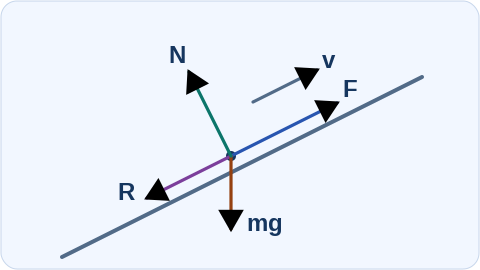
Use the driving force in the power equation. Resolve weight and resistance separately for the net uphill force.
Worked example
A small vehicle of mass moves straight uphill along a road whose sine of inclination is . A constant resistance of acts against the motion. The engine supplies in the direction of motion. Take . Find the driving force and the signed acceleration at the instant its speed is . The direction of motion is positive.
Find the driving force from newtons.
The opposition to forward motion is from resistance plus as the signed weight contribution.
Newton’s second law along the motion gives .
The driving force is and signed acceleration is .
Section 5 of 5 · Core · about 6 min
At steady speed the rate of gain of kinetic energy is zero. The engine may still be raising the height and replacing energy dissipated by resistance.
Worked example
A lifting trolley of mass moves steadily uphill at on a straight track of inclination whose sine is . A constant resistance of acts against motion. Take . Find the rate of gain of GPE, the rate of energy dissipation through resistance, and the engine power, all in watts.
The vertical speed is , so GPE increases by as a rate.
The resistive force dissipates . Steady speed means there is no rate of gain of kinetic energy.
The GPE gain rate is , the dissipation rate is , and the engine power is .
Question 1 of 4
0 / 4 checked in this collection
A motor does of work in . Find its average power in kilowatts.
Progress stays in this browser. Create an account to save it or sign in.
Show your working on paper and compare it with the worked solution and marking guidance.
Your review plan starts after your first check.