Maths4UBETA

Kinetic and gravitational potential energy

Calculate KE, recover speed and compare GPE relative to a consistent height datum.

Try the quick check →
Lesson 2 of 5

Section 1 of 5 · Core · about 6 min

How do mass and speed affect kinetic energy?

Kinetic energy is the energy associated with motion. It is determined by speed, so reversing the direction at the same speed leaves the kinetic energy unchanged.

Worked example

Calculate kinetic energy

A particle of mass 6 kg6\,\mathrm{kg} moves at 9 m s−19\,\mathrm{m\,s^{-1}}. Find its kinetic energy.

  1. Square the speed before multiplying by half the mass.

  2. K=12×6×92=243K=\frac12\times 6\times 9^2=243.

  3. The kinetic energy is 243 J243\,\mathrm J.

Your turn

A particle of mass 15 kg15\,\mathrm{kg} moves at 4 m s−14\,\mathrm{m\,s^{-1}}. Find its kinetic energy.

Enter an exact number, for example 3/2 or 2-sqrt(3).

Section 2 of 5 · Core · about 6 min

How can a kinetic energy change be negative?

The particle can have positive kinetic energy at both endpoints yet lose kinetic energy between them.

Worked example

Calculate a signed kinetic energy change

A particle of mass 5 kg5\,\mathrm{kg} changes its speed from 11 m s−111\,\mathrm{m\,s^{-1}} to 7 m s−17\,\mathrm{m\,s^{-1}}. Find its signed kinetic energy change.

  1. The initial and final kinetic energies are 6052 J\frac{605}{2}\,\mathrm J and 2452 J\frac{245}{2}\,\mathrm J, respectively.

  2. Change means final minus initial. The signed kinetic energy change is −180 J-180\,\mathrm J.

Your turn

A particle of mass 12 kg12\,\mathrm{kg} changes its speed from 9 m s−19\,\mathrm{m\,s^{-1}} to 4 m s−14\,\mathrm{m\,s^{-1}}. Find its signed kinetic energy change.

Enter an exact number, for example 3/2 or 2-sqrt(3).

Worked example

Calculate a signed kinetic energy change

A particle of mass 9 kg9\,\mathrm{kg} changes its speed from 7 m s−17\,\mathrm{m\,s^{-1}} to 12 m s−112\,\mathrm{m\,s^{-1}}. Find its signed kinetic energy change.

Try it on paper first.

  1. The initial and final kinetic energies are 4412 J\frac{441}{2}\,\mathrm J and 648 J648\,\mathrm J, respectively.

  2. Change means final minus initial. The signed kinetic energy change is 8552 J\frac{855}{2}\,\mathrm J.

Section 3 of 5 · Core · about 6 min

How do I find speed from a known kinetic energy?

Undo the kinetic energy formula by isolating the speed squared. Speed is a magnitude, so take the non-negative square root.

Worked example

Recover speed from kinetic energy

A trolley has mass 8 kg8\,\mathrm{kg} and kinetic energy 100 J100\,\mathrm J. Find its exact speed.

  1. Isolate the square of speed. v2=2Km=25v^2=\frac{2K}{m}=25.

  2. Speed is non-negative. Its exact value is 5 m s−15\,\mathrm{m\,s^{-1}}.

Your turn

A trolley has mass 9 kg9\,\mathrm{kg} and kinetic energy 225 J225\,\mathrm J. Find its exact speed.

Enter an exact number, for example 3/2 or 2-sqrt(3).

Worked example

Recover speed from kinetic energy

A trolley has mass 12 kg12\,\mathrm{kg} and kinetic energy 486 J486\,\mathrm J. Find its exact speed.

Try it on paper first.

  1. Isolate the square of speed. v2=2Km=81v^2=\frac{2K}{m}=81.

  2. Speed is non-negative. Its exact value is 9 m s−19\,\mathrm{m\,s^{-1}}.

Section 4 of 5 · Core · about 6 min

Why does the reference level matter for GPE?

Choose a height that is convenient to call zero. The GPE relative to that level may be negative, while the difference between two GPE values is the same for every choice of reference.
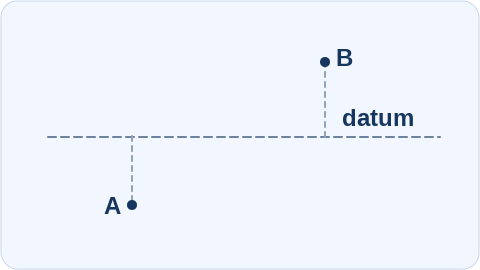
A dashed datum line lies between a higher point B and a lower point A. Vertical dashed projections mark their signed heights.

Use one datum for both points. The lower point has a negative height relative to this datum, but the change from A to B is positive.

Worked example

Calculate the potential energy change

A particle of mass 12 kg12\,\mathrm{kg} moves from height 8 m8\,\mathrm m to height 3 m3\,\mathrm m relative to the same reference level. Take g=10 m s−2g=10\,\mathrm{m\,s^{-2}}. Calculate its signed gravitational potential energy change.

  1. The height change is final minus initial: Δh=−5\Delta h=-5.

  2. The signed gravitational potential energy change is ΔU=mg Δh=−600\Delta U=mg\,\Delta h=-600 joules.

Your turn

A particle of mass 6 kg6\,\mathrm{kg} moves from height −3 m-3\,\mathrm m to height 2 m2\,\mathrm m relative to the same reference level. Take g=10 m s−2g=10\,\mathrm{m\,s^{-2}}. Calculate its signed gravitational potential energy change.

Enter an exact number, for example 3/2 or 2-sqrt(3).

Section 5 of 5 · Core · about 6 min

What makes up mechanical energy in this model?

At each position, compute kinetic energy from its speed and GPE from its height. Their sum is the mechanical energy relative to the chosen reference.

Worked example

Combine kinetic and potential energy

A particle of mass 5 kg5\,\mathrm{kg} moves at 4 m s−14\,\mathrm{m\,s^{-1}} at height 3 m3\,\mathrm m relative to a stated reference level. Take g=10 m s−2g=10\,\mathrm{m\,s^{-2}}. Find its kinetic energy, gravitational potential energy and total mechanical energy relative to this level.

  1. Kinetic energy is K=12mv2=40K=\frac12mv^2=40 joules.

  2. Gravitational potential energy relative to the reference is U=mgh=150U=mgh=150 joules.

  3. The kinetic and potential energies are 40 J40\,\mathrm J and 150 J150\,\mathrm J, so the total mechanical energy is 190 J190\,\mathrm J.

Your turn

A particle of mass 8 kg8\,\mathrm{kg} moves at 7 m s−17\,\mathrm{m\,s^{-1}} at height −4 m-4\,\mathrm m relative to a stated reference level. Take g=10 m s−2g=10\,\mathrm{m\,s^{-2}}. Find its kinetic energy, gravitational potential energy and total mechanical energy relative to this level.

Enter an exact number, for example 3/2 or 2-sqrt(3).

Enter an exact number, for example 3/2 or 2-sqrt(3).

Enter an exact number, for example 3/2 or 2-sqrt(3).

Worked examples

Practise the method

Core practice

Question 1 of 4

0 / 4 checked in this collection

Question list

Core practice

Fresh variants

Exam-style

Calculate kinetic energy

1 mark

A particle of mass 11 kg11\,\mathrm{kg} moves at 8 m s−18\,\mathrm{m\,s^{-1}}. Find its kinetic energy.

Enter an exact number, for example 3/2 or 2-sqrt(3).

Full answer-format guide

Exact numbers: 3/2, sqrt(5), 2-sqrt(3), pi/6, 3*pi/2. Sets: {1,4}. Intervals: (3,5]; a round bracket excludes the endpoint. Infinity: inf; union: U; no solutions: empty. Separate coordinate pairs or triples with semicolons. Expressions: 2x^2+3x-1; equations: x^2=3x+1 or the polynomial equal to zero. Factors: x-1 ; x+2. Parameter fraction: numerator ; denominator. List integer answers individually.

Review the method

Progress stays in this browser. Create an account to save it or sign in.

Extra practice from this lesson

Calculate kinetic energy

A particle of mass 20 kg20\,\mathrm{kg} moves at 13 m s−113\,\mathrm{m\,s^{-1}}. Find its kinetic energy.

Enter an exact value or round to 3 significant figures.

Calculate a signed kinetic energy change

A particle of mass 13 kg13\,\mathrm{kg} changes its speed from 10 m s−110\,\mathrm{m\,s^{-1}} to 6 m s−16\,\mathrm{m\,s^{-1}}. Find its signed kinetic energy change.

Enter an exact number, for example 3/2 or 2-sqrt(3).

Recover speed from kinetic energy

A trolley has mass 8 kg8\,\mathrm{kg} and kinetic energy 121 J121\,\mathrm J. Find its exact speed.

Enter an exact number, for example 3/2 or 2-sqrt(3).

Calculate the potential energy change

A particle of mass 8 kg8\,\mathrm{kg} moves from height 4 m4\,\mathrm m to height 7 m7\,\mathrm m relative to the same reference level. Take g=10 m s−2g=10\,\mathrm{m\,s^{-2}}. Calculate its signed gravitational potential energy change.

Enter an exact number, for example 3/2 or 2-sqrt(3).

Combine kinetic and potential energy

A particle of mass 7 kg7\,\mathrm{kg} moves at 5 m s−15\,\mathrm{m\,s^{-1}} at height 2 m2\,\mathrm m relative to a stated reference level. Take g=10 m s−2g=10\,\mathrm{m\,s^{-2}}. Find its kinetic energy, gravitational potential energy and total mechanical energy relative to this level.

Enter an exact value or round to 3 significant figures.

Enter an exact number, for example 3/2 or 2-sqrt(3).

Enter an exact value or round to 3 significant figures.

Apply it · original exam-style problems

Show your working on paper and compare it with the worked solution and marking guidance.

Come back to what needs practice

Quick revision sheet (A4)

Your review plan starts after your first check.