Maths4UBETA

Slack phases, collisions and changes of force

Use a new model at natural length, an impact or the boundary of a rough region.

Try the quick check →
Lesson 4 of 4

Section 1 of 5 · Core · about 5 min

How far does a mass continue rising after the string slackens?

The taut stage ends at natural length with a speed that must be carried into the free stage.

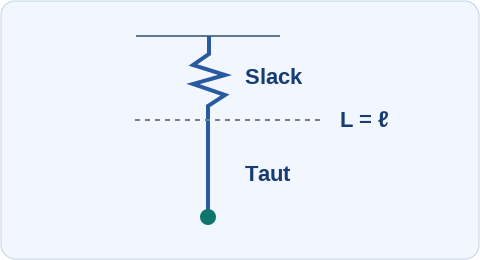
A vertical diagram marks the support, an upper position with slack string, the natural-length boundary and the lower taut state.

Start a new motion model at the natural-length boundary. No elastic force acts beyond it on the slack side.

Worked example

Split at the first slackening

A mass of 22 kilograms on a light elastic string of natural length 43 m\frac{4}{3}\,\mathrm m and modulus 803 N\frac{80}{3}\,\mathrm N is released from rest with extension 3 m3\,\mathrm m. It rises through the natural-length position. Take g=10 m s−2g=10\,\mathrm{m\,s^{-2}}. Find its exact speed there and the further maximum rise while the string is slack.

  1. At natural length there is no elastic energy left. Some initial elastic energy has gone into the GPE rise.

  2. The remaining KE is 30 J30\,\mathrm J, giving speed 30 m s−1\sqrt{30}\,\mathrm{m\,s^{-1}}.

  3. Above that point the string is slack. Gravity alone reduces the speed to zero, giving additional rise 32 m\frac{3}{2}\,\mathrm m.

Your turn

A mass of 33 kilograms on a light elastic string of natural length 53 m\frac{5}{3}\,\mathrm m and modulus 50 N50\,\mathrm N is released from rest with extension 72 m\frac{7}{2}\,\mathrm m. It rises through the natural-length position. Take g=10 m s−2g=10\,\mathrm{m\,s^{-2}}. Find its exact speed there and the further maximum rise while the string is slack.

Enter an exact number, for example 3/2 or 2-sqrt(3).

Enter an exact value or round to 3 significant figures.

Section 2 of 5 · Core · about 5 min

What happens before a slack string first becomes taut?

A mass initially closer to the support than the natural length can fall freely until the separation equals natural length.

Worked example

Follow a slack drop until the stretch turns

A mass of 33 kilograms hangs directly below a fixed point on an elastic string of natural length 72 m\frac{7}{2}\,\mathrm m and modulus 175 N175\,\mathrm N. It is released from rest when its distance below the point is just 135 m\frac{13}{5}\,\mathrm m. It remains below the attachment. Take g=10 m s−2g=10\,\mathrm{m\,s^{-2}}. Find its speed when the string first becomes taut and the greatest extension.

  1. The string is slack initially, so the particle falls freely over 910 m\frac{9}{10}\,\mathrm m. Its speed at natural length is 32 m s−13 \sqrt{2}\,\mathrm{m\,s^{-1}}.

  2. At greatest extension, total gravity work equals the elastic energy. Solve mg(d+x)=12kx2mg(d+x)=\frac12kx^2 where dd is the initial fall before the string is taut.

  3. Discard the negative extension root because the second stage is taut. The greatest extension is 95 m\frac{9}{5}\,\mathrm m.

Your turn

A mass of 44 kilograms hangs directly below a fixed point on an elastic string of natural length 4 m4\,\mathrm m and modulus 240 N240\,\mathrm N. It is released from rest when its distance below the point is just 6116 m\frac{61}{16}\,\mathrm m. It remains below the attachment. Take g=10 m s−2g=10\,\mathrm{m\,s^{-2}}. Find its speed when the string first becomes taut and the greatest extension.

Enter an exact value or round to 3 significant figures.

Enter an exact value or round to 3 significant figures.

Section 3 of 5 · Core · about 7 min

How far does a released cart travel against a new resistance?

At natural length, stored energy has become kinetic energy if there was no earlier resistance.

Worked example

Use an energy balance up to natural length

A spring of stiffness 5050 newtons per metre launches a 33 kilogram cart after being compressed by 23 m\frac{2}{3}\,\mathrm m. The cart leaves at natural length and crosses a level rough patch with constant resistance 12 N12\,\mathrm N. There is no earlier dissipation. Find the exact launch speed and how far into the patch it stops.

  1. Initial elastic energy becomes kinetic energy at the natural length. This gives 1069 m s−1\frac{10 \sqrt{6}}{9}\,\mathrm{m\,s^{-1}}.

  2. Only resistance does work on the level patch. Its work removes 1009 J\frac{100}{9}\,\mathrm J, so the stopping distance is 2527 m\frac{25}{27}\,\mathrm m.

Your turn

A spring of stiffness 6060 newtons per metre launches a 44 kilogram cart after being compressed by 1 m1\,\mathrm m. The cart leaves at natural length and crosses a level rough patch with constant resistance 16 N16\,\mathrm N. There is no earlier dissipation. Find the exact launch speed and how far into the patch it stops.

Enter an exact number, for example 3/2 or 2-sqrt(3).

Enter an exact value or round to 3 significant figures.

Worked example

Use an energy balance up to natural length

A spring of stiffness 7070 newtons per metre launches a 55 kilogram cart after being compressed by 43 m\frac{4}{3}\,\mathrm m. The cart leaves at natural length and crosses a level rough patch with constant resistance 20 N20\,\mathrm N. There is no earlier dissipation. Find the exact launch speed and how far into the patch it stops.

Try it on paper first.

  1. Initial elastic energy becomes kinetic energy at the natural length. This gives 4143 m s−1\frac{4 \sqrt{14}}{3}\,\mathrm{m\,s^{-1}}.

  2. Only resistance does work on the level patch. Its work removes 5609 J\frac{560}{9}\,\mathrm J, so the stopping distance is 289 m\frac{28}{9}\,\mathrm m.

Your turn

A spring of stiffness 8080 newtons per metre launches a 66 kilogram cart after being compressed by 53 m\frac{5}{3}\,\mathrm m. The cart leaves at natural length and crosses a level rough patch with constant resistance 24 N24\,\mathrm N. There is no earlier dissipation. Find the exact launch speed and how far into the patch it stops.

Enter an exact number, for example 3/2 or 2-sqrt(3).

Enter an exact value or round to 3 significant figures.

Section 4 of 5 · Core · about 5 min

Which laws apply before and after an impact?

An impact may transfer momentum between bodies and dissipate kinetic energy. Then the cart that reaches the spring begins a new elastic phase.

Worked example

Solve the collision before the elastic motion

A 33 kilogram cart strikes a stationary 22 kilogram cart directly at speed 5 m s−15\,\mathrm{m\,s^{-1}}. Their coefficient of restitution is 16\frac{1}{6}. The second cart immediately reaches a light uncompressed spring on a smooth track, with stiffness 4040 newtons per metre. Find the second cart's exact speed just after impact and its maximum spring compression.

  1. Use momentum conservation and restitution during the collision. The second cart leaves at 72 m s−1\frac{7}{2}\,\mathrm{m\,s^{-1}}.

  2. Use the second cart’s new KE, not the total initial KE of the two carts, for the compression stage.

  3. Equate that KE to elastic energy at rest. Maximum compression is 7520 m\frac{7 \sqrt{5}}{20}\,\mathrm m.

Your turn

A 44 kilogram cart strikes a stationary 33 kilogram cart directly at speed 6 m s−16\,\mathrm{m\,s^{-1}}. Their coefficient of restitution is 13\frac{1}{3}. The second cart immediately reaches a light uncompressed spring on a smooth track, with stiffness 5050 newtons per metre. Find the second cart's exact speed just after impact and its maximum spring compression.

Enter an exact value or round to 3 significant figures.

Enter an exact value or round to 3 significant figures.

Section 5 of 5 · Core · about 7 min

How do I avoid switching to the slack model too early?

Calculate the energy at the natural-length state. If that state is inaccessible, use the taut turning point first.

Worked example

Decide whether natural length is physically reached

A mass of 22 kilograms on a light vertical elastic string of stiffness 3030 newtons per metre is released from rest at extension 1 m1\,\mathrm m below equilibrium. Take g=10 m s−2g=10\,\mathrm{m\,s^{-2}}. Which event occurs first as it rises?

  1. Use the energy balance to predict the kinetic energy at natural length.

  2. After the rise against gravity, the prediction is −5 J-5\,\mathrm J.

  3. A negative prediction rules out reaching natural length. A zero prediction is a turning boundary. In this case: Turns while still taut.

Your turn

A 4 kg4\,\mathrm{kg} mass hangs from a light vertical elastic string of stiffness 40 N m−140\,\mathrm{N\,m^{-1}}. It is released from rest 52 m\frac52\,\mathrm m below the position where the string has its natural length. Take g=10 m s−2g=10\,\mathrm{m\,s^{-2}}. Which event occurs first?

First boundary outcome

Worked example

Decide whether natural length is physically reached

A mass of 44 kilograms on a light vertical elastic string of stiffness 4040 newtons per metre is released from rest at extension 2 m2\,\mathrm m below equilibrium. Take g=10 m s−2g=10\,\mathrm{m\,s^{-2}}. Which event occurs first as it rises?

Try it on paper first.

  1. Use the energy balance to predict the kinetic energy at natural length.

  2. After the rise against gravity, the prediction is 0 J0\,\mathrm J.

  3. A negative prediction rules out reaching natural length. A zero prediction is a turning boundary. In this case: Just reaches natural length with zero speed.

Your turn

A 6 kg6\,\mathrm{kg} mass hangs from a light vertical elastic string of stiffness 40 N m−140\,\mathrm{N\,m^{-1}}. It is released from rest when the extension is 3 m3\,\mathrm m. Take g=10 m s−2g=10\,\mathrm{m\,s^{-2}}. Which event occurs first as it moves upwards?

First boundary outcome

Worked examples

Practise the method

Core practice

Question 1 of 4

0 / 4 checked in this collection

Question list

Core practice

Fresh variants

Exam-style

Motion continues through a slack phase

3 marks

A string of natural length a and modulus 6mg6mg supports a total mass 4m4m in equilibrium. All except mass m is removed without an impulse. Give speed squared/(ag) when natural length is first reached, least separation from the fixed end/a in this ascent, and initial upward acceleration/g.

Enter an exact value or round to 3 significant figures.

Enter an exact value or round to 3 significant figures.

Enter an exact number, for example 3/2 or 2-sqrt(3).

Full answer-format guide

Exact numbers: 3/2, sqrt(5), 2-sqrt(3), pi/6, 3*pi/2. Sets: {1,4}. Intervals: (3,5]; a round bracket excludes the endpoint. Infinity: inf; union: U; no solutions: empty. Separate coordinate pairs or triples with semicolons. Expressions: 2x^2+3x-1; equations: x^2=3x+1 or the polynomial equal to zero. Factors: x-1 ; x+2. Parameter fraction: numerator ; denominator. List integer answers individually.

Review the method

Progress stays in this browser. Create an account to save it or sign in.

Extra practice from this lesson

Split at the first slackening

A mass of 44 kilograms on a light elastic string of natural length 2 m2\,\mathrm m and modulus 80 N80\,\mathrm N is released from rest with extension 4 m4\,\mathrm m. It rises through the natural-length position. Take g=10 m s−2g=10\,\mathrm{m\,s^{-2}}. Find its exact speed there and the further maximum rise while the string is slack.

Enter an exact number, for example 3/2 or 2-sqrt(3).

Enter an exact number, for example 3/2 or 2-sqrt(3).

Follow a slack drop until the stretch turns

A mass of 55 kilograms hangs directly below a fixed point on an elastic string of natural length 92 m\frac{9}{2}\,\mathrm m and modulus 315 N315\,\mathrm N. It is released from rest when its distance below the point is just 3710 m\frac{37}{10}\,\mathrm m. It remains below the attachment. Take g=10 m s−2g=10\,\mathrm{m\,s^{-2}}. Find its speed when the string first becomes taut and the greatest extension.

Enter an exact number, for example 3/2 or 2-sqrt(3).

Enter an exact number, for example 3/2 or 2-sqrt(3).

Use an energy balance up to natural length

A spring of stiffness 9090 newtons per metre launches a 77 kilogram cart after being compressed by 2 m2\,\mathrm m. The cart leaves at natural length and crosses a level rough patch with constant resistance 28 N28\,\mathrm N. There is no earlier dissipation. Find the exact launch speed and how far into the patch it stops.

Enter an exact number, for example 3/2 or 2-sqrt(3).

Enter an exact value or round to 3 significant figures.

Solve the collision before the elastic motion

A 55 kilogram cart strikes a stationary 44 kilogram cart directly at speed 7 m s−17\,\mathrm{m\,s^{-1}}. Their coefficient of restitution is 12\frac{1}{2}. The second cart immediately reaches a light uncompressed spring on a smooth track, with stiffness 6060 newtons per metre. Find the second cart's exact speed just after impact and its maximum spring compression.

Enter an exact value or round to 3 significant figures.

Enter an exact value or round to 3 significant figures.

Decide whether natural length is physically reached

A 9 kg9\,\mathrm{kg} mass hangs from a light vertical elastic string of stiffness 45 N m−145\,\mathrm{N\,m^{-1}}. It is drawn down 1 m1\,\mathrm m from equilibrium and released from rest. Take g=10 m s−2g=10\,\mathrm{m\,s^{-2}}. Which event occurs first as it moves upwards?

First boundary outcome

Apply it · original exam-style problems

Show your working on paper and compare it with the worked solution and marking guidance.

Come back to what needs practice

Quick revision sheet (A4)

Your review plan starts after your first check.