Maths4UBETA

Elastic energy, extension and compression

Derive stored energy and combine it with gravity and kinetic energy over a valid stage.

Try the quick check →
Lesson 2 of 4

Section 1 of 5 · Core · about 5 min

How much energy does changing the length store?

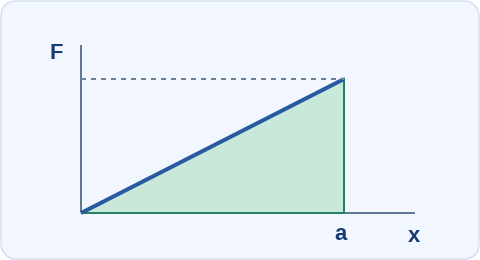
The force grows from zero with extension. The area under its linear force–extension graph gives stored energy.

An increasing line on force against extension axes encloses a shaded triangular area.

The area gives the elastic energy stored. At zero extension the spring force is zero.

Worked example

Interpret the deformation before calculating force

A light elastic string of natural length 32 m\frac{3}{2}\,\mathrm m and modulus 36 N36\,\mathrm N has straight end separation 74 m\frac{7}{4}\,\mathrm m. Find its extension and elastic potential energy.

  1. Subtract the natural length from the current separation. The signed change is 14 m\frac{1}{4}\,\mathrm m.

  2. The modulus divided by the natural length gives stiffness 2424. A stretched string pulls with tension 6 N6\,\mathrm N. This stores 34 J\frac{3}{4}\,\mathrm J of elastic energy.

Your turn

A light elastic string of natural length 2 m2\,\mathrm m and modulus 56 N56\,\mathrm N has straight end separation 52 m\frac{5}{2}\,\mathrm m. Find its extension and elastic potential energy.

Enter an exact value or round to 3 significant figures.

Enter an exact value or round to 3 significant figures.

Section 2 of 5 · Core · about 5 min

How can the speed at natural length reveal the compression?

At the natural length the spring stores zero energy. On a smooth horizontal track the released energy appears as kinetic energy.

Worked example

Use an energy balance up to natural length

A compressed spring of stiffness 5050 newtons per metre releases a 33 kilogram cart along a smooth horizontal track. It leaves the spring at natural length at speed 1069 m s−1\frac{10 \sqrt{6}}{9}\,\mathrm{m\,s^{-1}}. Find the original compression and stored energy.

  1. At natural length the elastic energy is zero. The current kinetic energy is 1009 J\frac{100}{9}\,\mathrm J.

  2. Equating the initial elastic energy to that KE gives compression 23 m\frac{2}{3}\,\mathrm m.

Your turn

A compressed spring of stiffness 6060 newtons per metre releases a 44 kilogram cart along a smooth horizontal track. It leaves the spring at natural length at speed 15 m s−1\sqrt{15}\,\mathrm{m\,s^{-1}}. Find the original compression and stored energy.

Enter an exact number, for example 3/2 or 2-sqrt(3).

Enter an exact number, for example 3/2 or 2-sqrt(3).

Section 3 of 5 · Core · about 7 min

Why is the greatest extension beyond equilibrium?

From rest at natural length, a hanging mass gains speed as it falls through the equilibrium position, then slows as tension increases.

Worked example

Find the equilibrium and turning extensions

A mass of 22 kilograms is attached to a fixed point by a light elastic string of natural length 43 m\frac{4}{3}\,\mathrm m and modulus 803 N\frac{80}{3}\,\mathrm N. It starts from rest at natural length. Take g=10 m s−2g=10\,\mathrm{m\,s^{-2}}. Find the extension at maximum speed and the greatest extension.

  1. Speed is greatest where the potential energy 12kx2−mgx\frac12kx^2-mgx is minimised, at extension 1 m1\,\mathrm m.

  2. For the other stop, equate the fall in GPE to the stored energy. The non-zero solution gives greatest extension 2 m2\,\mathrm m.

Your turn

A mass of 33 kilograms is attached to a fixed point by a light elastic string of natural length 53 m\frac{5}{3}\,\mathrm m and modulus 50 N50\,\mathrm N. It starts from rest at natural length. Take g=10 m s−2g=10\,\mathrm{m\,s^{-2}}. Find the extension at maximum speed and the greatest extension.

Enter an exact number, for example 3/2 or 2-sqrt(3).

Enter an exact number, for example 3/2 or 2-sqrt(3).

Worked example

Find the equilibrium and turning extensions

A mass of 44 kilograms is attached to a fixed point by a light elastic string of natural length 2 m2\,\mathrm m and modulus 80 N80\,\mathrm N. It starts from rest at natural length. Take g=10 m s−2g=10\,\mathrm{m\,s^{-2}}. Find the extension at maximum speed and the greatest extension.

Try it on paper first.

  1. Speed is greatest where the potential energy 12kx2−mgx\frac12kx^2-mgx is minimised, at extension 1 m1\,\mathrm m.

  2. For the other stop, equate the fall in GPE to the stored energy. The non-zero solution gives greatest extension 2 m2\,\mathrm m.

Your turn

A mass of 55 kilograms is attached to a fixed point by a light elastic string of natural length 73 m\frac{7}{3}\,\mathrm m and modulus 3503 N\frac{350}{3}\,\mathrm N. It starts from rest at natural length. Take g=10 m s−2g=10\,\mathrm{m\,s^{-2}}. Find the extension at maximum speed and the greatest extension.

Enter an exact number, for example 3/2 or 2-sqrt(3).

Enter an exact number, for example 3/2 or 2-sqrt(3).

Section 4 of 5 · Core · about 5 min

What if both turning points remain stretched?

With downwards extension xx, use total potential energy 12kx2−mgx\frac12kx^2-mgx relative to natural length.

Worked example

Find a turning point without losing tension

A mass of 22 kilograms on a light elastic string of natural length 43 m\frac{4}{3}\,\mathrm m and modulus 803 N\frac{80}{3}\,\mathrm N. It is released from rest below equilibrium at extension 32 m\frac{3}{2}\,\mathrm m. Take g=10 m s−2g=10\,\mathrm{m\,s^{-2}}. Find its next turning extension and greatest speed.

  1. The potential energy 12kx2−mgx\frac12kx^2-mgx is parabolic and symmetric about the equilibrium extension.

  2. An equal-energy point on the other side has extension 12 m\frac{1}{2}\,\mathrm m, which is still positive.

  3. At equilibrium the potential energy is least. The resulting greatest speed is 102 m s−1\frac{\sqrt{10}}{2}\,\mathrm{m\,s^{-1}}.

Your turn

A mass of 33 kilograms on a light elastic string of natural length 53 m\frac{5}{3}\,\mathrm m and modulus 50 N50\,\mathrm N. It is released from rest below equilibrium at extension 32 m\frac{3}{2}\,\mathrm m. Take g=10 m s−2g=10\,\mathrm{m\,s^{-2}}. Find its next turning extension and greatest speed.

Enter an exact value or round to 3 significant figures.

Enter an exact value or round to 3 significant figures.

Section 5 of 5 · Core · about 7 min

How do I tell whether the string becomes slack?

The energy equation can predict that natural length is not accessible from a given starting extension.

Worked example

Decide whether natural length is physically reached

A mass of 22 kilograms on a light vertical elastic string of stiffness 3030 newtons per metre is released from rest at extension 1 m1\,\mathrm m below equilibrium. Take g=10 m s−2g=10\,\mathrm{m\,s^{-2}}. Which event occurs first as it rises?

  1. Use the energy balance to predict the kinetic energy at natural length.

  2. After the rise against gravity, the prediction is −5 J-5\,\mathrm J.

  3. A negative prediction rules out reaching natural length. A zero prediction is a turning boundary. In this case: Turns while still taut.

Your turn

A mass of 33 kilograms on a light vertical elastic string of stiffness 3535 newtons per metre is released from rest at extension 187 m\frac{18}{7}\,\mathrm m below equilibrium. Take g=10 m s−2g=10\,\mathrm{m\,s^{-2}}. Which event occurs first as it rises?

First boundary outcome

Worked example

Decide whether natural length is physically reached

A mass of 44 kilograms on a light vertical elastic string of stiffness 4040 newtons per metre is released from rest at extension 2 m2\,\mathrm m below equilibrium. Take g=10 m s−2g=10\,\mathrm{m\,s^{-2}}. Which event occurs first as it rises?

Try it on paper first.

  1. Use the energy balance to predict the kinetic energy at natural length.

  2. After the rise against gravity, the prediction is 0 J0\,\mathrm J.

  3. A negative prediction rules out reaching natural length. A zero prediction is a turning boundary. In this case: Just reaches natural length with zero speed.

Your turn

A mass of 55 kilograms on a light vertical elastic string of stiffness 4545 newtons per metre is released from rest at extension 259 m\frac{25}{9}\,\mathrm m below equilibrium. Take g=10 m s−2g=10\,\mathrm{m\,s^{-2}}. Which event occurs first as it rises?

First boundary outcome

Worked examples

Practise the method

Core practice

Question 1 of 4

0 / 4 checked in this collection

Question list

Core practice

Fresh variants

Exam-style

Signed force and positive stored energy

3 marks

A guided spring has natural length 45\frac{4}{5} m and modulus 4040 N. Signed extension x is positive for stretching. It changes slowly from 110\frac{1}{10} m to 310\frac{3}{10} m. Give the final signed restoring force in the x-direction, final stored energy and work required, in N, J and J.

Enter an exact number, for example 3/2 or 2-sqrt(3).

Enter an exact value or round to 3 significant figures.

Enter an exact number, for example 3/2 or 2-sqrt(3).

Full answer-format guide

Exact numbers: 3/2, sqrt(5), 2-sqrt(3), pi/6, 3*pi/2. Sets: {1,4}. Intervals: (3,5]; a round bracket excludes the endpoint. Infinity: inf; union: U; no solutions: empty. Separate coordinate pairs or triples with semicolons. Expressions: 2x^2+3x-1; equations: x^2=3x+1 or the polynomial equal to zero. Factors: x-1 ; x+2. Parameter fraction: numerator ; denominator. List integer answers individually.

Review the method

Progress stays in this browser. Create an account to save it or sign in.

Extra practice from this lesson

Interpret the deformation before calculating force

A light elastic string of natural length 52 m\frac{5}{2}\,\mathrm m and modulus 80 N80\,\mathrm N has straight end separation 134 m\frac{13}{4}\,\mathrm m. Find its extension and elastic potential energy.

Enter an exact value or round to 3 significant figures.

Enter an exact number, for example 3/2 or 2-sqrt(3).

Use an energy balance up to natural length

A compressed spring of stiffness 7070 newtons per metre releases a 55 kilogram cart along a smooth horizontal track. It leaves the spring at natural length at speed 4143 m s−1\frac{4 \sqrt{14}}{3}\,\mathrm{m\,s^{-1}}. Find the original compression and stored energy.

Enter an exact value or round to 3 significant figures.

Enter an exact value or round to 3 significant figures.

Find the equilibrium and turning extensions

A mass of 66 kilograms is attached to a fixed point by a light elastic string of natural length 83 m\frac{8}{3}\,\mathrm m and modulus 160 N160\,\mathrm N. It starts from rest at natural length. Take g=10 m s−2g=10\,\mathrm{m\,s^{-2}}. Find the extension at maximum speed and the greatest extension.

Enter an exact number, for example 3/2 or 2-sqrt(3).

Enter an exact number, for example 3/2 or 2-sqrt(3).

Find a turning point without losing tension

A mass of 44 kilograms on a light elastic string of natural length 2 m2\,\mathrm m and modulus 80 N80\,\mathrm N. It is released from rest below equilibrium at extension 32 m\frac{3}{2}\,\mathrm m. Take g=10 m s−2g=10\,\mathrm{m\,s^{-2}}. Find its next turning extension and greatest speed.

Enter an exact value or round to 3 significant figures.

Enter an exact value or round to 3 significant figures.

Decide whether natural length is physically reached

A mass of 66 kilograms on a light vertical elastic string of stiffness 5050 newtons per metre is released from rest at extension 85 m\frac{8}{5}\,\mathrm m below equilibrium. Take g=10 m s−2g=10\,\mathrm{m\,s^{-2}}. Which event occurs first as it rises?

First boundary outcome

Apply it · original exam-style problems

Show your working on paper and compare it with the worked solution and marking guidance.

Come back to what needs practice

Quick revision sheet (A4)

Your review plan starts after your first check.