Maths4UBETA

Release, impacts and changes of centre

Join circular stages to projectile motion or collision equations without carrying an invalid law across the event.

Try the quick check →
Lesson 5 of 5

Section 1 of 5 · Core · about 5 min

Which quantities change instantly when a peg catches the string?

When the instantaneous new circle has the same tangent and ideal contact makes no tangential impulse, speed is unchanged. Radius and tension can change.

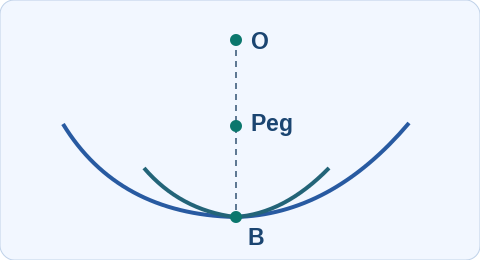
At the bottom B, the support lies directly above a peg and B. Two circular arcs have the same tangent at B.

A shorter free length gives a different inward acceleration even though the tangent speed at B is unchanged.

Worked example

Track the velocity when a peg changes the circle

A ball of mass 22 kilograms on a taut string of length 22 metres crosses the bottom at 5 m s−15\,\mathrm{m\,s^{-1}}. At that instant the string catches on a peg directly above the ball, leaving a new free length 65\frac{6}{5} metres. Assume the smooth instantaneous change preserves tangential speed. Find the tension immediately before and immediately after the catch. Take g=10 m s−2g=10\,\mathrm{m\,s^{-2}}.

  1. The bottom velocity is horizontal and tangent to each of the two circles. Use the same speed and change the radius.

  2. At the bottom the inward resultant is T−mgT-mg. With the first radius the tension is 45 N45\,\mathrm N.

  3. With the smaller radius the tension increases to 1853 N\frac{185}{3}\,\mathrm N.

Your turn

A ball of mass 33 kilograms on a taut string of length 52\frac{5}{2} metres crosses the bottom at 6 m s−16\,\mathrm{m\,s^{-1}}. At that instant the string catches on a peg directly above the ball, leaving a new free length 32\frac{3}{2} metres. Assume the smooth instantaneous change preserves tangential speed. Find the tension immediately before and immediately after the catch. Take g=10 m s−2g=10\,\mathrm{m\,s^{-2}}.

Enter an exact value or round to 3 significant figures.

Enter an exact number, for example 3/2 or 2-sqrt(3).

Section 2 of 5 · Core · about 5 min

Can the new circle be completed after the catch?

After a smooth catch, use the common bottom state and the new circle height. Energy and the constraint supply separate checks.

Worked example

Test the new circle after a peg changes the radius

A ball passes the bottom of a vertical circle with speed 55 m s−1\sqrt{55}\,\mathrm{m\,s^{-1}}. Its initially taut string has length 52\frac{5}{2} metres. It catches a fixed peg directly above the ball and has free length 11 metres after the catch. Assume the tangent velocity is unchanged. Take g=10 m s−2g=10\,\mathrm{m\,s^{-2}}. Find the predicted squared speed at the new top and decide whether the new full circle is possible.

  1. The new circle uses the shorter free length. Its top is 22 metres above the catch point.

  2. The energy equation predicts squared speed 1515 at the top. The string’s non-negative tension condition requires squared speed at least 1010 there.

  3. The predicted squared speed is 1515. Therefore the complete new circle is possible.

Your turn

A ball passes the bottom of a vertical circle with speed 36 m s−13 \sqrt{6}\,\mathrm{m\,s^{-1}}. Its initially taut string has length 33 metres. It catches a fixed peg directly above the ball and has free length 65\frac{6}{5} metres after the catch. Assume the tangent velocity is unchanged. Take g=10 m s−2g=10\,\mathrm{m\,s^{-2}}. Find the predicted squared speed at the new top and decide whether the new full circle is possible.

Enter an exact number, for example 3/2 or 2-sqrt(3).

Complete new circle

Section 3 of 5 · Core · about 7 min

Which law applies at an instantaneous collision?

An impact can change tangent speed abruptly. Use momentum in a direction with no external impulse and use restitution along the line of centres.

Worked example

Recalculate speed after a tangential impact

A ball of mass 22 kilograms on a taut string of length 22 metres strikes a stationary ball of mass 11 kilograms at the bottom of a vertical circle. It was moving at 5 m s−15\,\mathrm{m\,s^{-1}} and the direct horizontal impact has coefficient of restitution 13\frac{1}{3}. Find the first ball’s immediate speed and subsequent tension at the bottom. Take g=10 m s−2g=10\,\mathrm{m\,s^{-2}}.

  1. External support impulses have no horizontal component at the bottom. Conserve horizontal momentum and use the restitution relation along the line of centres.

  2. The first ball leaves with speed 259 m s−1\frac{25}{9}\,\mathrm{m\,s^{-1}}, and the second with speed 409 m s−1\frac{40}{9}\,\mathrm{m\,s^{-1}}.

  3. Apply the radial equation at the bottom with the first ball’s new speed. Its tension is 224581 N\frac{2245}{81}\,\mathrm N.

Your turn

A ball of mass 33 kilograms on a taut string of length 52\frac{5}{2} metres strikes a stationary ball of mass 32\frac{3}{2} kilograms at the bottom of a vertical circle. It was moving at 6 m s−16\,\mathrm{m\,s^{-1}} and the direct horizontal impact has coefficient of restitution 13\frac{1}{3}. Find the first ball’s immediate speed and subsequent tension at the bottom. Take g=10 m s−2g=10\,\mathrm{m\,s^{-2}}.

Enter an exact value or round to 3 significant figures.

Enter an exact value or round to 3 significant figures.

Worked example

Recalculate speed after a tangential impact

A ball of mass 44 kilograms on a taut string of length 33 metres strikes a stationary ball of mass 22 kilograms at the bottom of a vertical circle. It was moving at 7 m s−17\,\mathrm{m\,s^{-1}} and the direct horizontal impact has coefficient of restitution 13\frac{1}{3}. Find the first ball’s immediate speed and subsequent tension at the bottom. Take g=10 m s−2g=10\,\mathrm{m\,s^{-2}}.

Try it on paper first.

  1. External support impulses have no horizontal component at the bottom. Conserve horizontal momentum and use the restitution relation along the line of centres.

  2. The first ball leaves with speed 359 m s−1\frac{35}{9}\,\mathrm{m\,s^{-1}}, and the second with speed 569 m s−1\frac{56}{9}\,\mathrm{m\,s^{-1}}.

  3. Apply the radial equation at the bottom with the first ball’s new speed. Its tension is 14620243 N\frac{14620}{243}\,\mathrm N.

Your turn

A ball of mass 55 kilograms on a taut string of length 72\frac{7}{2} metres strikes a stationary ball of mass 52\frac{5}{2} kilograms at the bottom of a vertical circle. It was moving at 8 m s−18\,\mathrm{m\,s^{-1}} and the direct horizontal impact has coefficient of restitution 13\frac{1}{3}. Find the first ball’s immediate speed and subsequent tension at the bottom. Take g=10 m s−2g=10\,\mathrm{m\,s^{-2}}.

Enter an exact value or round to 3 significant figures.

Enter an exact value or round to 3 significant figures.

Section 4 of 5 · Core · about 5 min

What happens after release along a horizontal tangent?

The last tangent is the initial velocity of the free flight. Weight is the only force in the particle model after release.

Worked example

Transfer tangent velocity into free flight

A ball loses its constraint at speed 5 m s−15\,\mathrm{m\,s^{-1}}, moving right and horizontally. A level floor lies 209\frac{20}{9} metres below the release point. Take g=10 m s−2g=10\,\mathrm{m\,s^{-2}}. Find the time to the floor and its horizontal range from release.

  1. The velocity immediately after release is tangent to the old motion. Its horizontal and vertical components are 5 m s−15\,\mathrm{m\,s^{-1}} and 0 m s−10\,\mathrm{m\,s^{-1}}.

  2. Use the free-flight vertical equation with displacement −209- \frac{20}{9} metres. The positive time is 23\frac{2}{3} seconds.

  3. The horizontal range is 103\frac{10}{3} metres with unchanged horizontal velocity.

Your turn

A ball loses its constraint at speed 6 m s−16\,\mathrm{m\,s^{-1}}, moving right and horizontally. A level floor lies 55 metres below the release point. Take g=10 m s−2g=10\,\mathrm{m\,s^{-2}}. Find the time to the floor and its horizontal range from release.

Enter an exact number, for example 3/2 or 2-sqrt(3).

Enter an exact number, for example 3/2 or 2-sqrt(3).

Section 5 of 5 · Core · about 7 min

How does a tilted release change the flight equations?

A non-horizontal tangent adds an initial vertical component. Choose release as the location and time origin for the flight.

Worked example

Transfer tangent velocity into free flight

A ball loses its constraint at speed 5 m s−15\,\mathrm{m\,s^{-1}}, moving right and up at an angle whose sine is 35\frac{3}{5}. A level floor lies 29\frac{2}{9} metres below the release point. Take g=10 m s−2g=10\,\mathrm{m\,s^{-2}}. Find the time to the floor and its horizontal range from release.

  1. The velocity immediately after release is tangent to the old motion. Its horizontal and vertical components are 4 m s−14\,\mathrm{m\,s^{-1}} and 3 m s−13\,\mathrm{m\,s^{-1}}.

  2. Use the free-flight vertical equation with displacement −29- \frac{2}{9} metres. The positive time is 23\frac{2}{3} seconds.

  3. The horizontal range is 83\frac{8}{3} metres with unchanged horizontal velocity.

Your turn

A ball loses its constraint at speed 6 m s−16\,\mathrm{m\,s^{-1}}, moving right and up at an angle whose sine is 35\frac{3}{5}. A level floor lies 75\frac{7}{5} metres below the release point. Take g=10 m s−2g=10\,\mathrm{m\,s^{-2}}. Find the time to the floor and its horizontal range from release.

Enter an exact number, for example 3/2 or 2-sqrt(3).

Enter an exact value or round to 3 significant figures.

Worked example

Transfer tangent velocity into free flight

A ball loses its constraint at speed 7 m s−17\,\mathrm{m\,s^{-1}}, moving right and up at an angle whose sine is 35\frac{3}{5}. A level floor lies 14845\frac{148}{45} metres below the release point. Take g=10 m s−2g=10\,\mathrm{m\,s^{-2}}. Find the time to the floor and its horizontal range from release.

Try it on paper first.

  1. The velocity immediately after release is tangent to the old motion. Its horizontal and vertical components are 285 m s−1\frac{28}{5}\,\mathrm{m\,s^{-1}} and 215 m s−1\frac{21}{5}\,\mathrm{m\,s^{-1}}.

  2. Use the free-flight vertical equation with displacement −14845- \frac{148}{45} metres. The positive time is 43\frac{4}{3} seconds.

  3. The horizontal range is 11215\frac{112}{15} metres with unchanged horizontal velocity.

Your turn

A ball loses its constraint at speed 8 m s−18\,\mathrm{m\,s^{-1}}, moving right and up at an angle whose sine is 35\frac{3}{5}. A level floor lies 539\frac{53}{9} metres below the release point. Take g=10 m s−2g=10\,\mathrm{m\,s^{-2}}. Find the time to the floor and its horizontal range from release.

Enter an exact value or round to 3 significant figures.

Enter an exact value or round to 3 significant figures.

Worked examples

Practise the method

Core practice

Question 1 of 4

0 / 4 checked in this collection

Question list

Core practice

Fresh variants

Exam-style

All tangent components and the highest point

3 marks

A particle leaves the inside of a circle of radius a on an upper-right ascent, at upward height 25a\frac{2}{5}a, when its inward reaction first becomes zero. Give horizontal and vertical release velocities divided by √(ag), and the greatest free-flight height above the centre divided by a.

Enter an exact value or round to 3 significant figures.

Enter an exact value or round to 3 significant figures.

Enter an exact value or round to 3 significant figures.

Full answer-format guide

Exact numbers: 3/2, sqrt(5), 2-sqrt(3), pi/6, 3*pi/2. Sets: {1,4}. Intervals: (3,5]; a round bracket excludes the endpoint. Infinity: inf; union: U; no solutions: empty. Separate coordinate pairs or triples with semicolons. Expressions: 2x^2+3x-1; equations: x^2=3x+1 or the polynomial equal to zero. Factors: x-1 ; x+2. Parameter fraction: numerator ; denominator. List integer answers individually.

Review the method

Progress stays in this browser. Create an account to save it or sign in.

Extra practice from this lesson

Track the velocity when a peg changes the circle

A ball of mass 44 kilograms on a taut string of length 33 metres crosses the bottom at 7 m s−17\,\mathrm{m\,s^{-1}}. At that instant the string catches on a peg directly above the ball, leaving a new free length 95\frac{9}{5} metres. Assume the smooth instantaneous change preserves tangential speed. Find the tension immediately before and immediately after the catch. Take g=10 m s−2g=10\,\mathrm{m\,s^{-2}}.

Enter an exact value or round to 3 significant figures.

Enter an exact value or round to 3 significant figures.

Test the new circle after a peg changes the radius

A ball passes the bottom of a vertical circle with speed 77 m s−1\sqrt{77}\,\mathrm{m\,s^{-1}}. Its initially taut string has length 72\frac{7}{2} metres. It catches a fixed peg directly above the ball and has free length 75\frac{7}{5} metres after the catch. Assume the tangent velocity is unchanged. Take g=10 m s−2g=10\,\mathrm{m\,s^{-2}}. Find the predicted squared speed at the new top and decide whether the new full circle is possible.

Enter an exact number, for example 3/2 or 2-sqrt(3).

Complete new circle

Recalculate speed after a tangential impact

A ball of mass 66 kilograms on a taut string of length 44 metres strikes a stationary ball of mass 33 kilograms at the bottom of a vertical circle. It was moving at 9 m s−19\,\mathrm{m\,s^{-1}} and the direct horizontal impact has coefficient of restitution 13\frac{1}{3}. Find the first ball’s immediate speed and subsequent tension at the bottom. Take g=10 m s−2g=10\,\mathrm{m\,s^{-2}}.

Enter an exact number, for example 3/2 or 2-sqrt(3).

Enter an exact value or round to 3 significant figures.

Transfer tangent velocity into free flight

A ball loses its constraint at speed 7 m s−17\,\mathrm{m\,s^{-1}}, moving right and horizontally. A level floor lies 809\frac{80}{9} metres below the release point. Take g=10 m s−2g=10\,\mathrm{m\,s^{-2}}. Find the time to the floor and its horizontal range from release.

Enter an exact value or round to 3 significant figures.

Enter an exact value or round to 3 significant figures.

Transfer tangent velocity into free flight

A ball loses its constraint at speed 9 m s−19\,\mathrm{m\,s^{-1}}, moving right and up at an angle whose sine is 35\frac{3}{5}. A level floor lies 465\frac{46}{5} metres below the release point. Take g=10 m s−2g=10\,\mathrm{m\,s^{-2}}. Find the time to the floor and its horizontal range from release.

Enter an exact number, for example 3/2 or 2-sqrt(3).

Enter an exact value or round to 3 significant figures.

Apply it · original exam-style problems

Show your working on paper and compare it with the worked solution and marking guidance.

Come back to what needs practice

Quick revision sheet (A4)

Your review plan starts after your first check.