Maths4UBETA

Conical pendulums, linked strings and elastic constraints

Resolve the three-dimensional geometry into vertical balance and horizontal radial motion.

Try the quick check →
Lesson 2 of 5

Section 1 of 5 · Core · about 5 min

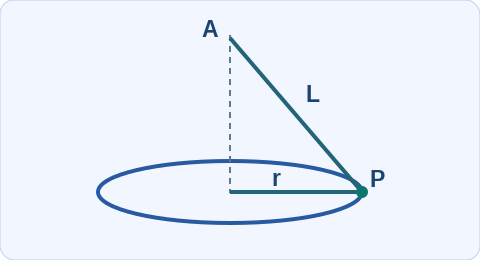
Which radius describes the pendulum's circle?

The string sweeps a cone while the mass moves in a horizontal circle. The slant string is not the horizontal radius.

The slant string from A to P meets a dashed vertical axis and a horizontal circular radius.

The slant length is greater than the horizontal radius. Resolve tension relative to the vertical.

Worked example

Resolve the conical pendulum

A particle of mass 11 kilograms is attached to a light inextensible string of length 32\frac{3}{2} metres and moves in a horizontal circle. The sine of its angle to the vertical is 513\frac{5}{13}. Find the radius and tension. Take g=10 m s−2g=10\,\mathrm{m\,s^{-2}}.

  1. Use r=Lsin⁡θr=L\sin\theta. The inclined tension has upward component Tcos⁡θT\cos\theta and inward component Tsin⁡θT\sin\theta.

  2. Vertical balance and the radial equation give Tcos⁡θ=mgT\cos\theta=mg and Tsin⁡θ=mrω2T\sin\theta=mr\omega^2, so Lω2cos⁡θ=gL\omega^2\cos\theta=g.

  3. The cosine is 1213\frac{12}{13}, radius 1526\frac{15}{26} metres and tension 656 N\frac{65}{6}\,\mathrm N.

Your turn

A particle of mass 32\frac{3}{2} kilograms is attached to a light inextensible string of length 22 metres and moves in a horizontal circle. The sine of its angle to the vertical is 35\frac{3}{5}. Find the radius and tension. Take g=10 m s−2g=10\,\mathrm{m\,s^{-2}}.

Enter an exact value or round to 3 significant figures.

Enter an exact value or round to 3 significant figures.

Section 2 of 5 · Core · about 5 min

How does angular speed reveal the cone angle?

Substitute the geometric radius into the radial equation. For a non-zero radius the sine factors cancel.

Worked example

Resolve the conical pendulum

A particle of mass 11 kilograms is attached to a light inextensible string of length 32\frac{3}{2} metres and moves in a horizontal circle. Angular speed is 653 rad s−1\frac{\sqrt{65}}{3}\,\mathrm{rad\,s^{-1}}. Find the cosine of the angle to the vertical and the radius. Take g=10 m s−2g=10\,\mathrm{m\,s^{-2}}.

  1. Use r=Lsin⁡θr=L\sin\theta. The inclined tension has upward component Tcos⁡θT\cos\theta and inward component Tsin⁡θT\sin\theta.

  2. Vertical balance and the radial equation give Tcos⁡θ=mgT\cos\theta=mg and Tsin⁡θ=mrω2T\sin\theta=mr\omega^2, so Lω2cos⁡θ=gL\omega^2\cos\theta=g.

  3. The cosine is 1213\frac{12}{13}, radius 1526\frac{15}{26} metres and tension 656 N\frac{65}{6}\,\mathrm N.

Your turn

A particle of mass 32\frac{3}{2} kilograms is attached to a light inextensible string of length 22 metres and moves in a horizontal circle. Angular speed is 52 rad s−1\frac{5}{2}\,\mathrm{rad\,s^{-1}}. Find the cosine of the angle to the vertical and the radius. Take g=10 m s−2g=10\,\mathrm{m\,s^{-2}}.

Enter an exact value or round to 3 significant figures.

Enter an exact value or round to 3 significant figures.

Section 3 of 5 · Core · about 7 min

How do two strings contribute to the turn?

In the symmetrical two-string arrangement, both tensions pull inward, but their vertical components oppose each other.

Worked example

Resolve both string tensions

Two equal light strings of length 52\frac{5}{2} metres connect a mass of 22 kilograms to fixed points directly above and below the circle's centre, symmetrically spaced. Each string makes an acute angle having cosine 45\frac{4}{5} with the vertical. Take g=10 m s−2g=10\,\mathrm{m\,s^{-2}}. The angular speed is 22 rad s−12 \sqrt{2}\,\mathrm{rad\,s^{-1}}. Find both tensions.

  1. The upper string pulls partly up, while the lower one pulls partly down. Both pull towards the axis in the horizontal direction.

  2. Vertical balance fixes TU−TLT_U-T_L, while the required radial force fixes TU+TLT_U+T_L.

  3. Solving gives upper tension 652 N\frac{65}{2}\,\mathrm N and lower tension 152 N\frac{15}{2}\,\mathrm N. Both are positive.

Your turn

Two equal light strings of length 33 metres connect a mass of 33 kilograms to fixed points directly above and below the circle's centre, symmetrically spaced. Each string makes an acute angle having cosine 45\frac{4}{5} with the vertical. Take g=10 m s−2g=10\,\mathrm{m\,s^{-2}}. The angular speed is 766 rad s−1\frac{7 \sqrt{6}}{6}\,\mathrm{rad\,s^{-1}}. Find both tensions.

Enter an exact value or round to 3 significant figures.

Enter an exact number, for example 3/2 or 2-sqrt(3).

Worked example

Resolve both string tensions

Two equal light strings of length 72\frac{7}{2} metres connect a mass of 44 kilograms to fixed points directly above and below the circle's centre, symmetrically spaced. Each string makes an acute angle having cosine 45\frac{4}{5} with the vertical. Take g=10 m s−2g=10\,\mathrm{m\,s^{-2}}. The angular speed is 21057 rad s−1\frac{2 \sqrt{105}}{7}\,\mathrm{rad\,s^{-1}}. Find both tensions.

Try it on paper first.

  1. The upper string pulls partly up, while the lower one pulls partly down. Both pull towards the axis in the horizontal direction.

  2. Vertical balance fixes TU−TLT_U-T_L, while the required radial force fixes TU+TLT_U+T_L.

  3. Solving gives upper tension 85 N85\,\mathrm N and lower tension 35 N35\,\mathrm N. Both are positive.

Your turn

Two equal light strings of length 44 metres connect a mass of 55 kilograms to fixed points directly above and below the circle's centre, symmetrically spaced. Each string makes an acute angle having cosine 45\frac{4}{5} with the vertical. Take g=10 m s−2g=10\,\mathrm{m\,s^{-2}}. The angular speed is 1464 rad s−1\frac{\sqrt{146}}{4}\,\mathrm{rad\,s^{-1}}. Find both tensions.

Enter an exact value or round to 3 significant figures.

Enter an exact number, for example 3/2 or 2-sqrt(3).

Section 4 of 5 · Core · about 5 min

At what angular speed can both strings stay straight?

Vertical balance sets the difference of the two tensions. When the radial demand is too low, the required lower tension becomes negative.

Worked example

Resolve both string tensions

Two equal light strings of length 52\frac{5}{2} metres connect a mass of 22 kilograms to fixed points directly above and below the circle's centre, symmetrically spaced. Each string makes an acute angle having cosine 45\frac{4}{5} with the vertical. Take g=10 m s−2g=10\,\mathrm{m\,s^{-2}}. Find the minimum angular speed for the model with both strings straight and each tension non-negative.

  1. Both tensions pull radially inwards. The upper one contributes upwards, the lower one downwards.

  2. Write (TU+TL)sin⁡θ=mrω2(T_U+T_L)\sin\theta=mr\omega^2 and (TU−TL)cos⁡θ=mg(T_U-T_L)\cos\theta=mg.

  3. At the threshold TL=0T_L=0, so angular speed is 5 rad s−1\sqrt{5}\,\mathrm{rad\,s^{-1}}.

Your turn

Two equal light strings of length 33 metres connect a mass of 33 kilograms to fixed points directly above and below the circle's centre, symmetrically spaced. Each string makes an acute angle having cosine 45\frac{4}{5} with the vertical. Take g=10 m s−2g=10\,\mathrm{m\,s^{-2}}. Find the minimum angular speed for the model with both strings straight and each tension non-negative.

Enter an exact value or round to 3 significant figures.

Section 5 of 5 · Further applications · about 7 min

What length appears in an elastic conical pendulum?

A Hookean string has a natural length and a separate stretched length. Use the latter to draw the circular geometry.

Worked example

Find the stretched length of a conical string

A mass of 22 kilograms moves in a horizontal circle, attached to an elastic string of natural length 43\frac{4}{3} metres and modulus 50 N50\,\mathrm N. Its angular speed is 52 rad s−1\frac{5}{2}\,\mathrm{rad\,s^{-1}}. Find the stretched length and radius. Take g=10 m s−2g=10\,\mathrm{m\,s^{-2}}.

  1. Inward and vertical equations give T=mLω2T=mL\omega^2 and cos⁡θ=gLω2\cos\theta=\frac{g}{L\omega^2}.

  2. Equate tension to λ(L−l)l\frac{\lambda(L-l)}l. Solving gives length 22 metres, above natural length.

  3. The cosine is 45\frac{4}{5}. The stretched length is 22 metres and radius is 65\frac{6}{5} metres.

Your turn

A mass of 33 kilograms moves in a horizontal circle, attached to an elastic string of natural length 53\frac{5}{3} metres and modulus 1252 N\frac{125}{2}\,\mathrm N. Its angular speed is 534 rad s−1\frac{5 \sqrt{3}}{4}\,\mathrm{rad\,s^{-1}}. Find the stretched length and radius. Take g=10 m s−2g=10\,\mathrm{m\,s^{-2}}.

Enter an exact value or round to 3 significant figures.

Enter an exact value or round to 3 significant figures.

Worked example

Find the stretched length of a conical string

A mass of 44 kilograms moves in a horizontal circle, attached to an elastic string of natural length 22 metres and modulus 75 N75\,\mathrm N. Its angular speed is 152 rad s−1\frac{\sqrt{15}}{2}\,\mathrm{rad\,s^{-1}}. Find the stretched length and radius. Take g=10 m s−2g=10\,\mathrm{m\,s^{-2}}.

Try it on paper first.

  1. Inward and vertical equations give T=mLω2T=mL\omega^2 and cos⁡θ=gLω2\cos\theta=\frac{g}{L\omega^2}.

  2. Equate tension to λ(L−l)l\frac{\lambda(L-l)}l. Solving gives length 103\frac{10}{3} metres, above natural length.

  3. The cosine is 45\frac{4}{5}. The stretched length is 103\frac{10}{3} metres and radius is 22 metres.

Your turn

A mass of 55 kilograms moves in a horizontal circle, attached to an elastic string of natural length 73\frac{7}{3} metres and modulus 1752 N\frac{175}{2}\,\mathrm N. Its angular speed is 524 rad s−1\frac{5 \sqrt{2}}{4}\,\mathrm{rad\,s^{-1}}. Find the stretched length and radius. Take g=10 m s−2g=10\,\mathrm{m\,s^{-2}}.

Enter an exact number, for example 3/2 or 2-sqrt(3).

Enter an exact value or round to 3 significant figures.

Worked examples

Practise the method

Core practice

Question 1 of 4

0 / 4 checked in this collection

Question list

Core practice

Fresh variants

Exam-style

All conical-pendulum quantities

4 marks

A conical pendulum has length 5a5a and cosine 35\frac{3}{5} to the downward vertical. Give r/a, T/(mg), ω²a/g and v²/(ag).

Enter the value on its own or write r = … . Fractions and exact square roots are accepted.

Enter an exact value or round to 3 significant figures.

Enter an exact value or round to 3 significant figures.

Enter an exact value or round to 3 significant figures.

Full answer-format guide

Exact numbers: 3/2, sqrt(5), 2-sqrt(3), pi/6, 3*pi/2. Sets: {1,4}. Intervals: (3,5]; a round bracket excludes the endpoint. Infinity: inf; union: U; no solutions: empty. Separate coordinate pairs or triples with semicolons. Expressions: 2x^2+3x-1; equations: x^2=3x+1 or the polynomial equal to zero. Factors: x-1 ; x+2. Parameter fraction: numerator ; denominator. List integer answers individually.

Review the method

Progress stays in this browser. Create an account to save it or sign in.

Extra practice from this lesson

Resolve the conical pendulum

A particle of mass 22 kilograms is attached to a light inextensible string of length 52\frac{5}{2} metres and moves in a horizontal circle. The sine of its angle to the vertical is 513\frac{5}{13}. Find the radius and tension. Take g=10 m s−2g=10\,\mathrm{m\,s^{-2}}.

Enter an exact value or round to 3 significant figures.

Enter an exact value or round to 3 significant figures.

Resolve the conical pendulum

A particle of mass 22 kilograms is attached to a light inextensible string of length 52\frac{5}{2} metres and moves in a horizontal circle. Angular speed is 393 rad s−1\frac{\sqrt{39}}{3}\,\mathrm{rad\,s^{-1}}. Find the cosine of the angle to the vertical and the radius. Take g=10 m s−2g=10\,\mathrm{m\,s^{-2}}.

Enter an exact value or round to 3 significant figures.

Enter an exact value or round to 3 significant figures.

Resolve both string tensions

Two equal light strings of length 92\frac{9}{2} metres connect a mass of 66 kilograms to fixed points directly above and below the circle's centre, symmetrically spaced. Each string makes an acute angle having cosine 45\frac{4}{5} with the vertical. Take g=10 m s−2g=10\,\mathrm{m\,s^{-2}}. The angular speed is 2223 rad s−1\frac{2 \sqrt{22}}{3}\,\mathrm{rad\,s^{-1}}. Find both tensions.

Enter an exact value or round to 3 significant figures.

Enter an exact value or round to 3 significant figures.

Resolve both string tensions

Two equal light strings of length 72\frac{7}{2} metres connect a mass of 44 kilograms to fixed points directly above and below the circle's centre, symmetrically spaced. Each string makes an acute angle having cosine 45\frac{4}{5} with the vertical. Take g=10 m s−2g=10\,\mathrm{m\,s^{-2}}. Find the minimum angular speed for the model with both strings straight and each tension non-negative.

Enter an exact value or round to 3 significant figures.

Find the stretched length of a conical string

A mass of 66 kilograms moves in a horizontal circle, attached to an elastic string of natural length 83\frac{8}{3} metres and modulus 100 N100\,\mathrm N. Its angular speed is 52114 rad s−1\frac{5 \sqrt{21}}{14}\,\mathrm{rad\,s^{-1}}. Find the stretched length and radius. Take g=10 m s−2g=10\,\mathrm{m\,s^{-2}}.

Enter an exact value or round to 3 significant figures.

Enter an exact value or round to 3 significant figures.

Apply it · original exam-style problems

Show your working on paper and compare it with the worked solution and marking guidance.

Come back to what needs practice

Quick revision sheet (A4)

Your review plan starts after your first check.