Maths4UBETA

Mutually exclusive and combined events

Add disjoint outcomes, multiply along a path and identify independence.

Try the quick check →
Lesson 1 of 2

Section 1 of 4 · Core · about 8 min

Check whether events can happen together

List outcomes for one turn of a game.

Worked example

Add mutually exclusive outcomes

A bag holds 5 blue, 3 yellow and 4 red counters. Choose one counter at random.

  1. Give the probability of blue or yellow.

    [2]
  2. Explain why the named events are mutually exclusive.

    [1]
  1. (a) There are 8 suitable counters from 12 counters altogether.

  2. 23\frac{2}{3}

  3. (b) There is no overlap between the two sets of single-draw outcomes.

  4. A single counter cannot be both blue and yellow.
Your turn

A bag holds 3 blue, 5 yellow and 4 red counters. Choose one counter at random.

Give the probability of blue or yellow.

Use a fraction, a percentage or a decimal rounded to at least 3 significant figures.

Worked example

Add mutually exclusive outcomes

A bag holds 6 blue, 3 yellow and 4 red counters. Choose one counter at random.

  1. Give the probability of blue or yellow.

    [2]
  2. Explain why the named events are mutually exclusive.

    [1]

Try it on paper first.

  1. (a) There are 9 suitable counters from 13 counters altogether.

  2. 913\frac{9}{13}

  3. (b) There is no overlap between the two sets of single-draw outcomes.

  4. A single counter cannot be both blue and yellow.
Your turn

A bag holds 4 blue, 5 yellow and 4 red counters. Choose one counter at random.

Give the probability of blue or yellow.

Use a fraction, a percentage or a decimal rounded to at least 3 significant figures.

Section 2 of 4 · Core · about 8 min

Use the outcomes left over

List all possible outcomes so that each is counted once.

Worked example

Use the complementary outcome

A spinner has 15 equal sections. Exactly 7 are marked A and 4 are marked B. All other sections are marked C.

  1. Find the probability of a C.

    [2]
  2. Explain how you checked the three probabilities.

    [1]
  1. (a) The known outcomes make up 11 sections.

  2. Subtract these from 15. There are 4 sections for C.

  3. 415\frac{4}{15}

  4. (b) One of A, B and C happens on each spin.

  5. They add to 1.

Your turn

A spinner has 16 equal sections. Exactly 5 are marked A and 7 are marked B. All other sections are marked C.

Find the probability of a C.

Use a fraction, a percentage or a decimal rounded to at least 3 significant figures.

Worked example

Use the complementary outcome

A spinner has 16 equal sections. Exactly 8 are marked A and 4 are marked B. All other sections are marked C.

  1. Find the probability of a C.

    [2]
  2. Explain how you checked the three probabilities.

    [1]

Try it on paper first.

  1. (a) The known outcomes make up 12 sections.

  2. Subtract these from 16. There are 4 sections for C.

  3. 14\frac{1}{4}

  4. (b) One of A, B and C happens on each spin.

  5. They add to 1.

Your turn

A spinner has 17 equal sections. Exactly 6 are marked A and 7 are marked B. All other sections are marked C.

Find the probability of a C.

Use a fraction, a percentage or a decimal rounded to at least 3 significant figures.

Section 3 of 4 · Core · about 8 min

Follow one tree path

Label stages of the experiment separately even when the probabilities match.

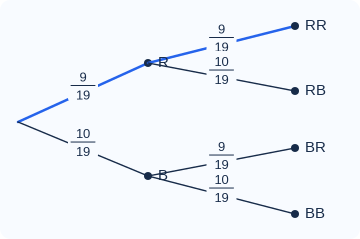
Two draws of 9 red and 10 blue counters, with replacement. First red 9/19. Given red, second red 9/19; given blue, second red 9/19. Blue branch at each node is the complement.

Multiply the two highlighted branches for the red–red path.

Worked example

Follow a path with replacement

A bag has 9 red and 10 blue counters. Choose two at random, one after the other. Put the first counter back before the second draw.

  1. Find the probability of two red counters.

    [2]
  2. Are the red outcomes on the two draws independent? Explain.

    [2]
  3. Find the probability of getting one counter of each colour.

    [2]
  1. (a) The first red probability is 919\frac{9}{19}.

    Two draws of 9 red and 10 blue counters, with replacement. First red 9/19. Given red, second red 9/19; given blue, second red 9/19. Blue branch at each node is the complement.

  2. After a red, the next red probability is 919\frac{9}{19}.

  3. Multiply along the red–red path.

  4. 81361\frac{81}{361}

  5. (b) Compare the second red probability after a red with the probability before drawing.

  6. Yes. The first result does not affect the second probability.

  7. (c) Red then blue and blue then red are different paths. Each has probability 90361\frac{90}{361}.

  8. Add these two probabilities.

  9. 180361\frac{180}{361}

Your turn

A bag has 7 red and 12 blue counters. Choose two at random, one after the other. Put the first counter back before the second draw.

Find the probability of two red counters.

Use a fraction, a percentage or a decimal rounded to at least 3 significant figures.

Worked example

Follow a path with replacement

A bag has 10 red and 10 blue counters. Choose two at random, one after the other. Put the first counter back before the second draw.

  1. Find the probability of two red counters.

    [2]
  2. Are the red outcomes on the two draws independent? Explain.

    [2]
  3. Find the probability of getting one counter of each colour.

    [2]

Try it on paper first.

  1. (a) The first red probability is 12\frac{1}{2}.

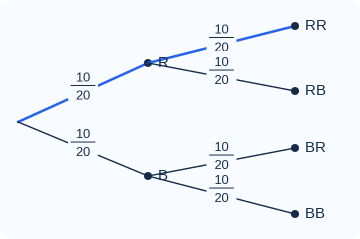
    Two draws of 10 red and 10 blue counters, with replacement. First red 10/20. Given red, second red 10/20; given blue, second red 10/20. Blue branch at each node is the complement.

  2. After a red, the next red probability is 12\frac{1}{2}.

  3. Multiply along the red–red path.

  4. 14\frac{1}{4}

  5. (b) Compare the second red probability after a red with the probability before drawing.

  6. Yes. The first result does not affect the second probability.

  7. (c) Red then blue and blue then red are different paths. Each has probability 14\frac{1}{4}.

  8. Add these two probabilities.

  9. 12\frac{1}{2}

Your turn

A bag has 8 red and 12 blue counters. Choose two at random, one after the other. Put the first counter back before the second draw.

Find the probability of two red counters.

Use a fraction, a percentage or a decimal rounded to at least 3 significant figures.

Section 4 of 4 · Core · about 8 min

Update a changing experiment

Draw the second stage using the bag that remains after the first draw.

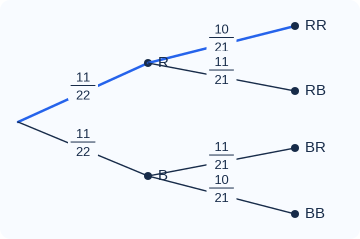
Two draws of 11 red and 11 blue counters, without replacement. First red 11/22. Given red, second red 10/21; given blue, second red 11/21. Blue branch at each node is the complement.

Multiply the two highlighted branches for the red–red path.

Worked example

Update each branch without replacement

A bag has 11 red and 11 blue counters. Choose two at random, one after the other. Keep the first counter out for the second draw.

  1. Find the probability of two red counters.

    [2]
  2. Are the red outcomes on the two draws independent? Explain.

    [2]
  3. Find the probability of getting one counter of each colour.

    [2]
  1. (a) The first red probability is 12\frac{1}{2}.

    Two draws of 11 red and 11 blue counters, without replacement. First red 11/22. Given red, second red 10/21; given blue, second red 11/21. Blue branch at each node is the complement.

  2. After a red, the next red probability is 1021\frac{10}{21}.

  3. Multiply along the red–red path.

  4. 521\frac{5}{21}

  5. (b) Compare the second red probability after a red with the probability before drawing.

  6. No. The first result changes the contents for the second draw.

  7. (c) Red then blue and blue then red are different paths. Each has probability 1142\frac{11}{42}.

  8. Add these two probabilities.

  9. 1121\frac{11}{21}

Your turn

For the 11 red and 11 blue counters above, the first counter was blue. What is the probability of red on the next draw?

Use a fraction, a percentage or a decimal rounded to at least 3 significant figures.

Your turn

A bag has 9 red and 13 blue counters. Choose two at random, one after the other. Keep the first counter out for the second draw.

Find the probability of two red counters.

Use a fraction, a percentage or a decimal rounded to at least 3 significant figures.

Worked example

Update each branch without replacement

A bag has 12 red and 11 blue counters. Choose two at random, one after the other. Keep the first counter out for the second draw.

  1. Find the probability of two red counters.

    [2]
  2. Are the red outcomes on the two draws independent? Explain.

    [2]
  3. Find the probability of getting one counter of each colour.

    [2]

Try it on paper first.

  1. (a) The first red probability is 1223\frac{12}{23}.

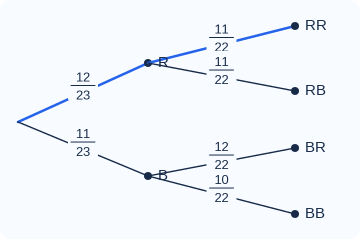
    Two draws of 12 red and 11 blue counters, without replacement. First red 12/23. Given red, second red 11/22; given blue, second red 12/22. Blue branch at each node is the complement.

  2. After a red, the next red probability is 12\frac{1}{2}.

  3. Multiply along the red–red path.

  4. 623\frac{6}{23}

  5. (b) Compare the second red probability after a red with the probability before drawing.

  6. No. The first result changes the contents for the second draw.

  7. (c) Red then blue and blue then red are different paths. Each has probability 623\frac{6}{23}.

  8. Add these two probabilities.

  9. 1223\frac{12}{23}

Your turn

A bag has 10 red and 14 blue counters. Choose two at random, one after the other. Keep the first counter out for the second draw.

Find the probability of two red counters.

Use a fraction, a percentage or a decimal rounded to at least 3 significant figures.

Worked examples

Practise the method

Core practice

Question 1 of 12

0 / 12 checked in this collection

Question list

Core practice

Fresh variants

Exam-style

Add mutually exclusive outcomes

1 mark

A bag holds 7 blue, 6 yellow and 10 red counters. Choose one counter at random.

Give the probability of blue or yellow.

Use a fraction, a percentage or a decimal rounded to at least 3 significant figures.

Full answer-format guide

Exact numbers: 3/2, sqrt(5), 2-sqrt(3), pi/6, 3*pi/2. Sets: {1,4}. Intervals: (3,5]; a round bracket excludes the endpoint. Infinity: inf; union: U; no solutions: empty. Separate coordinate pairs or triples with semicolons. Expressions: 2x^2+3x-1; equations: x^2=3x+1 or the polynomial equal to zero. Factors: x-1 ; x+2. Parameter fraction: numerator ; denominator. List integer answers individually.

Review the method

Progress stays in this browser. Create an account to save it or sign in.

Extra practice from this lesson

A bag holds 12 blue, 7 yellow and 4 red counters. Choose one counter at random.

Give the probability of blue or yellow.

Use a fraction, a percentage or a decimal rounded to at least 3 significant figures.

A bag holds 2 blue, 7 yellow and 4 red counters. Choose one counter at random.

Give the probability of blue or yellow.

Use a fraction, a percentage or a decimal rounded to at least 3 significant figures.

A spinner has 16 equal sections. Exactly 3 are marked A and 9 are marked B. All other sections are marked C.

Find the probability of a C.

Use a fraction, a percentage or a decimal rounded to at least 3 significant figures.

A spinner has 17 equal sections. Exactly 4 are marked A and 9 are marked B. All other sections are marked C.

Find the probability of a C.

Use a fraction, a percentage or a decimal rounded to at least 3 significant figures.

A bag has 5 red and 14 blue counters. Choose two at random, one after the other. Put the first counter back before the second draw.

Find the probability of two red counters.

Use a fraction, a percentage or a decimal rounded to at least 3 significant figures.

A bag has 6 red and 14 blue counters. Choose two at random, one after the other. Put the first counter back before the second draw.

Find the probability of two red counters.

Use a fraction, a percentage or a decimal rounded to at least 3 significant figures.

A bag has 7 red and 17 blue counters. Choose two at random, one after the other. Keep the first counter out for the second draw.

Find the probability of two red counters.

Use a fraction, a percentage or a decimal rounded to at least 3 significant figures.

A bag has 8 red and 17 blue counters. Choose two at random, one after the other. Keep the first counter out for the second draw.

Find the probability of two red counters.

Use a fraction, a percentage or a decimal rounded to at least 3 significant figures.

Apply it · original exam-style problems

Show your working on paper and compare it with the worked solution and marking guidance.

Come back to what needs practice

Quick revision sheet (A4)

Your review plan starts after your first check.