Maths4UBETA

Ratio and direct or inverse proportion

Share in a ratio and decide whether a fixed unit rate or a fixed product applies.

Try the quick check →
Lesson 5 of 5

Section 1 of 3 · Core · about 8 min

Build a bar of equal parts

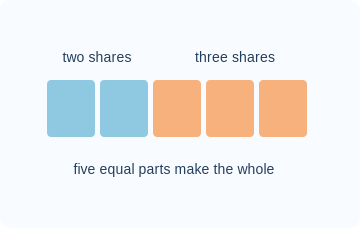
Use one bar which contains all the parts stated in the ratio.

Two blue equal parts and three yellow equal parts forming one five-part bar

The ratio 2 to 3 makes five parts altogether. Start by finding the value of one part.

Worked example

Share a total in parts

Red and green counters are in the ratio 5 : 3. There are 24 counters altogether.

  1. Find the number of red counters.

    [2]
  2. State the fraction of counters that are green.

    [1]
  1. (a) There are 8 equal parts. Each part contains 3 counters.

  2. Use 5 parts for red.

  3. 1515

  4. (b) Green uses 3 parts of the 8 total parts.

  5. 38\frac{3}{8}

Your turn

Red and green counters are in the ratio 13 : 5. There are 54 counters altogether.

Find the number of red counters.

Enter the whole-number count.

Worked example

Share a total in parts

Red and green counters are in the ratio 6 : 3. There are 27 counters altogether.

  1. Find the number of red counters.

    [2]
  2. State the fraction of counters that are green.

    [1]

Try it on paper first.

  1. (a) There are 9 equal parts. Each part contains 3 counters.

  2. Use 6 parts for red.

  3. 1818

  4. (b) Green uses 3 parts of the 9 total parts.

  5. 13\frac{1}{3}

Your turn

Red and green counters are in the ratio 2 : 5. There are 21 counters altogether.

Find the number of red counters.

Enter the whole-number count.

Section 2 of 3 · Core · about 8 min

Look for a fixed price per unit

Make a table of amount and cost to see whether their quotient stays constant.

Worked example

Follow a direct proportion

6 metres of cord cost 9 credits at a constant price per metre.

  1. Find the cost of 11 metres in credits.

    [2]
  2. Describe what doubling the length does to the cost.

    [1]
  1. (a) One metre costs 1.5 credits.

  2. Multiply this by 11.

  3. 332\frac{33}{2}

  4. (b) The price per metre stays fixed and the length doubles.

  5. It doubles the cost.

Your turn

2 metres of cord cost 3 credits at a constant price per metre.

Find the cost of 3 metres in credits.

Enter an exact value or round to 3 significant figures.

Worked example

Follow a direct proportion

7 metres of cord cost 10.5 credits at a constant price per metre.

  1. Find the cost of 13 metres in credits.

    [2]
  2. Describe what doubling the length does to the cost.

    [1]

Try it on paper first.

  1. (a) One metre costs 1.5 credits.

  2. Multiply this by 13.

  3. 392\frac{39}{2}

  4. (b) The price per metre stays fixed and the length doubles.

  5. It doubles the cost.

Your turn

3 metres of cord cost 4.5 credits at a constant price per metre.

Find the cost of 5 metres in credits.

Enter an exact value or round to 3 significant figures.

Section 3 of 3 · Core · about 8 min

Look for a fixed product

Think about a fixed job shared among equal workers.

Worked example

Use an inverse proportion

14 identical machines complete a run in 18 minutes. They share the work equally and run at the same rate.

  1. Find the time in minutes with 21 machines.

    [2]
  2. Explain how you knew whether the time grows or shrinks.

    [1]
  1. (a) The fixed amount of work is 14 × 18 machine-minutes.

  2. Share these across 21 machines.

  3. 1212

  4. (b) The relationship is an inverse proportion under the stated assumptions.

  5. The total work stays the same. More machines complete it sooner.

Your turn

6 identical machines complete a run in 24 minutes. They share the work equally and run at the same rate.

Find the time in minutes with 9 machines.

Enter one number. Fractions and decimals are accepted.

Worked example

Use an inverse proportion

16 identical machines complete a run in 18 minutes. They share the work equally and run at the same rate.

  1. Find the time in minutes with 24 machines.

    [2]
  2. Explain how you knew whether the time grows or shrinks.

    [1]

Try it on paper first.

  1. (a) The fixed amount of work is 16 × 18 machine-minutes.

  2. Share these across 24 machines.

  3. 1212

  4. (b) The relationship is an inverse proportion under the stated assumptions.

  5. The total work stays the same. More machines complete it sooner.

Your turn

8 identical machines complete a run in 24 minutes. They share the work equally and run at the same rate.

Find the time in minutes with 12 machines.

Enter one number. Fractions and decimals are accepted.

Worked examples

Practise the method

Core practice

Question 1 of 12

0 / 12 checked in this collection

Question list

Core practice

Fresh variants

Exam-style

Share a total in parts

1 mark

Red and green counters are in the ratio 10 : 3. There are 117 counters altogether.

Find the number of red counters.

Enter the whole-number count.

Full answer-format guide

Exact numbers: 3/2, sqrt(5), 2-sqrt(3), pi/6, 3*pi/2. Sets: {1,4}. Intervals: (3,5]; a round bracket excludes the endpoint. Infinity: inf; union: U; no solutions: empty. Separate coordinate pairs or triples with semicolons. Expressions: 2x^2+3x-1; equations: x^2=3x+1 or the polynomial equal to zero. Factors: x-1 ; x+2. Parameter fraction: numerator ; denominator. List integer answers individually.

Review the method

Progress stays in this browser. Create an account to save it or sign in.

Extra practice from this lesson

Red and green counters are in the ratio 9 : 7. There are 48 counters altogether.

Find the number of red counters.

Enter the whole-number count.

Red and green counters are in the ratio 10 : 7. There are 51 counters altogether.

Find the number of red counters.

Enter the whole-number count.

10 metres of cord cost 15 credits at a constant price per metre.

Find the cost of 13 metres in credits.

Enter an exact value or round to 3 significant figures.

11 metres of cord cost 16.5 credits at a constant price per metre.

Find the cost of 15 metres in credits.

Enter an exact value or round to 3 significant figures.

22 identical machines complete a run in 30 minutes. They share the work equally and run at the same rate.

Find the time in minutes with 33 machines.

Enter one number. Fractions and decimals are accepted.

24 identical machines complete a run in 30 minutes. They share the work equally and run at the same rate.

Find the time in minutes with 36 machines.

Enter one number. Fractions and decimals are accepted.

Apply it · original exam-style problems

Show your working on paper and compare it with the worked solution and marking guidance.

Come back to what needs practice

Quick revision sheet (A4)

Your review plan starts after your first check.