Maths4UBETA

Letters and algebraic expressions

Use letters for changing or unknown values, collect like terms and expand one bracket.

Try the quick check →
Lesson 1 of 3

Section 1 of 3 · Core · about 8 min

What can a letter stand for?

A letter can name a number that is unknown, fixed or allowed to change. Read its meaning in the question.

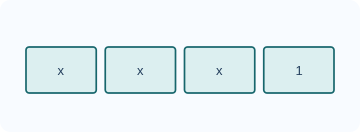
x, x, x, 1

The three x tiles combine into 3x. The unit tile remains a separate term.

Worked example

Tickets and a booking charge

A club buys 2 tickets at qq pounds each and pays a fixed booking charge of £5.

  1. Write an expression for the total cost.

    [2]
  2. Explain which value can vary when a different ticket type is chosen.

    [2]
  1. (a) Multiply the ticket price by the number of tickets.

  2. Add the fixed charge once.

  3. 2q+52q+5

  4. (b) A letter can stand for a value that changes.

  5. The price per ticket, q, can vary. The number of tickets and the booking charge are fixed here.

Your turn

A club buys 2 tickets at qq pounds each and pays a fixed booking charge of £25.

Write an expression for the total cost.

Choose one answer

Worked example

Tickets and a booking charge

A club buys 2 tickets at qq pounds each and pays a fixed booking charge of £6.

  1. Write an expression for the total cost.

    [2]
  2. Explain which value can vary when a different ticket type is chosen.

    [2]

Try it on paper first.

  1. (a) Multiply the ticket price by the number of tickets.

  2. Add the fixed charge once.

  3. 2q+62q+6

  4. (b) A letter can stand for a value that changes.

  5. The price per ticket, q, can vary. The number of tickets and the booking charge are fixed here.

Your turn

A club buys 2 tickets at qq pounds each and pays a fixed booking charge of £26.

Write an expression for the total cost.

Choose one answer

Section 2 of 3 · Core · about 8 min

Which terms can we join?

An x term names one kind of amount. A constant is given as a plain number.

Worked example

Like terms

A group of terms is 18x+7+2x18x+7+2x.

  1. Simplify the expression.

    [2]
  2. Work out the value of your simplified expression when x is 4.

    [2]
  1. (a) Combine the two terms containing x. Their coefficients are 18 and 2.

  2. The constant 7 remains separate.

  3. 20x+720x+7.

  4. (b) Put 4 in place of x.

  5. Multiply 20 by 4, then add 7.

  6. 8787.

Your turn

A group of terms is 38x+5+3x38x+5+3x.

Simplify the expression.

Enter an expression in x; use ^ for powers and / for fractions.

Worked example

Like terms

A group of terms is 29x+8−2x29x+8-2x.

  1. Simplify the expression.

    [2]
  2. Work out the value of your simplified expression when x is 5.

    [2]

Try it on paper first.

  1. (a) Combine the two terms containing x. Their coefficients are 29 and -2.

  2. The constant 8 remains separate.

  3. 27x+827x+8.

  4. (b) Put 5 in place of x.

  5. Multiply 27 by 5, then add 8.

  6. 143143.

Your turn

A group of terms is 49x+6−3x49x+6-3x.

Simplify the expression.

Enter an expression in x; use ^ for powers and / for fractions.

Section 3 of 3 · Core · about 8 min

What sits outside the bracket?

Think of a rectangle split into strips. Its height multiplies each strip width.

Worked example

An area model for a bracket

The sides of a rectangle are 22 and x+31x+31 units.

  1. Expand 2(x+31)2(x+31).

    [2]
  2. Find its area when x is 2.

    [2]
  1. (a) Split the rectangle into strips of widths x and 31.

  2. Multiply each width by 2.

  3. 2x+622x+62.

  4. (b) The longer side becomes 33 units.

  5. Multiply that by 2.

  6. 6666 square units.

Your turn

The sides of a rectangle are 33 and x+9x+9 units.

Expand 3(x+9)3(x+9).

Enter an expression in x; use ^ for powers and / for fractions.

Worked example

An area model for a bracket

The sides of a rectangle are 22 and x+32x+32 units.

  1. Expand 2(x+32)2(x+32).

    [2]
  2. Find its area when x is 2.

    [2]

Try it on paper first.

  1. (a) Split the rectangle into strips of widths x and 32.

  2. Multiply each width by 2.

  3. 2x+642x+64.

  4. (b) The longer side becomes 34 units.

  5. Multiply that by 2.

  6. 6868 square units.

Your turn

The sides of a rectangle are 33 and x+10x+10 units.

Expand 3(x+10)3(x+10).

Enter an expression in x; use ^ for powers and / for fractions.

Worked examples

Practise the method

Core practice

Question 1 of 12

0 / 12 checked in this collection

Question list

Core practice

Fresh variants

Exam-style

Tickets and a booking charge

1 mark

A club buys 4 tickets at qq pounds each and pays a fixed booking charge of £10.

Write an expression for the total cost.

Choose one answer

Choose one option. Explain your reasoning on paper.

Review the method

Progress stays in this browser. Create an account to save it or sign in.

Extra practice from this lesson

A club buys 3 tickets at qq pounds each and pays a fixed booking charge of £4.

Write an expression for the total cost.

Choose one answer

A club buys 3 tickets at qq pounds each and pays a fixed booking charge of £5.

Write an expression for the total cost.

Choose one answer

A group of terms is 17x+3+3x17x+3+3x.

Simplify the expression.

Enter an expression in x; use ^ for powers and / for fractions.

A group of terms is 28x+4−3x28x+4-3x.

Simplify the expression.

Enter an expression in x; use ^ for powers and / for fractions.

The sides of a rectangle are 44 and x+29x+29 units.

Expand 4(x+29)4(x+29).

Enter an expression in x; use ^ for powers and / for fractions.

The sides of a rectangle are 44 and x+30x+30 units.

Expand 4(x+30)4(x+30).

Enter an expression in x; use ^ for powers and / for fractions.

Apply it · original exam-style problems

Show your working on paper and compare it with the worked solution and marking guidance.

Come back to what needs practice

Quick revision sheet (A4)

Your review plan starts after your first check.