Worked example
Read a maximum from the midline
Find the maximum value of .
The midline is . The amplitude is .
The maximum is .
Answer: .
Sketch a scaled and shifted wave, read its range and recover amplitude, midline and period.
Try the quick check →Section 1 of 3 · Lesson · about 8 min
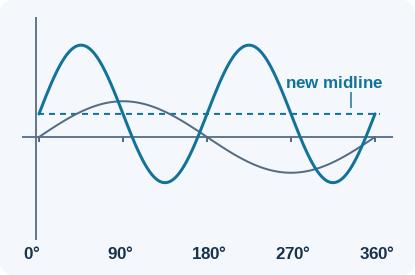
Doubling the angle creates two cycles. The shifted blue curve oscillates either side of its dotted midline.
Put a dotted line at y equal to the vertical shift. This is the centre of the wave. The amplitude is the step from the centre to a peak or a trough. If the maximum and minimum are given instead, their mean gives the midline and half their difference gives the amplitude. This also tells you how to find a missing vertical scale from a graph.
Worked example
Find the maximum value of .
The midline is . The amplitude is .
The maximum is .
Answer: .
Worked example
A cosine curve has minimum and maximum . Find its amplitude.
Try it on paper first.
The vertical distance between its extrema is .
Only half that distance is above the midline. Divide by .
Answer: .
Section 2 of 3 · Lesson · about 8 min
Use the expression inside the brackets for the angles on the usual wave. Solve a short equation for the x-coordinate of each point. For a sketch, begin with the ends of one cycle and divide that distance into four equal parts. Scale the ordinate and apply the vertical shift. If the domain ends in the middle of a cycle, sketch only the part requested.
Worked example
Find the period of the graph in radians.
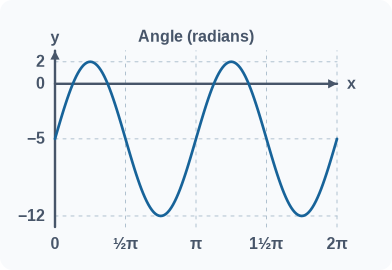
One full repeat of sine takes in the argument.
The input multiplier is . Divide the original period by .
Answer: .
Worked example
Find the minimum value of .
Try it on paper first.
The function before shifting has minimum .
The shifted minimum is .
Answer: .
Section 3 of 3 · Lesson · about 8 min
If the midline is and the amplitude is , then the vertical scale and the shift are already known. Read the horizontal distance between matching peaks. Divide the standard period by this distance to find the argument multiplier. To choose a starting curve, look at the value at the origin and the direction it is moving. Check a second landmark after writing the function.
Worked example
A sine curve has peaks of and troughs of . Find the value of its midline.
The line lies halfway between and .
Average the two values to obtain .
Answer: .
Worked example
Find all x-intercepts of for . Give the x-coordinates.
Try it on paper first.
A non-zero scale leaves the zeros unchanged.
Within a full period, the argument is . Repeat by adding or subtracting .
The given interval for the full argument is . Solve for after listing the possible arguments.
Answer: .
Question 1 of 5
0 / 5 checked in this collection
Find the maximum value of .
Progress stays in this browser. Create an account to save it or sign in.
Show your working on paper and compare it with the worked solution and marking guidance.
Your review plan starts after your first check.