Worked example
Read a point on a basic graph
The graph is . Find its exact ordinate at .
Move along the horizontal axis to the given angle. The repeat distance is .
Reducing the input to one cycle gives the ordinate .
Answer: .
Draw and read sine, cosine and tangent, including their zeros, repeats and differences.
Try the quick check →Section 1 of 3 · Lesson · about 8 min
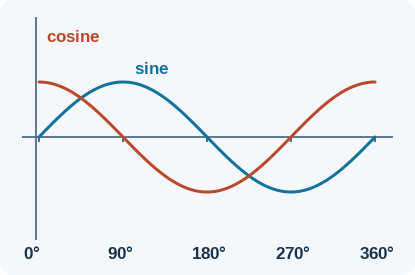
Sine (blue) starts at zero. Cosine (orange) starts at its maximum.
Draw a horizontal angle axis and a vertical value axis. Use evenly spaced quarter-turn marks. Follow the unit-circle coordinates through one turn to plot the first curve. For sine, the coordinate goes up, back to zero, down and back to zero. For cosine, the coordinate starts at the right-hand edge of the circle, which gives its maximum. Join the plotted points with a smooth curve and use a ruler for the axes.
Worked example
The graph is . Find its exact ordinate at .
Move along the horizontal axis to the given angle. The repeat distance is .
Reducing the input to one cycle gives the ordinate .
Answer: .
Worked example
Find the exact value of .
Try it on paper first.
After removing whole turns, evaluate .
The reference angle is . Use the signs of the coordinates in the actual quadrant.
Sine has exact value .
Answer: .
Section 2 of 3 · Lesson · about 8 min
Choose matching points facing the same direction. Two successive rising zeros of sine are one whole cycle apart. A rising zero and the next falling zero are separated by only half a cycle. In a formula with a scaled angle, start from the basic period and divide by the angle multiplier.
| Function | Full period in degrees | Full period in radians |
|---|---|---|
| Sine or cosine | ||
| Tangent |
Worked example
Find the period of the graph in degrees.
One full repeat of tangent takes in the argument.
The input multiplier is . Divide the original period by .
Answer: .
Worked example
The graph is . Find its exact ordinate at .
Try it on paper first.
Move along the horizontal axis to the given angle. The repeat distance is .
Reducing the input to one cycle gives the ordinate .
Answer: .
Section 3 of 3 · Lesson · about 8 min
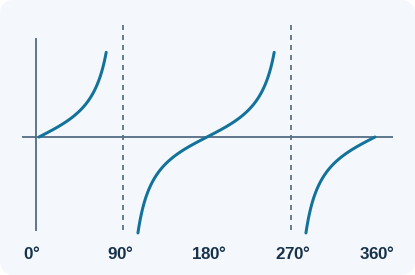
The tangent curve approaches a vertical asymptote from either side. Leave a gap between branches.
Use the denominator to find an asymptote. Draw a dashed vertical line there before sketching the curve. Between two asymptotes, tangent runs through all real values. Through its zeros the curve rises, on both sides of a quarter-turn it approaches different ends of the y-axis, and across the asymptote it breaks. For sine and cosine a scale changes the height, but for tangent there is no greatest or least y-value.
Worked example
Give the x-coordinates of all vertical asymptotes of for .
The graph is undefined where the cosine of the argument is zero.
Within a full period, the argument is . Repeat by adding or subtracting .
The given interval for the full argument is . Solve for after listing the possible arguments.
Answer: .
Worked example
Find all x-intercepts of for . Give the x-coordinates.
Try it on paper first.
A non-zero scale leaves the zeros unchanged.
Within a full period, the argument is . Repeat by adding or subtracting .
The given interval for the full argument is . Solve for after listing the possible arguments.
Answer: .
Question 1 of 5
0 / 5 checked in this collection
The graph is . Find its exact ordinate at .
Progress stays in this browser. Create an account to save it or sign in.
Show your working on paper and compare it with the worked solution and marking guidance.
Your review plan starts after your first check.